Imagine two colleagues discussing a new policy in their office meeting. One calmly shares facts, listens to the other side, and tries to reach a thoughtful conclusion. The other raises their voice, insists they are right, and refuses to listen. This everyday scene perfectly explains the difference between debate and argument.
A debate is usually a structured and respectful exchange of ideas where people aim to present logical points. An argument, on the other hand, often involves emotional disagreement where people try to prove themselves right. Understanding the difference between debate and argument helps us communicate more effectively in schools, workplaces, and social discussions.
Many learners struggle with this concept because the words seem similar, yet their purposes differ greatly. Knowing the difference between debate and argument allows individuals to express opinions wisely and avoid unnecessary conflict. This article will explore the debate vs argument concept in detail with clear explanations and real-life examples.
Key Difference Between the Both
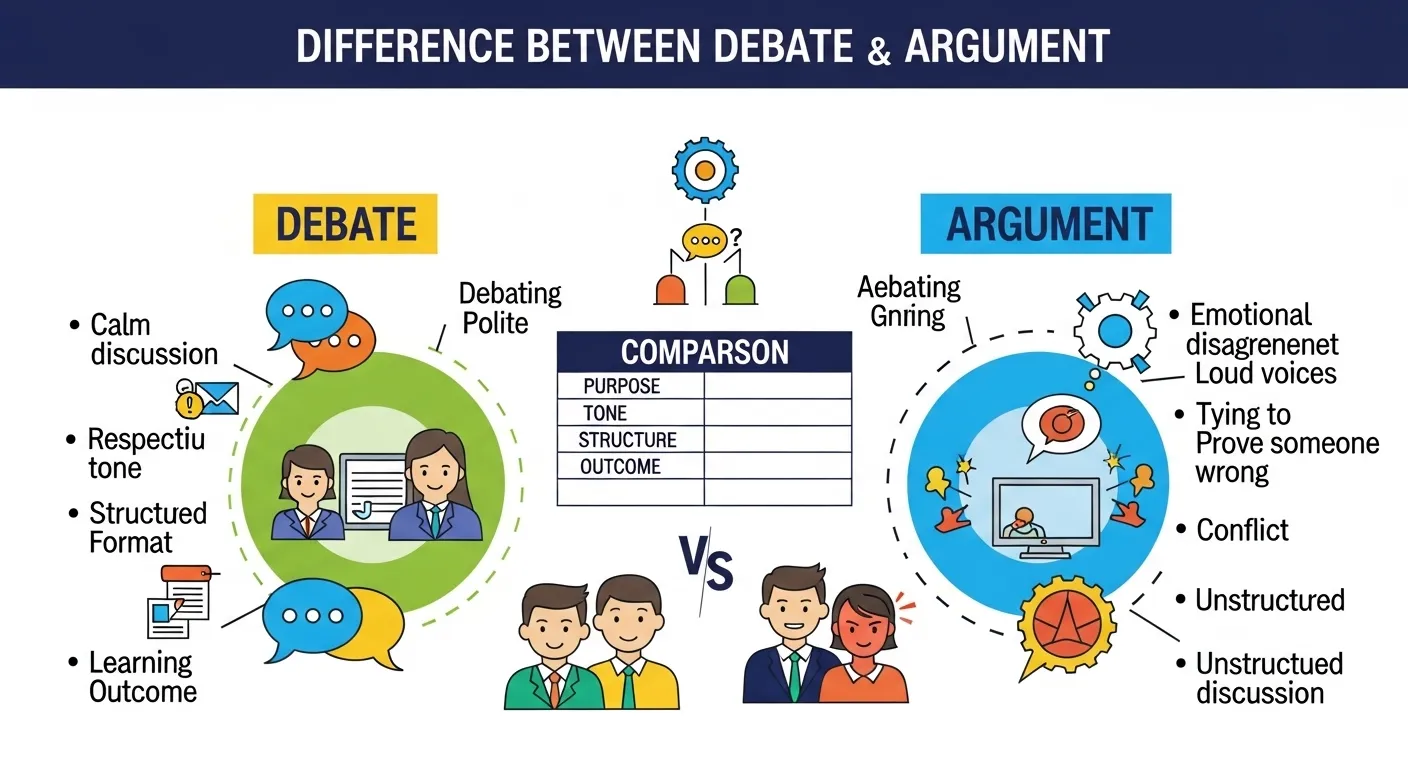
The difference between debate and argument lies mainly in purpose, tone, and structure. A debate is usually organized and focuses on presenting logical points to explore an issue. It encourages listening, reasoning, and constructive discussion.
An argument, however, often occurs spontaneously when people strongly disagree. It may involve emotional reactions, personal opinions, and sometimes conflict.
In short:
- Debate aims to exchange ideas and reach understanding.
- Argument often aims to prove someone else wrong.
Understanding this difference improves communication and prevents misunderstandings.
Why Is Their Difference Necessary to Know for Learners and Experts?
Knowing the difference between debate and argument is important for both students and professionals. In education, debates help learners develop critical thinking and analytical skills. Students learn how to support ideas with facts and respect opposing viewpoints.
Society also benefits from healthy debates. Political systems, academic research, and community discussions rely on structured debates to reach balanced decisions. If people fail to understand the debate vs argument difference, discussions may turn hostile rather than constructive.
Pronunciation of Both (US & UK)
Before exploring deeper differences, it helps to know how these words sound.
| Word | US Pronunciation | UK Pronunciation |
| Debate | /dɪˈbeɪt/ | /dɪˈbeɪt/ |
| Argument | /ˈɑːrɡjumənt/ | /ˈɑːɡjumənt/ |
Although pronunciation varies slightly between American and British accents, the meaning remains consistent. Now, let us explore the difference between debate and argument in detail.
Difference Between the Keywords
1. Purpose
Debate: The purpose is to explore different perspectives and reach understanding.
Example 1: Students debate whether school uniforms are necessary.
Example 2: Politicians debate policies before passing a law.
Argument: The purpose is usually to prove someone wrong or defend one’s position.
Example 1: Two friends argue about which football team is better.
Example 2: Neighbors argue over a parking space.
2. Tone
Debate: Calm and respectful.
Example 1: A classroom debate where students politely present opinions.
Example 2: A TV debate where participants follow speaking rules.
Argument: Emotional and sometimes aggressive.
Example 1: A couple arguing loudly over household issues.
Example 2: Customers arguing with a shopkeeper.
3. Structure
Debate: Organized with rules and moderators.
Example 1: Formal debate competitions in schools.
Example 2: Parliamentary debates.
Argument: Usually unstructured and spontaneous.
Example 1: Friends arguing during a game.
Example 2: A heated online comment discussion.
4. Evidence
Debate: Supported by facts, research, and logic.
Example 1: Students citing statistics during debate.
Example 2: Experts presenting research findings.
Argument: Often based on opinions or emotions.
Example 1: Someone arguing that a movie is better without evidence.
Example 2: A person insisting on their opinion about politics.
5. Outcome
Debate: Leads to learning and deeper understanding.
Example 1: Participants learning new viewpoints.
Example 2: Policy improvements after debate.
Argument: May lead to conflict or damaged relationships.
Example 1: Friends stopping communication after argument.
Example 2: Family disputes escalating.
6. Participation
Debate: Participants take turns speaking.
Example 1: Debate teams presenting points one by one.
Example 2: Panel discussions with speaking time.
Argument: Participants may interrupt each other.
Example 1: People shouting over each other.
Example 2: Online arguments with rapid replies.
7. Emotional Level
Debate: Mostly rational and controlled.
Example 1: Academic debates about scientific theories.
Example 2: Student competitions.
Argument: Highly emotional.
Example 1: Couples arguing over misunderstandings.
Example 2: Fans arguing over sports teams.
8. Environment
Debate: Usually public or formal.
Example 1: School competitions.
Example 2: Political debates.
Argument: Often private or informal.
Example 1: Arguments at home.
Example 2: Arguments between friends.
9. Goal
Debate: To share knowledge and ideas.
Example 1: Classroom debates to improve learning.
Example 2: Academic conferences.
Argument: To win or dominate the conversation.
Example 1: Someone insisting their opinion is right.
Example 2: Heated workplace disagreement.
10. Result
Debate: Encourages respect and critical thinking.
Example 1: Students appreciating opposing views.
Example 2: Public discussions improving policies.
Argument: Often creates tension.
Example 1: Family disputes causing stress.
Example 2: Workplace conflicts affecting teamwork.
Nature and Behaviour of Both
A debate reflects intellectual curiosity and openness. Participants behave politely, listen carefully, and respond with logical reasoning. It encourages cooperation and mutual respect.
An argument, however, often reflects emotional intensity. People focus on defending themselves rather than understanding others. As a result, arguments may escalate quickly and lead to frustration.
Why People Are Confused About Their Use?
Many people confuse these words because both involve disagreement. In everyday conversation, people sometimes say they are “debating” when they are actually arguing.
Another reason is that debates can sometimes become arguments if participants lose patience or become emotional. This overlap causes confusion in understanding the difference between debate and argument.
Table Showing Difference and Similarity
| Aspect | Debate | Argument | Similarity |
| Purpose | Exchange ideas | Prove someone wrong | Both involve disagreement |
| Tone | Calm | Emotional | Both involve strong opinions |
| Structure | Organized | Unstructured | Both require communication |
| Evidence | Logical facts | Personal opinions | Both involve viewpoints |
Which Is Better in What Situation?
A debate is better in academic, professional, and public discussions. It allows participants to exchange ideas respectfully and find balanced solutions. In schools and universities, debates encourage learning and critical thinking. They help people analyze issues logically rather than emotionally.
An argument, however, may sometimes occur naturally when emotions are strong. While arguments are not always productive, they can reveal genuine feelings or unresolved conflicts. The key is to manage arguments carefully and transform them into constructive discussions whenever possible.
How the Keywords Are Used in Metaphors and Similes
Both words can appear in figurative expressions.
Examples:
- “Their discussion turned into a storm of argument.”
- “The debate was like a chess match, each side planning careful moves.”
- “Their argument spread like wildfire through the office.”
- “The debate flowed like a calm river of ideas.”
Connotative Meaning
Debate
Positive/Neutral Connotation
Examples:
- “The debate improved students’ understanding.”
- “The conference hosted an intellectual debate.”
Argument
Often Negative Connotation
Examples:
- “Their argument ruined the evening.”
- “The argument created tension in the team.”
However, argument can sometimes be neutral in academic writing, meaning a reasoned point.
Example:
- “The author presents a strong argument in the article.”
Idioms or Proverbs Related to the Words
1. “Pick an argument”
Meaning: To intentionally start a disagreement.
Example: He always picks an argument over small issues.
2. “Win the argument but lose the friend”
Meaning: Being right may harm relationships.
Example: She proved her point but lost the friendship.
3. “Healthy debate”
Meaning: Constructive discussion.
Example: The class enjoyed a healthy debate about technology.
Works in Literature Featuring the Keywords
- “The Federalist Papers” – Political essays presenting debates about governance (Alexander Hamilton, James Madison, John Jay, 1788).
- “On Liberty” – Philosophical debates on freedom (John Stuart Mill, 1859).
- “The Argumentative Indian” – Essays discussing debates in society (Amartya Sen, 2005).
Movies Related to Debate or Argument
- The Great Debaters (2007, USA)
- 12 Angry Men (1957, USA)
- Argument (1969, France)
Frequently Asked Questions
1. What is the basic difference between debate and argument?
A debate is structured and logical, while an argument is emotional and often unstructured.
2. Can a debate turn into an argument?
Yes, if participants become emotional or stop respecting each other’s viewpoints.
3. Is argument always negative?
Not always. In academic writing, argument can mean a logical claim supported by evidence.
4. Why are debates important in education?
Debates improve critical thinking, communication skills, and respect for diverse opinions.
5. How can arguments be avoided?
By listening carefully, controlling emotions, and turning disagreements into constructive discussions.
How Both Are Useful for Surroundings
Both debate and argument play roles in daily life. Debates encourage learning, innovation, and balanced decision-making in society. They help communities solve problems and develop new ideas.
Arguments, although sometimes uncomfortable, can highlight issues that need attention. When managed carefully, arguments can lead to clarification and eventually transform into meaningful debates.
Final Words for Both
Debate and argument may appear similar, but their intentions and outcomes are different. A debate reflects logic and cooperation, while an argument often reflects emotion and conflict. Recognizing the debate vs argument difference helps people communicate more effectively and maintain respectful relationships.
Conclusion
The difference between debate and argument is essential for effective communication. While both involve disagreement, debates are structured, logical, and focused on understanding different viewpoints. Arguments, in contrast, often arise from emotional reactions and a desire to prove someone wrong. Learning the debate vs argument distinction helps students, professionals, and communities engage in productive discussions. When people transform arguments into debates, conversations become more meaningful and respectful. Ultimately, understanding this difference promotes healthier relationships, stronger communication skills, and a more thoughtful society.

I am content creator and comparison blogger focused on analyzing key differences between terms, concepts, and ideas to deliver accurate, easy-to-understand information. So I decided to create a platform where these differences are explained in the simplest way possible.