In a modern hospital, imagine a patient who has just undergone major abdominal surgery. Despite needing proper nutrition for recovery, they are unable to eat or digest food normally. In such situations, doctors rely on intravenous feeding methods, which brings us to the important concept of difference between ppn and tpn. These two medical approaches ensure that the body receives essential nutrients even when the digestive system is not functioning properly.
When healthcare professionals evaluate ppn vs tpn, they carefully consider factors such as the patient’s condition, the duration of treatment, and the level of nutritional support required. For instance, a patient with short-term illness may only need partial support, while someone in critical condition might depend entirely on IV nutrition. This is why understanding both is not just important for doctors but also for students and learners in the medical field.
In real-world clinical practice, confusion between these two methods can lead to improper care decisions. Therefore, gaining clarity about difference between ppn and tpn helps improve patient safety, treatment effectiveness, and recovery outcomes. In this detailed guide, we will break down both concepts in a simple, structured, and practical way so you can fully understand their differences, uses, and importance.
Key Difference Between the Both
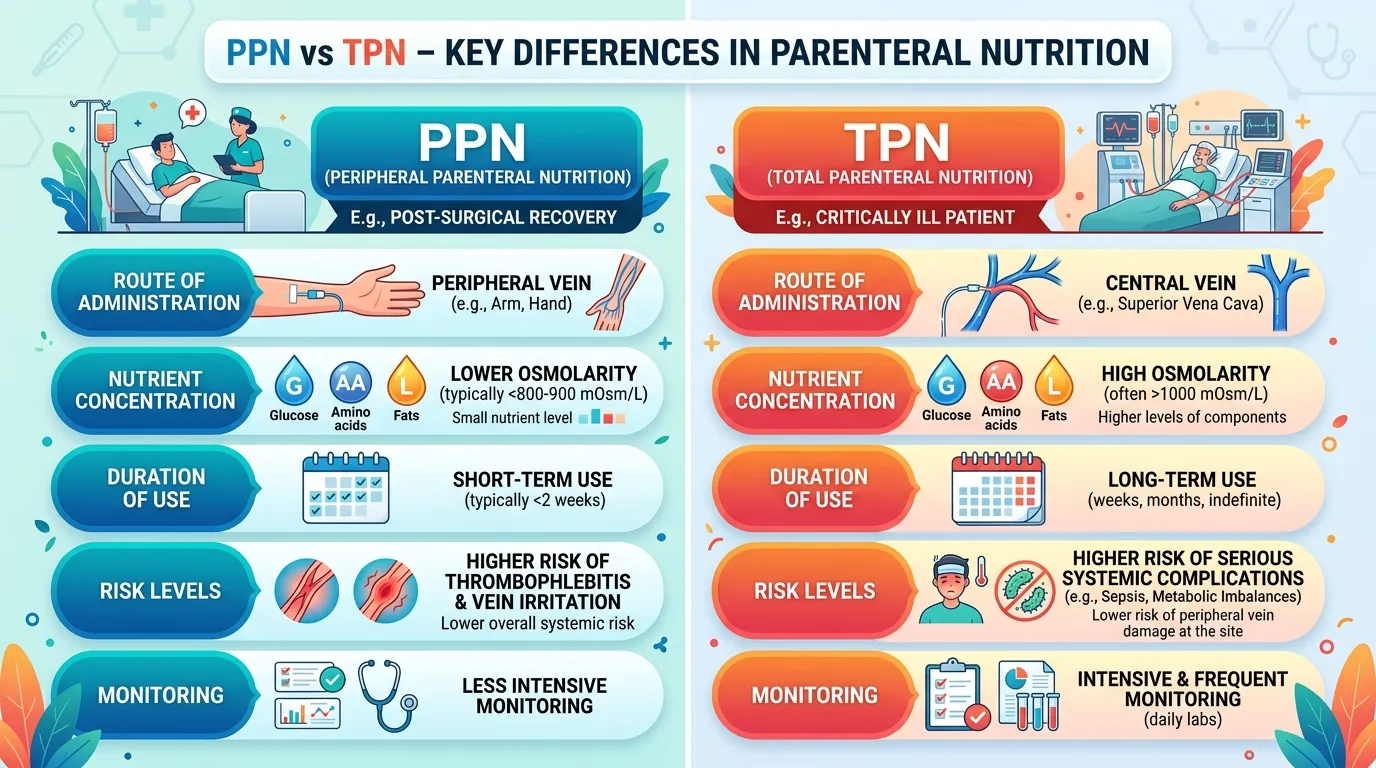
The primary difference lies in the route and concentration of nutrients.
- PPN (Peripheral Parenteral Nutrition) is delivered through peripheral veins and is less concentrated.
- TPN (Total Parenteral Nutrition) is delivered through central veins and provides complete nutrition with higher concentration.
Why Is Their Difference Important?
Understanding the difference between PPN and TPN is vital for both learners and healthcare professionals. These methods are life-saving for patients who cannot eat or digest food normally. Misusing them can lead to complications such as infections, malnutrition, or vein damage. In society, proper knowledge ensures better patient care, reduces hospital risks, and improves recovery outcomes. For medical students, it builds foundational clinical knowledge, while for experts, it supports accurate treatment decisions.
Pronunciation of Both (US & UK)
- PPN: /ˌpiː.piːˈɛn/ (US & UK similar)
- TPN: /ˌtiː.piːˈɛn/ (US & UK similar)
Now that we understand how to say them correctly, let’s dive deeper into their detailed comparison.
Difference Between PPN and TPN
1. Route of Administration
PPN is given through smaller peripheral veins.
TPN is given through larger central veins.
Examples:
- A patient with mild malnutrition receives PPN in the arm vein.
- A critically ill patient receives TPN through a central catheter.
2. Nutrient Concentration
PPN contains diluted nutrients.
TPN contains highly concentrated nutrients.
Examples:
- PPN includes low glucose concentration.
- TPN includes high glucose and amino acids.
3. Duration of Use
PPN is used short-term.
TPN is used long-term.
Examples:
- PPN for 5–7 days post-surgery.
- TPN for weeks in chronic illness.
4. Calorie Supply
PPN provides partial calories.
TPN provides full nutritional needs.
Examples:
- PPN supplements oral intake.
- TPN replaces all food intake.
5. Vein Type
PPN uses small veins.
TPN uses large central veins.
Examples:
- PPN through hand veins.
- TPN through subclavian vein.
6. Risk Level
PPN has lower risk.
TPN has higher risk of infection.
Examples:
- PPN rarely causes severe complications.
- TPN may cause bloodstream infections.
7. Osmolarity
PPN has low osmolarity.
TPN has high osmolarity.
Examples:
- PPN avoids vein irritation.
- TPN requires central vein due to concentration.
8. Cost
PPN is less expensive.
TPN is more expensive.
Examples:
- PPN used in basic care.
- TPN used in ICU settings.
9. Monitoring
PPN requires less monitoring.
TPN requires strict monitoring.
Examples:
- PPN monitored occasionally.
- TPN needs daily lab tests.
10. Indications
PPN for mild cases.
TPN for severe cases.
Examples:
- PPN for temporary digestive issues.
- TPN for intestinal failure.
Nature and Behaviour of Both
PPN:
PPN is supportive and temporary. It works as a supplement rather than a complete solution. It is gentle on the body and suitable for short recovery phases.
TPN:
TPN is intensive and comprehensive. It completely replaces oral feeding and is used in serious medical conditions. It requires strict medical supervision.
Why People Are Confused About Their Use?
| Aspect | PPN | TPN | Similarity |
|---|---|---|---|
| Full Form | Peripheral Parenteral Nutrition | Total Parenteral Nutrition | Both provide IV nutrition |
| Route | Peripheral veins | Central veins | Both use IV lines |
| Purpose | Partial nutrition | Complete nutrition | Both support patients |
| Duration | Short-term | Long-term | Used when oral feeding fails |
| Risk | Low | High | Require medical supervision |
Which Is Better in What Situation?
PPN:
PPN is better for short-term nutritional support when the patient can still eat partially. It is ideal for post-surgery recovery or mild digestive issues. It is safer and less invasive, making it suitable for temporary use.
TPN:
TPN is better for severe cases where the digestive system cannot function at all. It provides complete nutrition and is essential for critically ill patients. Though more complex, it is life-saving in long-term conditions.
Use in Metaphors and Similes
- “PPN is like a backup generator—supportive but not the main source.”
- “TPN is like a full power plant—providing complete energy.”
Connotative Meaning
PPN: Neutral to positive
- Example: “PPN helped the patient recover quickly.”
TPN: Neutral (sometimes negative due to risks)
- Example: “TPN was necessary despite its complications.”
Idioms or Proverbs Related
While no direct idioms exist, similar expressions can be used:
- “A helping hand” (PPN)
- Example: PPN acts as a helping hand during recovery.
- “All-in-one solution” (TPN)
- Example: TPN is an all-in-one solution for nutrition.
Works in Literature
- Clinical Nutrition Handbook – Medical Guide – Various Authors – 2018
- Principles of Nutritional Support – Medical Text – Dr. Smith – 2020
Movie Names Related
- The Doctor (1991, USA)
- Patch Adams (1998, USA)
Frequently Asked Questions
1. What is the main difference between PPN and TPN?
PPN provides partial nutrition through peripheral veins, while TPN provides complete nutrition through central veins.
2. Is TPN more dangerous than PPN?
Yes, TPN has higher risks like infections and requires close monitoring.
3. Can PPN replace normal food completely?
No, PPN is only a supplement and cannot fully replace food.
4. When is TPN necessary?
TPN is used when the digestive system is not working at all.
5. Why do doctors choose PPN over TPN?
Doctors choose PPN when the patient needs short-term and less intensive nutritional support.
How Both Are Useful for Surroundings
PPN and TPN improve healthcare systems by supporting patient recovery and reducing mortality. They help hospitals manage critical cases and ensure patients receive proper nutrition even when they cannot eat. This contributes to healthier communities and better medical outcomes.
Final Words for Both
PPN and TPN are essential medical tools. While PPN supports recovery, TPN sustains life in critical conditions. Both serve unique but equally important roles in healthcare.
Conclusion
Understanding the difference between PPN and TPN is crucial in modern medicine. While both methods provide nutrition through IV, their applications, risks, and benefits differ significantly. PPN is suitable for short-term, less severe cases, while TPN is essential for long-term, critical conditions. By clearly understanding ppn vs tpn, healthcare providers can make informed decisions that improve patient outcomes. Whether you are a student or a professional, mastering this concept enhances both knowledge and practical skills in medical care.

I am content creator and comparison blogger focused on analyzing key differences between terms, concepts, and ideas to deliver accurate, easy-to-understand information. So I decided to create a platform where these differences are explained in the simplest way possible.