Imagine walking along a seaside harbor where fishermen proudly display their fresh catch. Among the usual fish, you notice a strange one round, spiky, and oddly inflated. Curious, you ask whether it’s a pufferfish or a blowfish. The fisherman shrugs and says, “Same thing, just different names.” This simple moment captures a confusion many people experience when encountering these fascinating sea creatures.
The topic of pufferfish vs blowfish often raises questions among students, writers, and even professionals. Are they different species, or just different names? Understanding the difference between pufferfish and blowfish is essential for both language clarity and scientific accuracy. In everyday conversation, people tend to use both terms interchangeably, which adds to the confusion.
However, when we explore them more deeply, we find that the difference is mainly about usage, tone, and context rather than biology. In this article, we will simplify the concept of pufferfish vs blowfish so you can confidently use both terms in the right situations.
Key Difference Between the Both
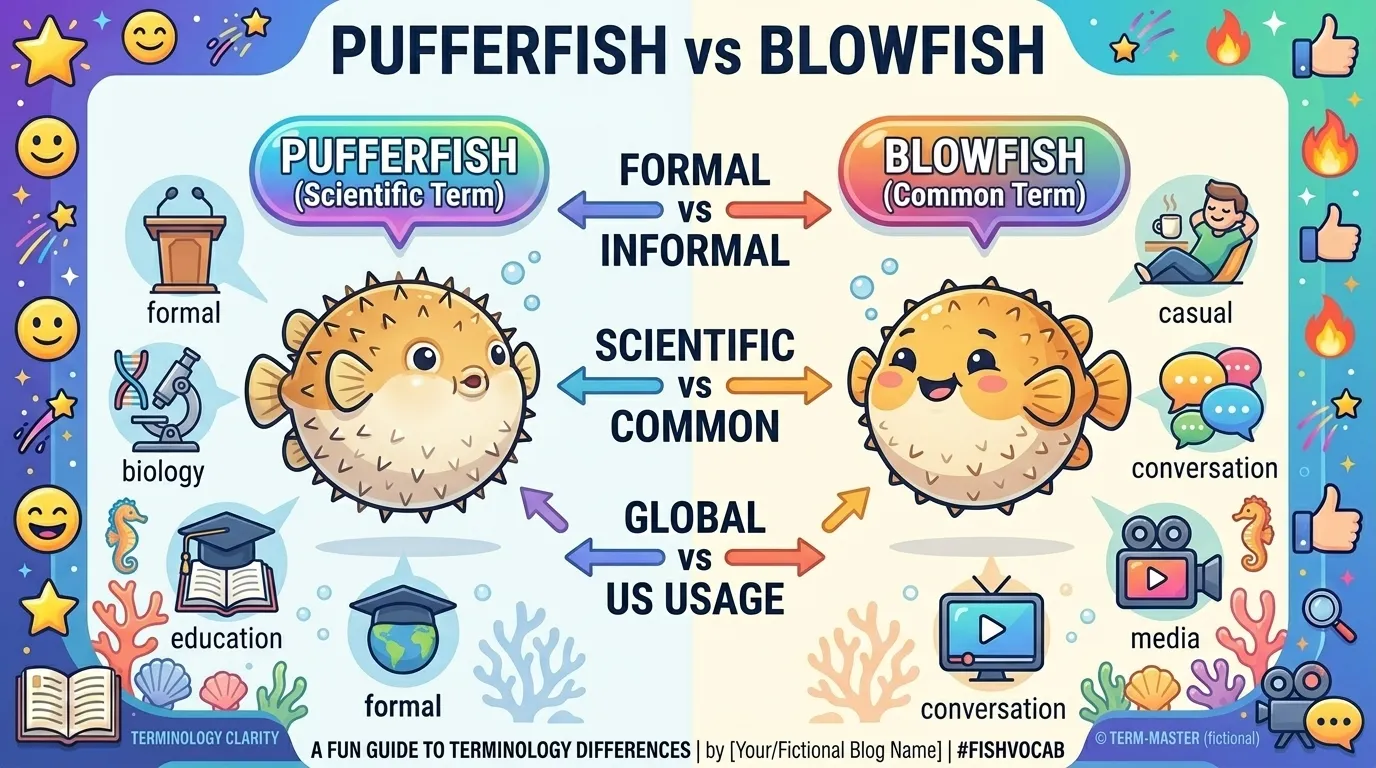
The key difference between both is not biological but linguistic.
- Pufferfish is the formal, scientific, and widely accepted term used in education and research.
- Blowfish is an informal, conversational term commonly used in everyday language, especially in American English.
Both terms refer to fish from the same family, known for their ability to inflate their bodies as a defense mechanism.
Why Is Their Difference Important for Learners and Experts?
Understanding the difference between these terms is important for several reasons: First, it improves academic accuracy. Students studying marine biology or environmental science must use precise terminology like pufferfish to avoid confusion. Second, it enhances communication skills. Writers and speakers can choose the right word based on their audience. For example, “pufferfish” works better in formal writing, while “blowfish” suits casual conversation.
Third, it promotes cultural awareness. Different regions prefer different terms, so knowing both helps in global communication. Finally, it ensures safety awareness. These fish contain a powerful toxin, and correctly identifying them is crucial in contexts like cooking or marine research.
Pronunciation of Both (US & UK)
- Pufferfish
US: /ˈpʌfərfɪʃ/
UK: /ˈpʌfəfɪʃ/ - Blowfish
US: /ˈbloʊfɪʃ/
UK: /ˈbləʊfɪʃ/
Now that you know how to say them correctly, let’s explore their detailed differences.
Difference Between the Pufferfish and Blowfish
1. Formal vs Informal Usage
Pufferfish is used in formal and academic contexts, while blowfish is more casual.
Examples:
- Scientists study pufferfish behavior in laboratories.
- Children often point at a blowfish in aquariums.
2. Regional Preference
Pufferfish is used globally, whereas blowfish is more common in the United States.
Examples:
- British documentaries refer to pufferfish.
- American TV shows mention blowfish.
3. Scientific Accuracy
Pufferfish aligns with biological classification, while blowfish does not emphasize taxonomy.
Examples:
- Biology textbooks list pufferfish species.
- Blogs may casually mention blowfish.
4. Tone and Style
Pufferfish sounds technical, while blowfish sounds friendly and informal.
Examples:
- “Pufferfish toxicity levels are dangerous.”
- “Look at that cute blowfish!”
5. Educational Context
Teachers and researchers prefer pufferfish, while students may use blowfish.
Examples:
- A teacher explains pufferfish defense mechanisms.
- A student says, “That blowfish is funny.”
6. Media Representation
Documentaries use pufferfish, while cartoons often use blowfish.
Examples:
- Nature films show pufferfish in the ocean.
- Animated characters are often called blowfish.
7. Culinary Usage
Pufferfish is used in professional cooking contexts, especially for dishes like fugu.
Examples:
- Chefs prepare pufferfish carefully.
- Tourists may ask about blowfish dishes.
8. Precision
Pufferfish is more precise, while blowfish is generalized.
Examples:
- Scientists classify pufferfish species.
- People loosely refer to them as blowfish.
9. Popular Usage
Blowfish is more common in everyday speech.
Examples:
- Social media posts mention blowfish.
- Academic journals mention pufferfish.
10. Search and Learning Context
Pufferfish is used in research, while blowfish appears in casual searches.
Examples:
- “Pufferfish poison facts” in research.
- “Funny blowfish videos” online.
Nature and Behaviour of Both
Pufferfish, also known as blowfish, are unique marine animals famous for their ability to inflate their bodies. When threatened, they swallow water or air, expanding into a round shape that makes it difficult for predators to eat them.
They are generally slow swimmers but highly intelligent. One of their most remarkable features is the presence of tetrodotoxin, a powerful poison that can be deadly to predators and humans. Despite this, they are usually calm and non-aggressive creatures unless provoked.
Why Are People Confused About Their Use?
The confusion arises because both terms refer to the same fish. The difference is based on language rather than biology. Media, culture, and regional preferences all influence which term people use.
Table: Difference and Similarity
| Aspect | Pufferfish | Blowfish | Similarity |
|---|---|---|---|
| Meaning | Scientific term | Informal term | Same fish |
| Usage | Formal | Casual | Interchangeable |
| Region | Global | Mostly US | Widely known |
| Tone | Technical | Friendly | Descriptive |
| Behavior | Inflates body | Inflates body | Identical |
Which Is Better in What Situation?
When writing academic papers, teaching students, or discussing marine biology, pufferfish is the better choice. It ensures clarity, professionalism, and accuracy. Researchers and educators rely on this term because it aligns with scientific classification. On the other hand, in casual conversations, storytelling, or entertainment, blowfish is more suitable. It sounds more natural and engaging for general audiences.
Use in Metaphors and Similes
Both terms are used metaphorically to describe human behavior:
- “He puffed up like a pufferfish when praised.”
- “She reacted like a blowfish under pressure.”
These expressions suggest defensiveness or exaggerated reactions.
Connotative Meaning
- Pufferfish: Neutral and scientific
Example: “The pufferfish is a fascinating species.” - Blowfish: Slightly playful or informal
Example: “That blowfish looks funny and cute.”
Idioms or Proverbs
While there are no traditional idioms, creative phrases exist:
- “Don’t puff up like a pufferfish.”
- “He’s all blowfish, no bite.”
Works in Literature
- Ocean Creatures Guide – Marine Biology (2018)
- The Defense of the Pufferfish – Science Writing (2015)
Movies Related to Both
- Finding Nemo (2003, USA) – Features a blowfish character
- Blue Planet (2001, UK) – Shows pufferfish behavior
FAQs
1. Are pufferfish and blowfish the same?
Yes, both refer to the same type of fish.
2. Which term is more correct?
Pufferfish is more scientifically accurate.
3. Why are they called blowfish?
Because they inflate or “blow up” their bodies.
4. Are they dangerous?
Yes, they contain a strong toxin.
5. Can humans eat them?
Yes, but only when prepared by trained professionals.
How Both Are Useful for Surroundings
Pufferfish play an important role in marine ecosystems. They help maintain balance by controlling smaller marine populations. Their presence also indicates a healthy ocean environment. Additionally, they contribute to scientific research and attract tourism in aquariums.
Final Words for the Both
Whether you say pufferfish or blowfish, you are referring to one of nature’s most unique and fascinating creatures. The difference lies mainly in language and context, not in the fish itself.
Conclusion
The difference between pufferfish and blowfish highlights how language and science can overlap yet differ in subtle ways. While both terms describe the same fish, their usage depends on context, audience, and purpose. Understanding pufferfish vs blowfish allows you to communicate more clearly and accurately, whether in academic writing or casual conversation. By learning these distinctions, you not only improve your vocabulary but also gain a deeper appreciation for marine life and the richness of language.

My name is Ryan Mitchell, and I am a comparison content writer based in the United States. I specialize in creating clear and easy-to-understand articles that explain the differences between similar concepts, products, and ideas. My work focuses on helping readers quickly understand what makes two things different so they can make better decisions.