Imagine a classroom where a teacher carefully explains a concept, breaking it down into simple steps so every student can understand. Now picture a speaker standing before a crowd, passionately encouraging people to follow certain values or beliefs. These two scenes may seem similar at first, but they clearly reflect the difference between teaching and preaching. Teaching focuses on delivering knowledge in a structured, logical, and unbiased way, while preaching emphasizes persuasion, emotion, and belief.
In everyday life, we often come across situations where the line between these two becomes blurred. This is why understanding teaching vs preaching is so important. Whether you are a student trying to learn, a teacher guiding others, or even someone sharing opinions online, knowing the distinction helps you communicate more effectively. The concept of both also plays a major role in education, leadership, and social interactions.
Moreover, in modern society where information spreads quickly, the confusion between these two can lead to misunderstandings. Sometimes, what is meant to educate may come across as forceful, while genuine guidance may be mistaken for bias. This is where a clear understanding of teaching vs preaching becomes essential.
Key Difference Between the Both
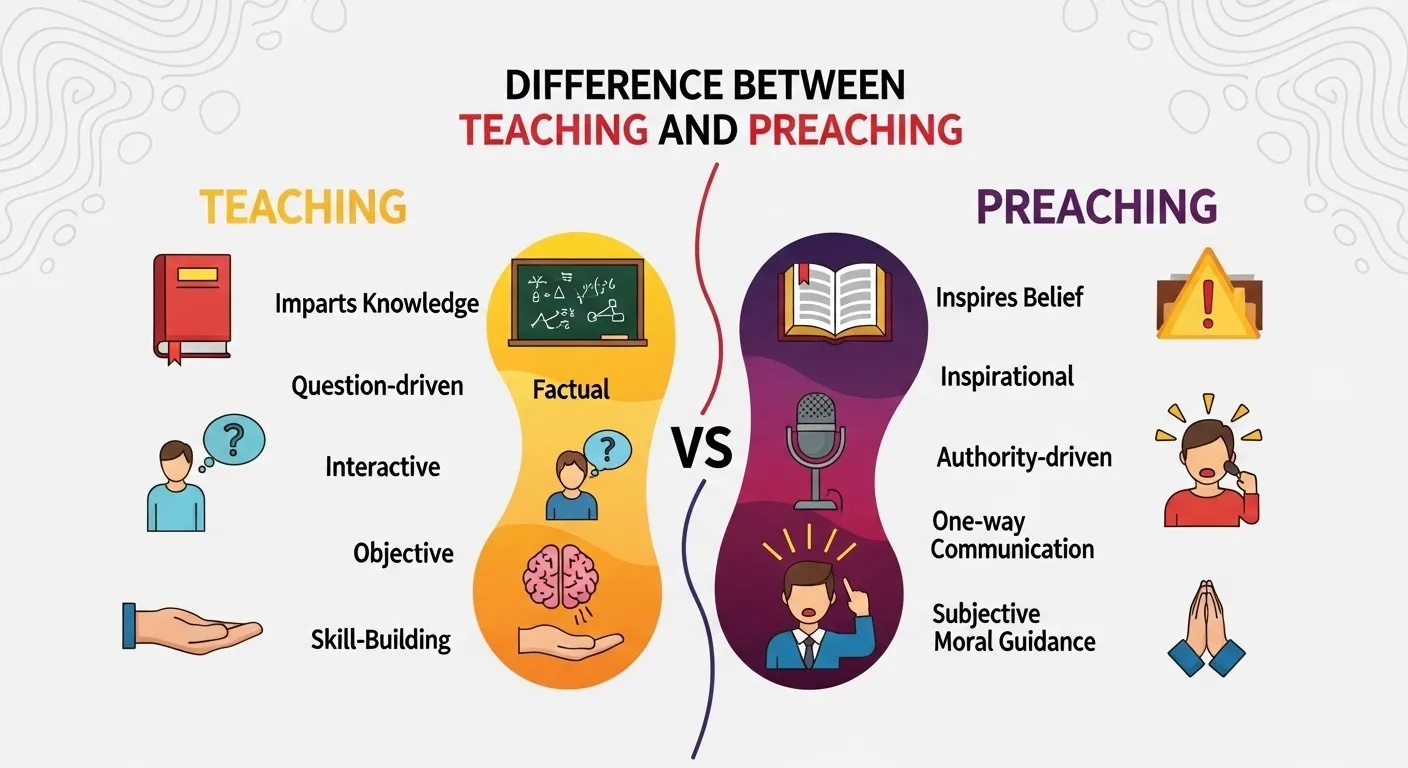
The core difference between teaching and preaching lies in purpose and delivery. Teaching focuses on explaining facts, concepts, or skills in a structured and neutral way. Preaching, on the other hand, is about persuading or inspiring people to adopt beliefs, values, or behaviors, often emotionally.
Why Is Their Difference Necessary to Know?
Understanding the difference between teaching and preaching is essential for both learners and experts. In education, clear teaching ensures knowledge transfer without bias. In society, preaching can motivate change, but when confused with teaching, it may lead to misunderstanding or manipulation. Professionals like teachers, leaders, and public speakers benefit from knowing when to inform and when to inspire. This clarity builds trust, improves communication, and supports critical thinking in communities.
Pronunciation of Both (US & UK)
- Teaching
- US: /ˈtiː.tʃɪŋ/
- UK: /ˈtiː.tʃɪŋ/
- Preaching
- US: /ˈpriː.tʃɪŋ/
- UK: /ˈpriː.tʃɪŋ/
Now that you know how these words sound, let’s dive deeper into how they truly differ in meaning and use.
Difference Between Teaching and Preaching
1. Purpose
Teaching aims to inform; preaching aims to persuade.
- Example 1: A teacher explains science facts.
- Example 2: A preacher urges moral behavior.
2. Tone
Teaching is neutral; preaching is emotional.
- Example 1: A lecture on history remains factual.
- Example 2: A speech encourages ethical living passionately.
3. Approach
Teaching is structured; preaching is expressive.
- Example 1: Lessons follow a syllabus.
- Example 2: Sermons follow inspiration.
4. Audience Interaction
Teaching encourages questions; preaching expects acceptance.
- Example 1: Students ask questions in class.
- Example 2: Listeners absorb a sermon quietly.
5. Content Type
Teaching focuses on knowledge; preaching focuses on values.
- Example 1: Math formulas are taught.
- Example 2: Honesty is preached.
6. Flexibility
Teaching adapts to learners; preaching follows belief.
- Example 1: A teacher changes methods.
- Example 2: A preacher sticks to doctrine.
7. Outcome
Teaching builds understanding; preaching builds conviction.
- Example 1: Students learn a skill.
- Example 2: People adopt a belief.
8. Environment
Teaching occurs in classrooms; preaching in religious or public spaces.
- Example 1: School lessons.
- Example 2: Church sermons.
9. Evidence Use
Teaching uses facts; preaching may use faith or emotion.
- Example 1: Scientific data is presented.
- Example 2: Stories inspire moral lessons.
10. Authority
Teaching relies on expertise; preaching relies on belief or authority.
- Example 1: Certified teachers educate.
- Example 2: Religious leaders preach.
Nature and Behaviour of Both
Teaching is logical, patient, and learner-centered. It focuses on clarity, understanding, and engagement. Teachers adapt their style based on student needs.
Preaching is passionate, persuasive, and belief-driven. It often uses strong emotions and conviction to influence listeners.
Why People Are Confused About Their Use?
| Aspect | Teaching | Preaching | Similarity |
| Purpose | Inform | Persuade | Both guide people |
| Tone | Neutral | Emotional | Both involve speaking |
| Audience | Interactive | Passive | Both address groups |
| Content | Knowledge-based | Value-based | Both share ideas |
| Goal | Understanding | Influence | Both aim to impact |
People confuse them because both involve communication and guidance, but their intent differs.
Which Is Better in What Situation?
Teaching is better in academic and professional environments where clarity and factual understanding are required. It ensures learners gain accurate knowledge and develop critical thinking skills.
Preaching is more effective in situations where motivation, inspiration, or moral guidance is needed. It can influence attitudes and encourage behavioral change. The choice depends on whether the goal is to inform or inspire this is where understanding both becomes crucial.
Use in Metaphors and Similes
- Teaching: “He teaches like a guiding light.”
- Preaching: “She was preaching like a roaring fire.”
These comparisons highlight calm guidance versus intense persuasion.
Connotative Meaning
Teaching
- Positive: Guidance, learning (e.g., “Her teaching improved lives.”)
- Neutral: Instruction (e.g., “Teaching is her profession.”)
Preaching
- Positive: Inspiration (e.g., “He preached hope.”)
- Negative: Overbearing (e.g., “Stop preaching to me.”)
Idioms or Proverbs
- “Practice what you preach”
- Example: He advises honesty but lies—he doesn’t practice what he preaches.
- “Teach someone a lesson”
- Example: The experience taught him a lesson about trust.
Works in Literature
- Teaching
- “Emile” – Philosophy, Jean-Jacques Rousseau, 1762
- Preaching
- “Sinners in the Hands of an Angry God” – Sermon, Jonathan Edwards, 1741
Movies Related to the Both
- Teaching
- Dead Poets Society (1989, USA)
- Preaching
- The Preacher’s Wife (1996, USA)
Frequently Asked Questions
1. Is teaching the same as preaching?
No, teaching informs while preaching persuades.
2. Can a teacher preach?
Yes, but it may reduce objectivity.
3. Is preaching always religious?
Mostly, but it can also be motivational.
4. Which is more effective?
Depends on the goal—learning or inspiration.
5. Why is teaching vs preaching important?
It helps avoid confusion and improves communication.
How Both Are Useful for Surroundings
Teaching builds educated societies by spreading knowledge and skills. Preaching shapes values and morals, guiding people toward ethical behavior. Together, they create balanced communities where knowledge and character grow side by side.
Final Words for the Both
Both serve different yet valuable roles. One educates the mind, while the other influences the heart. Understanding when to use each makes communication more effective and meaningful.
Conclusion
The difference between teaching and preaching is more than just a linguistic distinction. It represents two powerful ways of influencing people and shaping society. Teaching is rooted in clarity, logic, and the transfer of knowledge, helping individuals grow intellectually and develop essential skills. Preaching, on the other hand, appeals to emotions, beliefs, and values, encouraging people to reflect and often change their behavior. By understanding teaching vs preaching, individuals can choose the right communication style for the right situation. This awareness not only improves personal and professional interactions but also prevents misunderstandings. In a world where both information and influence matter, balancing these two approaches ensures that messages are both meaningful and effective.

I am content creator and comparison blogger focused on analyzing key differences between terms, concepts, and ideas to deliver accurate, easy-to-understand information. So I decided to create a platform where these differences are explained in the simplest way possible.