Language is full of moving parts, and two of the most essential ones are verbs and adverbs. Imagine a student in a classroom describing his day: “I run every morning,” he says. Then he adds, “I run quickly.” The first sentence tells us what he does, while the second explains how he does it. This simple real-life moment highlights the core of difference between verb and adverb.
A verb shows action or a state, while an adverb adds more detail to that action. Understanding verb vs adverb is not just about grammar rules it shapes how clearly we communicate.
Whether you’re writing an email, telling a story, or giving instructions, knowing verb vs adverb helps you express thoughts more accurately and effectively.
Key Difference Between Verb and Adverb
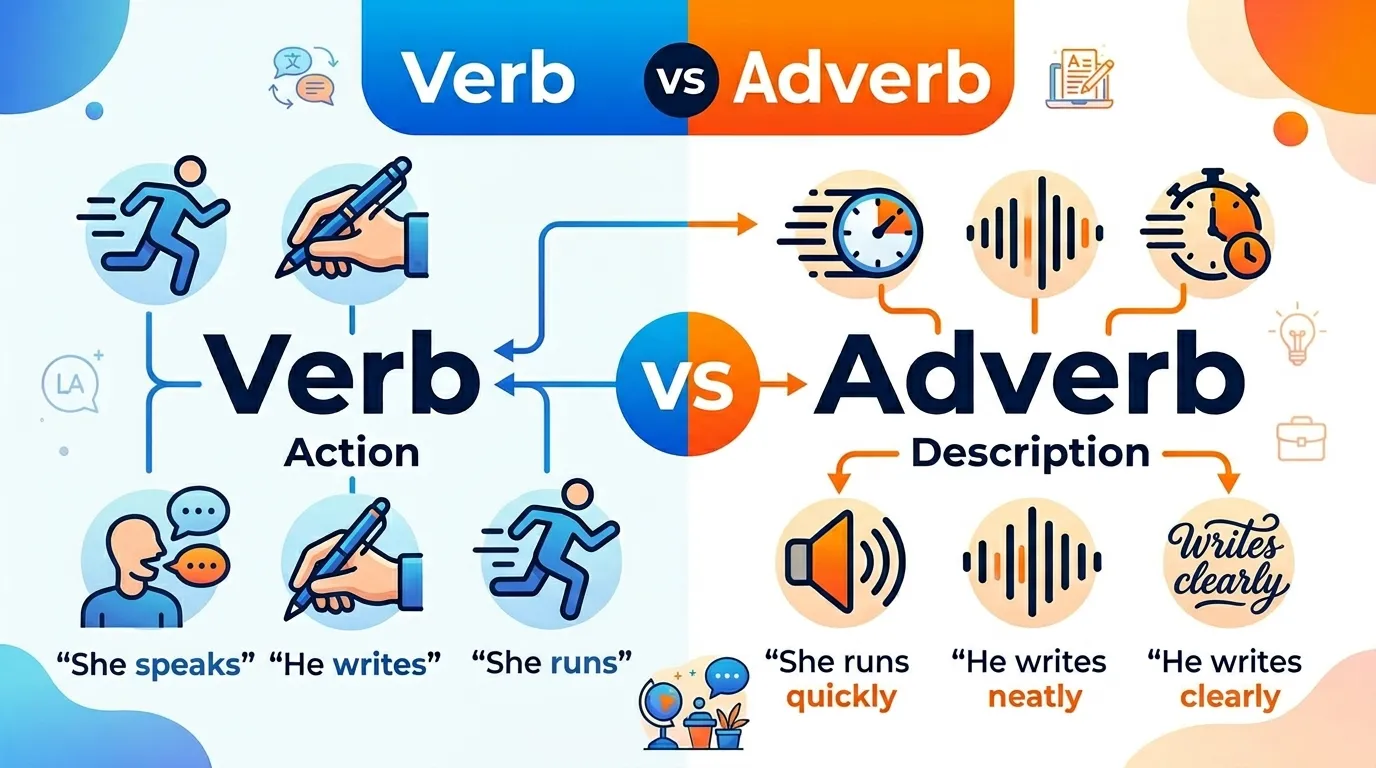
The main difference lies in their function. A verb expresses an action, occurrence, or state of being. An adverb, on the other hand, modifies or describes a verb, adjective, or even another adverb. Simply put, verbs are the “doers,” while adverbs are the “describers.”
Why Is Their Difference Necessary to Know?
Understanding the difference between verbs and adverbs is essential for both learners and experts. For students, it builds a strong grammatical foundation, making writing and speaking clearer. For professionals, it enhances communication precision—especially in teaching, journalism, and business writing.
In society, effective communication reduces misunderstandings. For example, saying “He speaks” is different from “He speaks clearly.” The addition of an adverb can influence perception, tone, and clarity. This is why mastering verb vs adverb is vital for confident expression in everyday life.
Pronunciation of Both (US & UK)
- Verb
- US: /vɝːb/
- UK: /vɜːb/
- Adverb
- US: /ˈæd.vɝːb/
- UK: /ˈæd.vɜːb/
Now that you know how they sound, let’s dive deeper into how they function and differ in practical usage.
Difference between Verb and Adverb
1. Function
- Verb: Shows action or state
- Example 1: She runs daily.
- Example 2: He is happy.
- Adverb: Describes how, when, where, or to what extent
- Example 1: She runs quickly.
- Example 2: He speaks softly.
2. Role in Sentence
- Verb: Essential part of a sentence
- Example 1: They play.
- Example 2: Birds fly.
- Adverb: Optional but adds detail
- Example 1: They play well.
- Example 2: Birds fly high.
3. Position
- Verb: Usually after subject
- Example 1: She writes.
- Example 2: We eat.
- Adverb: Flexible position
- Example 1: She quickly writes.
- Example 2: She writes quickly.
4. Forms
- Verb: Changes form (run, runs, ran)
- Example 1: He runs.
- Example 2: He ran.
- Adverb: Often ends in -ly
- Example 1: Slowly
- Example 2: Happily
5. Necessity
- Verb: Mandatory
- Example 1: She sings.
- Example 2: They laugh.
- Adverb: Not always needed
- Example 1: She sings beautifully.
- Example 2: They laugh loudly.
6. Meaning Contribution
- Verb: Core meaning
- Example 1: He drives.
- Example 2: She reads.
- Adverb: Adds detail
- Example 1: He drives carefully.
- Example 2: She reads quietly.
7. Types
- Verb: Action, linking, helping
- Example 1: Run (action)
- Example 2: Is (linking)
- Adverb: Manner, time, place
- Example 1: Quickly (manner)
- Example 2: Yesterday (time)
8. Dependency
- Verb: Independent
- Example 1: He works.
- Example 2: She dances.
- Adverb: Depends on other words
- Example 1: He works hard.
- Example 2: She dances gracefully.
9. Questions Answered
- Verb: What is happening?
- Example 1: She writes.
- Example 2: He jumps.
- Adverb: How/when/where?
- Example 1: She writes quickly.
- Example 2: He jumps high.
10. Complexity
- Verb: Simpler concept
- Example 1: Eat
- Example 2: Sleep
- Adverb: More descriptive
- Example 1: Slowly
- Example 2: Often
Nature and Behaviour of Both
Verbs are dynamic and essential—they carry the backbone of a sentence. Without verbs, sentences cannot exist. Adverbs are flexible and descriptive, enriching language by adding detail. While verbs are fixed in necessity, adverbs are optional but powerful.
Why People Are Confused About Their Use?
| Feature | Verb | Adverb | Similarity |
| Function | Shows action | Describes action | Both relate to action |
| Importance | Essential | Optional | Both improve meaning |
| Position | Fixed | Flexible | Both fit into sentences |
| Form | Changes tense | Often ends in -ly | Both follow grammar rules |
Confusion arises because adverbs often relate closely to verbs, making learners think they serve the same purpose.
Which Is Better in What Situation?
A verb is always necessary because it forms the core of any sentence. Without it, communication breaks down completely. In situations like instructions, storytelling, or reporting facts, verbs are the foundation.
An adverb becomes important when clarity and detail are required. In professional writing or creative storytelling, adverbs help paint a clearer picture. They refine meaning and make communication more engaging and precise.
Use in Metaphors and Similes
- Verb metaphor: “Time flies”
- Adverb simile: “He runs like the wind quickly”
Verbs often symbolize action, while adverbs enhance imagery.
Connotative Meaning
- Verb: Neutral
- Example: “She runs” (simple action)
- Adverb: Can be positive or negative
- Positive: “She runs gracefully”
- Negative: “He speaks rudely”
Idioms or Proverbs Related to the Words
- “Actions speak louder than words” (verb-focused)
- Example: He proved his honesty through actions.
- “Slow and steady wins the race” (adverb-focused)
- Example: She worked slowly but succeeded.
Works in Literature
- “Hamlet” (Tragedy, William Shakespeare, 1603)
- “Pride and Prejudice” (Novel, Jane Austen, 1813)
- “The Elements of Style” (Grammar Guide, Strunk & White, 1918)
Movies Related to Language or Expression
- “The King’s Speech” (2010, UK)
- “Dead Poets Society” (1989, USA)
- “Freedom Writers” (2007, USA)
Frequently Asked Questions
1. What is the main difference between a verb and an adverb?
A verb shows action, while an adverb describes how the action happens.
2. Can a sentence exist without an adverb?
Yes, but not without a verb.
3. Do all adverbs end in -ly?
No, some like “fast” and “well” do not.
4. Can an adverb modify another adverb?
Yes, for example: “very quickly.”
5. Why is verb vs adverb important in writing?
It ensures clarity and adds detail to communication.
How Both Are Useful for Surroundings
Verbs help us describe actions happening around us, while adverbs help us explain those actions in more detail. Together, they make communication richer and more meaningful in daily life.
Final Words for Both
Verbs are the engine of language, while adverbs are the polish that enhances expression. Both are essential in their own ways.
Conclusion
Understanding the difference between verbs and adverbs is key to mastering English communication. Verbs provide the structure and meaning, while adverbs enhance clarity and detail. Together, they create well-formed and expressive sentences. Whether you are a beginner or an expert, mastering verb vs adverb will significantly improve your writing and speaking skills. By practicing their usage and recognizing their roles, you can communicate more effectively and confidently in any situation.

My name is Ryan Mitchell, and I am a comparison content writer based in the United States. I specialize in creating clear and easy-to-understand articles that explain the differences between similar concepts, products, and ideas. My work focuses on helping readers quickly understand what makes two things different so they can make better decisions.