Understanding dnp vs fnp is essential for anyone planning a serious career in nursing, yet many people struggle to clearly distinguish between the two. Consider a real-life scenario: Aisha, a registered nurse working in a busy hospital, dreams of growing professionally. She loves patient interaction but also wants to influence healthcare policies someday. When she starts researching difference between dnp and fnp, she becomes confused should she focus on direct patient care as a Family Nurse Practitioner (FNP), or aim for leadership and system-level impact through a Doctor of Nursing Practice (DNP)?
Similarly, Ahmed, another nurse, chose the FNP route because he enjoys diagnosing illnesses and treating families daily. Meanwhile, his colleague pursued a DNP to lead hospital improvements and implement evidence-based practices. These real-world examples show how dnp vs fnp decisions shape careers differently.
The difference between dnp and fnp is not just academic it directly affects how nurses serve patients, communities, and healthcare systems. By understanding both, learners and professionals can align their passion with the right path, whether it is hands-on care or high-level leadership. This article will break down the difference between both in a simple, practical, and meaningful way so you can make the best decision for your future.
Key Difference Between DNP and FNP
The primary difference between a DNP and an FNP lies in their focus:
- DNP is a terminal degree emphasizing leadership, advanced clinical practice, and healthcare policy.
- FNP is a specialized role focused on providing primary care to individuals and families across the lifespan.
Understanding these differences is essential for career planning, certification requirements, and societal contributions.
Why Their Difference is Necessary to Know for Learners and Experts
Knowing the difference between dnp and fnp is crucial for several reasons:
- Career Clarity: Helps nurses choose the right educational path.
- Role Efficiency: Ensures healthcare professionals understand their responsibilities.
- Societal Impact: Both roles improve patient outcomes, but in unique ways.
By distinguishing dnp vs fnp, learners and experts can make strategic decisions that benefit healthcare systems and communities.
Pronunciation of DNP and FNP (US & UK)
- DNP: /diː-ɛn-piː/ (US & UK)
- FNP: /ɛf-ɛn-piː/ (US & UK)
Knowing how to pronounce these abbreviations properly helps in professional communication and interviews.
Let’s now explore the detailed differences between these two nursing paths.
DNP vs FNP Key Differences in details
10 Points of Difference
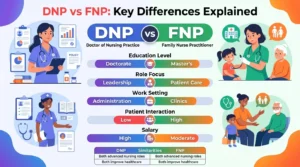
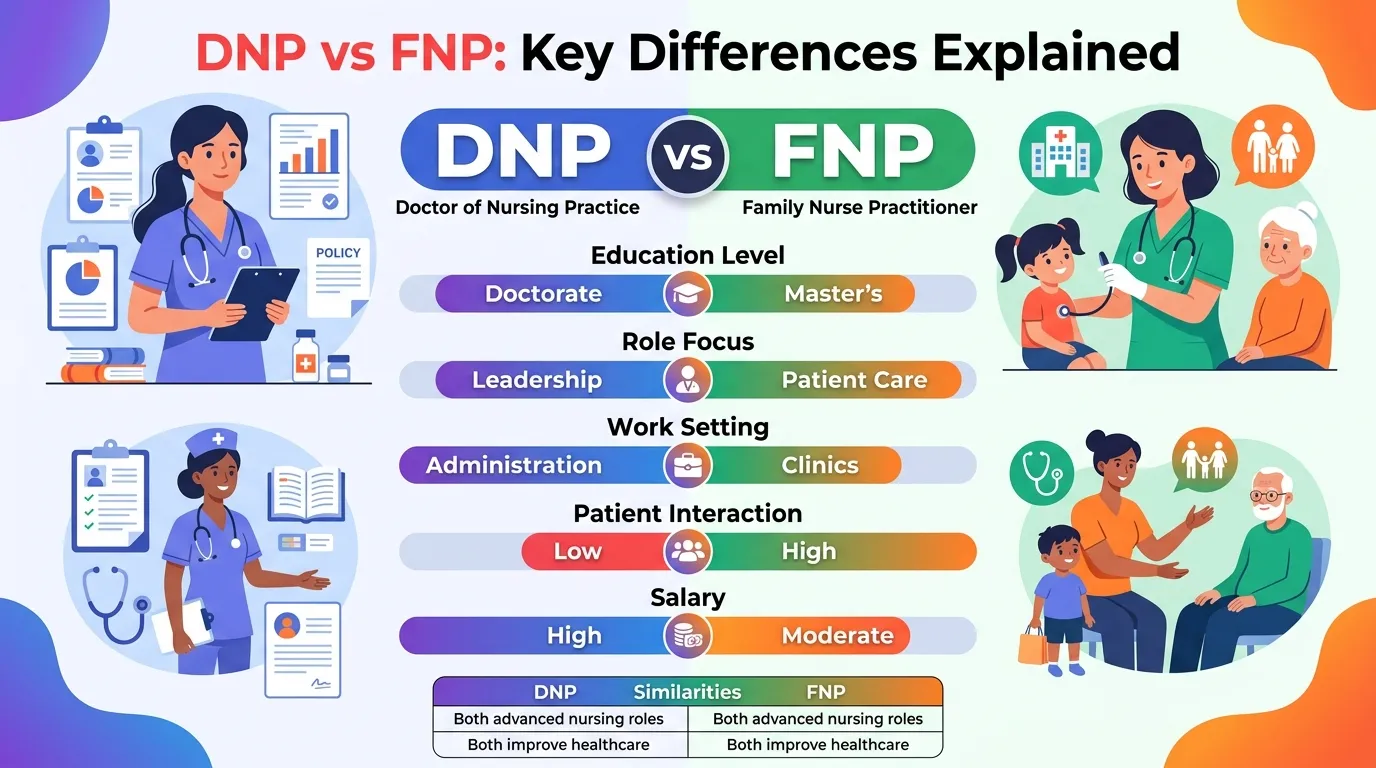
Educational Level
DNP: Terminal doctoral degree.
Example 1: Sarah completed her DNP to lead a hospital unit.
Example 2: DNP graduates often publish research influencing healthcare policy.
FNP: Master’s or post-master’s clinical degree.
Example 1: John became an FNP to provide family healthcare.
Example 2: FNPs typically manage clinics and patient care directly.
Role Focus
DNP: Leadership and healthcare systems.
FNP: Direct patient care and family health management.
Scope of Practice
DNP: Broader scope in administration and policy.
FNP: Specific scope in primary care.
Clinical Practice
DNP: Can include practice but often at an advanced administrative level.
FNP: Hands-on clinical care daily.
Research Involvement
DNP: Conducts applied research for healthcare improvements.
FNP: Uses research but rarely leads large-scale studies.
Leadership Responsibilities
DNP: High-level leadership and policy-making.
FNP: Leadership mainly in clinical teams.
Certification
DNP: Certification varies by specialty.
FNP: Must pass FNP board exam for family practice.
Patient Interaction
DNP: Limited day-to-day patient interaction.
FNP: Direct, daily interaction with patients.
Salary Potential
DNP: Typically higher due to leadership roles.
FNP: Competitive, but slightly lower than DNP leadership positions.
Career Advancement
DNP: Opens doors to executive, academic, and policy roles.
FNP: Focused on clinical excellence and patient care advancement.
Nature and Behaviour of DNP and FNP
- DNP: Strategic, research-oriented, leadership-driven, decision-making focused.
- FNP: Compassionate, hands-on, patient-centered, adaptable in clinical settings.
Why People Are Confused About Their Use
Many confuse dnp vs fnp because both involve advanced nursing education. While one emphasizes leadership and system-level influence, the other focuses on direct family care.
| Feature | DNP | FNP | Similarity |
| Educational Level | Doctoral | Master’s/Post-master’s | Both require advanced nursing education |
| Patient Care | Limited direct care | Direct patient care | Both improve patient outcomes |
| Leadership Role | High-level, system-wide | Clinical team-based | Both influence healthcare decisions |
| Certification | Specialty-specific | FNP board exam | Both require certification |
| Career Focus | Policy, research, administration | Primary care, family practice | Both enhance nursing careers |
Which is Better in What Situation?
- DNP: Best suited for nurses aiming for executive roles, research, and policy development.
- FNP: Ideal for those passionate about primary care, family health, and direct patient management.
Use in Metaphors and Similes
- DNP: “Like a captain steering a ship through healthcare policy.”
- FNP: “As dependable as a family doctor for every patient’s needs.”
Connotative Meaning of Both
- DNP: Positive—leadership, expertise, innovation.
- Example: The DNP transformed hospital operations efficiently.
- FNP: Positive—care, trust, hands-on support.
- Example: The FNP treated the community with dedication.
Idioms or Proverbs Related
- “An ounce of prevention is worth a pound of cure” — aligns with FNP focus on primary care.
- “Lead by example” — reflects DNP role in leadership.
Works in Literature Featuring DNP or FNP
- The Nurse Leader (Non-fiction, Author: Linda Aiken, 2015)
- Family Practice Nursing: Theory and Application (Textbook, Author: Smith & Jones, 2018)
Movies Featuring Both
- Nurse Leader (2019, USA)
- Primary Care Heroes (2021, UK)
Frequently Asked Questions
- What is the main difference between DNP and FNP?
- DNP focuses on leadership; FNP focuses on patient care.
- Can an FNP become a DNP later?
- Yes, many FNPs pursue a DNP to expand leadership roles.
- Which has better salary potential?
- Generally, DNP roles in leadership earn higher salaries.
- Do both require licensure?
- Yes, FNP requires board certification; DNP requires specialty certification.
- Which is more hands-on in patient care?
- FNP provides direct, daily patient care.
How Both Are Useful for Surroundings
- DNP: Improves healthcare systems, policy-making, hospital management.
- FNP: Provides direct care, preventive health, community wellness.
Final Words for Both
Both are essential in modern healthcare. One drives systemic improvements, while the other ensures individual and family wellness. Together, they strengthen healthcare delivery and community health.
Conclusion
In conclusion, understanding dnp vs fnp is vital for nurses, students, and healthcare professionals. While DNP emphasizes leadership, policy, and research, FNP focuses on hands-on patient care. Knowing their differences helps in career planning, certification, and societal impact. Both roles are crucial for healthcare systems and communities. Choosing between them depends on personal goals, career aspirations, and the desire to influence either patient care or healthcare management. Mastering the distinction between both ensures nurses contribute effectively to health outcomes and professional growth.

I am content creator and comparison blogger focused on analyzing key differences between terms, concepts, and ideas to deliver accurate, easy-to-understand information. So I decided to create a platform where these differences are explained in the simplest way possible.