In a small therapy room, a young client begins to trust their therapist deeply. Over time, they start seeing the therapist as a parental figure someone who listens, understands, and provides emotional safety. Meanwhile, the therapist, without realizing it, starts feeling overly protective toward the client, as if they were caring for their own child. This real-world scenario perfectly explains the concepts of transference vs countertransference.
Understanding the difference between them is essential in psychology, especially in therapeutic relationships. The phrase transference vs countertransference highlights two emotional processes that occur between client and therapist. In the difference between both, one involves the client projecting feelings, while the other involves the therapist responding emotionally.
The difference between both becomes clearer when we explore how these feelings develop and affect interactions. In fact, analyzing transference vs countertransference helps professionals maintain ethical boundaries and effective therapy.
Key Difference Between the Both
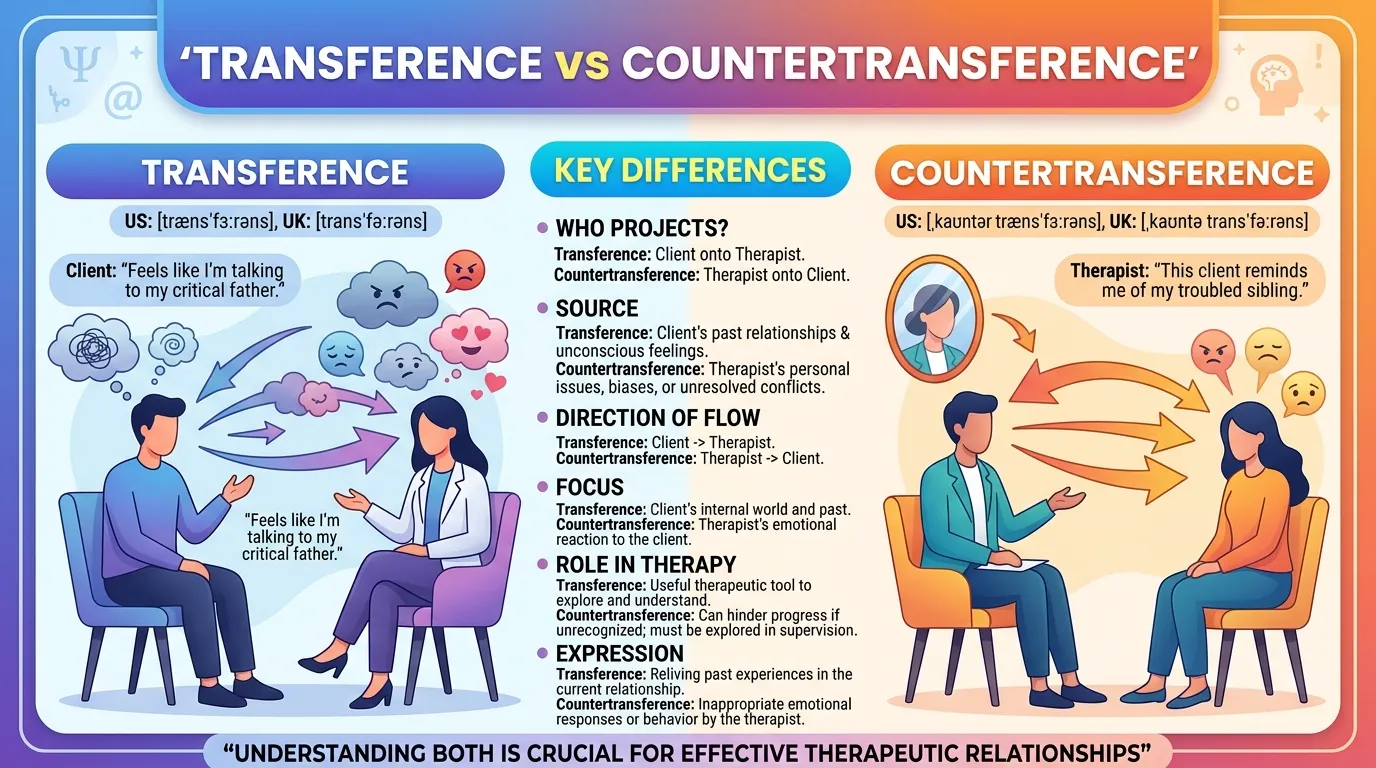
The difference between transference and countertransference lies mainly in the direction of emotional projection. Transference is when a client redirects feelings from past relationships onto the therapist. Countertransference, on the other hand, occurs when the therapist projects their own emotional responses onto the client.
Why Is Their Difference Necessary to Know?
Understanding the difference between transference and countertransference is crucial for both learners and professionals. For students of psychology, it builds a strong conceptual foundation. For therapists, it ensures ethical practice and emotional awareness.
In society, this knowledge helps improve communication and emotional intelligence. Misunderstanding these dynamics can lead to unhealthy relationships, not just in therapy but also in workplaces and families. Recognizing transference vs countertransference allows individuals to reflect on their emotional patterns and respond more thoughtfully.
Pronunciation of Both (US & UK)
- Transference
- US: /ˈtræns.fɝː.əns/
- UK: /ˈtræns.fər.əns/
- Countertransference
- US: /ˌkaʊn.t̬ɚ.trænsˈfɝː.əns/
- UK: /ˌkaʊn.tə.trænsˈfɜː.rəns/
Now that we understand how to say these terms, let’s move deeper into their detailed comparison.
Difference Between Transference vs Countertransference
1. Definition
- Transference: Client projects past feelings onto therapist.
- Example 1: A client treats therapist like their father.
- Example 2: A client feels anger due to past betrayal.
- Countertransference: Therapist projects feelings onto client.
- Example 1: Therapist feels protective like a parent.
- Example 2: Therapist feels irritation due to personal bias.
2. Direction of Emotion
- Transference: Client → Therapist
- Example 1: Client seeks approval like from a parent.
- Example 2: Client fears rejection from therapist.
- Countertransference: Therapist → Client
- Example 1: Therapist becomes overly attached.
- Example 2: Therapist avoids certain topics emotionally.
3. Origin
- Transference: Comes from client’s past experiences
- Example 1: Childhood trauma
- Example 2: Past relationships
- Countertransference: Comes from therapist’s personal history
- Example 1: Therapist’s unresolved issues
- Example 2: Personal emotional triggers
4. Awareness Level
- Transference: Often unconscious
- Example 1: Client unaware of projection
- Example 2: Client confused about feelings
- Countertransference: Can be conscious or unconscious
- Example 1: Therapist notices bias
- Example 2: Therapist unknowingly reacts emotionally
5. Role in Therapy
- Transference: Tool for understanding client
- Example 1: Reveals hidden emotions
- Example 2: Helps explore past relationships
- Countertransference: Must be managed carefully
- Example 1: Used for insight if controlled
- Example 2: Harmful if unchecked
6. Impact on Relationship
- Transference: Shapes client perception
- Example 1: Idealizing therapist
- Example 2: Distrusting therapist
- Countertransference: Affects therapist behavior
- Example 1: Favoring client
- Example 2: Becoming distant
7. Control
- Transference: Managed through therapy discussion
- Example 1: Therapist explains patterns
- Example 2: Client gains awareness
- Countertransference: Requires supervision
- Example 1: Therapist seeks guidance
- Example 2: Therapist practices self-reflection
8. Ethical Concerns
- Transference: Generally expected
- Example 1: Normal in therapy
- Example 2: Used as therapeutic tool
- Countertransference: Risky if unmanaged
- Example 1: Boundary issues
- Example 2: Emotional bias
9. Emotional Intensity
- Transference: Can be intense
- Example 1: Deep attachment
- Example 2: Strong resentment
- Countertransference: Varies
- Example 1: Mild empathy
- Example 2: Strong emotional reaction
10. Purpose
- Transference: Helps healing
- Example 1: Revisiting past trauma
- Example 2: Emotional release
- Countertransference: Needs control for effectiveness
- Example 1: Insight for therapist
- Example 2: Risk if misused
Nature and Behaviour of Both
Transference is emotional, unconscious, and rooted in past experiences. It often repeats patterns from earlier relationships. Countertransference is reactive and depends on the therapist’s emotional state and personal experiences. While transference is expected, countertransference must be carefully managed.
Why People Are Confused About Their Use?
| Aspect | Transference | Countertransference | Similarity |
| Source | Client | Therapist | Both emotional |
| Direction | Client → Therapist | Therapist → Client | Occur in therapy |
| Awareness | Mostly unconscious | Mixed | Psychological processes |
| Role | Helpful tool | Risky if unmanaged | Affect relationship |
People confuse them because both involve emotional projection and occur in the same setting.
Which Is Better in What Situation?
Transference is beneficial in therapy because it allows the therapist to understand the client’s emotional world. It helps uncover hidden feelings and unresolved conflicts, making it a powerful therapeutic tool.
Countertransference, however, is only beneficial when recognized and controlled. If managed properly, it can provide insights into the client’s behavior. Otherwise, it can harm the therapeutic relationship.
Use in Metaphors and Similes
- Transference: “Like a mirror of past emotions”
- Countertransference: “Like an echo of the therapist’s inner world”
Example:
- Her feelings were like transference, reflecting her childhood.
- His reaction was like countertransference, shaped by his own past.
Connotative Meaning of Both
- Transference: Neutral to positive
- Example: Useful in therapy
- Countertransference: Slightly negative
- Example: Risk of bias
Idioms or Proverbs Related
- “Emotional baggage” (Transference)
- Example: He carried emotional baggage into therapy.
- “Seeing through your own lens” (Countertransference)
- Example: The therapist judged through their own lens.
Works in Literature
- Studies on Hysteria – Psychology, Sigmund Freud, 1895
- The Interpretation of Dreams – Psychology, Sigmund Freud, 1899
Movies Related to Transference vs Countertransference
- Good Will Hunting – 1997, USA
- A Dangerous Method – 2011, UK/Canada
Frequently Asked Questions
1. What is the main difference?
Transference is from client to therapist; countertransference is the opposite.
2. Is transference good or bad?
It is generally helpful in therapy.
3. Can countertransference be useful?
Yes, if managed properly.
4. Why do they occur?
Due to past experiences and emotional patterns.
5. Are they common?
Yes, especially in therapy settings.
How Both Are Useful for Surroundings
Both concepts improve emotional awareness and communication. They help people understand their reactions and build healthier relationships in daily life.
Final Words for Both
Transference reveals the client’s inner world, while countertransference reflects the therapist’s emotional responses. Both are essential in psychological practice when handled correctly.
Conclusion
The difference between Transference vs Countertransference is fundamental in understanding human emotions and relationships. While transference allows clients to project past experiences, countertransference reflects the therapist’s reactions. Recognizing transference vs countertransference ensures ethical and effective therapy. By understanding these concepts, individuals can develop better emotional awareness and healthier interactions. Ultimately, mastering the difference between transference and countertransference benefits both professionals and society as a whole.

I am content creator and comparison blogger focused on analyzing key differences between terms, concepts, and ideas to deliver accurate, easy-to-understand information. So I decided to create a platform where these differences are explained in the simplest way possible.