When Ahmed, a farmer in a rural village, heard strange noises near his livestock at night, he reached for his shotgun but paused. Should he load buckshot or a slug? This real-world dilemma highlights the importance of understanding the buckshot vs slug difference.
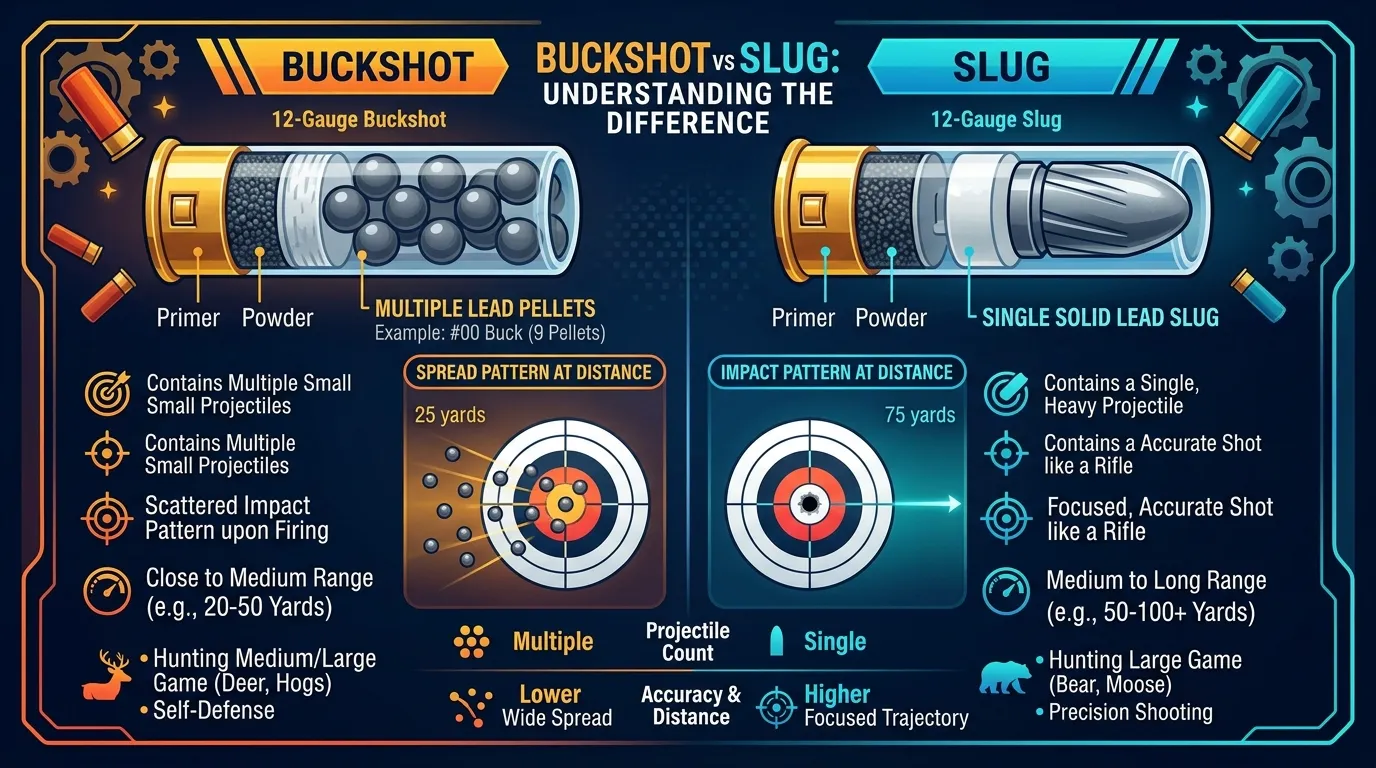
Both are types of shotgun ammunition, yet they serve entirely different purposes. In simple terms, buckshot contains multiple small pellets, while a slug is a single large projectile. Knowing the difference between buckshot and slug is not just about firearms it’s about safety, precision, and appropriate use.
Whether you’re a hunter, a learner, or simply curious, understanding buckshot vs slug can help you make informed decisions. Many people confuse these terms due to their shared use in shotguns, but their impact, range, and effectiveness differ greatly. This article explores the difference between buckshot and slug in a simple, clear, and practical way.
Buckshot vs Slug Key Difference
The core difference lies in structure and purpose:
- Buckshot: Contains multiple small pellets that spread out after firing.
- Slug: A single, solid projectile designed for accuracy and power.
Why Is Their Difference Necessary to Know?
Understanding the difference between buckshot and slug is crucial for both learners and professionals. For beginners, it ensures safe handling and appropriate usage. For experts like hunters or law enforcement officers, it determines effectiveness in specific scenarios.
In society, this knowledge helps prevent accidents, promotes responsible firearm usage, and ensures ethical hunting practices. Choosing the wrong ammunition can lead to unintended consequences, making this distinction essential for safety and efficiency.
Pronunciation of the Both (US & UK)
- Buckshot
- US: /ˈbʌk.ʃɑːt/
- UK: /ˈbʌk.ʃɒt/
- Slug
- US: /slʌɡ/
- UK: /slʌɡ/
Now that you know how to say them correctly, let’s dive deeper into their differences.
Buckshot vs Slug Difference in details
1. Structure
- Buckshot: Multiple pellets packed in a shell
Example 1: Used for hunting birds
Example 2: Effective in close-range defense - Slug: Single solid projectile
Example 1: Used for large game hunting
Example 2: Suitable for precise targeting
2. Spread
- Buckshot: Wide spread after firing
Example 1: Hits multiple targets
Example 2: Covers larger area - Slug: No spread, travels straight
Example 1: Hits a single target
Example 2: Maintains accuracy
3. Range
- Buckshot: Short to medium range
Example 1: Effective within 30–50 yards
Example 2: Used in home defense - Slug: Long range
Example 1: Effective beyond 100 yards
Example 2: Used in hunting large animals
4. Accuracy
- Buckshot: Less precise
Example 1: Useful in close quarters
Example 2: Not ideal for long distances - Slug: Highly accurate
Example 1: Suitable for target shooting
Example 2: Used in precision hunting
5. Impact
- Buckshot: Multiple smaller impacts
Example 1: Spreads damage
Example 2: Less penetration - Slug: Single powerful impact
Example 1: Deep penetration
Example 2: High stopping power
6. Usage
- Buckshot: Self-defense and small game
Example 1: Home protection
Example 2: Hunting birds - Slug: Large game hunting
Example 1: Deer hunting
Example 2: Law enforcement use
7. Recoil
- Buckshot: Moderate recoil
Example 1: Easier to handle
Example 2: Suitable for beginners - Slug: Heavy recoil
Example 1: Requires experience
Example 2: Harder to control
8. Penetration
- Buckshot: Lower penetration
Example 1: Safer in confined spaces
Example 2: Less wall penetration - Slug: High penetration
Example 1: Can pass through objects
Example 2: Requires caution
9. Cost
- Buckshot: Generally cheaper
Example 1: Widely available
Example 2: Affordable for practice - Slug: More expensive
Example 1: Specialized use
Example 2: Higher manufacturing cost
10. Purpose
- Buckshot: Area coverage
Example 1: Crowd control
Example 2: Defensive shooting - Slug: Precision and power
Example 1: Target accuracy
Example 2: Hunting large animals
Nature and Behaviour of the Both
Buckshot behaves like a spreading cloud of pellets, making it effective for close-range situations. It is less predictable at longer distances.
Slug, on the other hand, behaves like a bullet. It travels in a straight line with high velocity, offering accuracy and deep penetration.
Why People Are Confused About Their Use?
People often confuse buckshot vs slug because both are used in shotguns. The similarity in appearance of shells and lack of awareness leads to misunderstanding. Additionally, beginners assume all shotgun ammunition works the same way, which is not true.
Difference and Similarity Table (Buckshot vs Slug)
| Feature | Buckshot | Slug | Similarity |
| Structure | Multiple pellets | Single projectile | Both used in shotguns |
| Range | Short | Long | Used for shooting |
| Accuracy | Low | High | Require aiming |
| Impact | Spread damage | Focused damage | Can be powerful |
| Usage | Defense, small game | Large game hunting | Used by professionals |
Which Is Better in What Situation?
Buckshot is better for close-range situations such as home defense or hunting small animals. Its spread increases the chances of hitting a target, making it ideal when precision is less critical.
Slug is better for long-range and precision-based scenarios. It is suitable for hunting large animals or situations where accuracy and penetration are essential. Choosing between buckshot vs slug depends on your specific need.
Use in Metaphors and Similes
- Buckshot metaphor: “His ideas spread like buckshot in every direction.”
- Slug metaphor: “Her focus hit the problem like a slug—direct and powerful.”
Connotative Meaning of Both
- Buckshot
- Neutral/Negative: Lack of focus
Example: His strategy was buckshot, lacking direction.
- Neutral/Negative: Lack of focus
- Slug
- Positive/Negative: Power or laziness
Example: He delivered a slug of effort into the project.
- Positive/Negative: Power or laziness
Idioms or Proverbs Related
- “Slow as a slug”
Example: He moved as slow as a slug during the race.* - “Hit like a ton of bricks” (similar to slug impact)
Example: The news hit him like a slug.*
Works in Literature
- “Slugfest” (Sports Genre, Various Authors, 2005)
- “Buckshot Stories” (Fiction, Regional Writers, 1998)
Movies Related to Both
- “Slugterra” (2012, Canada)
- “Buckshot” (2017, USA)
Frequently Asked Questions
1. What is the main difference between buckshot and slug?
Buckshot contains multiple pellets, while a slug is a single projectile.
2. Which is more accurate, Buckshot vs Slug?
Slug is more accurate due to its single projectile design.
3. Is buckshot safer for home defense?
Yes, because it has less penetration compared to a slug.
4. Can both be used in the same shotgun?
Yes, most shotguns can fire both types.
5. Which is better for hunting?
It depends buckshot for small game, slug for large game.
How Both Are Useful for Surroundings
Buckshot is useful for pest control and protection in rural areas, while slug is useful for controlled hunting and professional applications. Both contribute to safety and resource management when used responsibly.
Final Words for the Both
Buckshot and slug are not interchangeable they are designed for different purposes. Understanding their nature ensures safe and effective use.
Conclusion
In conclusion, the difference between buckshot and slug lies in their design, purpose, and performance. Buckshot offers spread and is ideal for close-range use, while slug provides accuracy and power for long distances. Knowing the difference between buckshot and slug helps users make informed decisions, whether for safety, hunting, or professional use. While both serve important roles, choosing the right one depends on your specific needs. By understanding buckshot vs slug, you not only improve your knowledge but also promote responsible and effective usage.

I am content creator and comparison blogger focused on analyzing key differences between terms, concepts, and ideas to deliver accurate, easy-to-understand information. So I decided to create a platform where these differences are explained in the simplest way possible.