Many users get confused about the difference between MDX and RDX because both terms sound similar and are often discussed in gaming, automotive, and technology-related conversations. In simple words, MDX and RDX are two different product lines that serve different purposes, especially in the automotive industry under the Acura brand.
If you have ever searched “what is MDX and RDX,” “which is better MDX or RDX,” or “how does MDX compare to RDX,” you are not alone. The confusion usually happens because both vehicles come from the same manufacturer and share premium features.
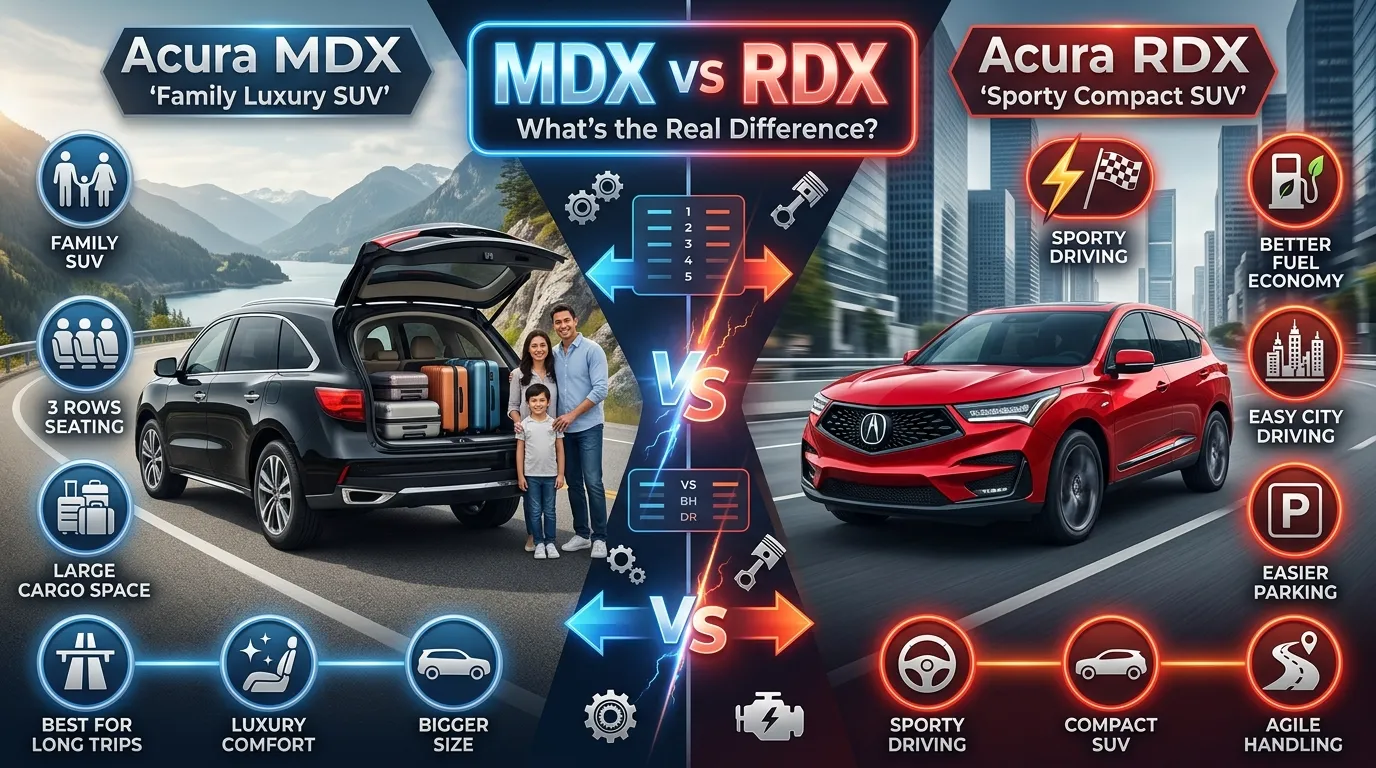
The difference between MDX and RDX mainly comes down to size, seating capacity, driving style, and purpose. The MDX is a larger three-row luxury SUV built for families and long-distance comfort, while the RDX is a smaller two-row luxury SUV designed for sporty city driving and daily commuting.
In this detailed guide, you will learn the exact difference between MDX and RDX, their features, performance, size, technology, pricing, real-world use cases, and which one makes more sense for your lifestyle in 2026.
Quick Answer: Difference Between MDX and RDX
The MDX is a midsize luxury SUV with three rows and more passenger space, while the RDX is a compact luxury SUV with two rows and a sportier driving feel.
Simple Example
- A large family usually prefers the MDX.
- A city commuter or young professional usually prefers the RDX.
In short:
- MDX = Bigger and family-focused
- RDX = Smaller and sporty
Definition of MDX and RDX
- MDX: A midsize luxury SUV from Acura designed for families, comfort, and extra seating capacity.
- RDX: A compact luxury SUV from Acura designed for sporty handling, urban driving, and modern luxury features.
Pronunciation of MDX and RDX
| Model | US Pronunciation | UK Pronunciation |
|---|---|---|
| MDX | Em-Dee-Ex | Em-Dee-Ex |
| RDX | Ar-Dee-Ex | Ar-Dee-Ex |
Now let’s understand the actual differences that matter in real-life driving and buying decisions.
Difference Between MDX and RDX Comparison Table
| Feature | MDX | RDX |
|---|---|---|
| SUV Type | Midsize luxury SUV | Compact luxury SUV |
| Seating Capacity | Up to 7 passengers | Up to 5 passengers |
| Rows | 3 rows | 2 rows |
| Driving Feel | Smooth and comfortable | Sporty and agile |
| Fuel Economy | Slightly lower | Better efficiency |
| Cargo Space | Larger storage area | Moderate storage |
| Best Use | Families and travel | City driving |
| Price | Higher | Lower |
| Parking Ease | Harder in tight spaces | Easier to park |
| Interior Style | Spacious luxury | Driver-focused luxury |
Key Differences Explained Between MDX and RDX in Details
Size and Space Difference
One of the biggest differences between MDX and RDX is size.
The MDX is much larger and provides:
- extra legroom
- third-row seating
- bigger cargo space
The RDX feels more compact and manageable, especially in crowded cities.
In practical use, many beginners do not realize how important SUV dimensions become during daily driving and parking.
Seating Capacity Difference
The MDX can seat up to seven passengers, while the RDX seats five.
This makes the MDX more suitable for:
- large families
- group travel
- long road trips
The RDX works better for:
- singles
- couples
- small families
Driving Experience Difference
The RDX delivers a sportier driving experience because of its lighter body and compact size.
Drivers often describe it as:
- responsive
- quick
- energetic
The MDX focuses more on:
- comfort
- smooth highway cruising
- stability
Fuel Efficiency Difference
Smaller SUVs usually consume less fuel, and the RDX performs better in this area.
Users searching “which is more fuel efficient MDX or RDX” often choose the RDX for commuting and urban use.
Cargo and Storage Difference
The MDX provides significantly more storage capacity.
This becomes useful for:
- luggage
- sports gear
- shopping
- family travel
The RDX still offers good cargo space, but not at the same level as the MDX.
Price Difference
The MDX generally costs more because it offers:
- larger size
- third-row seating
- extra luxury space
The RDX is more affordable and often considered a strong value luxury SUV.
What Is the Main Difference Between MDX and RDX?
The real difference is purpose.
MDX Is Built For:
- family transportation
- luxury road trips
- bigger passenger capacity
- comfort-focused driving
RDX Is Built For:
- sporty daily driving
- compact luxury
- easier maneuverability
- fuel-conscious users
This is why automotive reviewers on YouTube frequently compare both SUVs in “family SUV vs compact SUV” discussions.
Difference Between MDX and RDX Interior Features
MDX Interior Features
The MDX interior focuses heavily on passenger comfort.
Popular features include:
- spacious cabin layout
- advanced driver assistance systems
- luxury leather seating
- panoramic roof options
- premium family-friendly design
In real scenarios, families appreciate the quieter and roomier environment.
RDX Interior Features
The RDX interior feels more modern and sporty.
It usually includes:
- driver-focused cockpit layout
- responsive infotainment systems
- stylish dashboard design
- compact premium feel
Many younger buyers prefer the RDX because it feels more dynamic behind the wheel.
Difference Between MDX and RDX Performance
| Performance Area | MDX | RDX |
|---|---|---|
| Highway Comfort | Excellent | Very good |
| Sporty Feel | Moderate | High |
| Urban Handling | Good | Excellent |
| Suspension Style | Comfort-focused | Sport-tuned |
| Long Trip Experience | Superior | Comfortable |
The RDX feels faster and more playful, while the MDX feels calmer and more refined during long-distance driving.
Why People Get Confused Between MDX and RDX
Similar Names
The names MDX and RDX sound extremely similar, especially for first-time buyers.
Same Brand Identity
Both SUVs belong to Acura, which causes users to assume they are simply different trims of the same model.
Automotive Media Comparisons
Platforms like Instagram, YouTube, and car review websites constantly compare both SUVs together.
That increases confusion among beginners.
Common Mistakes with MDX and RDX
Thinking Bigger Is Always Better
Many buyers choose the MDX without actually needing third-row seating.
Fix:
Always match the SUV to your daily lifestyle.
Ignoring Parking Needs
Large SUVs become difficult in busy urban environments.
Fix:
City drivers should strongly consider the RDX.
Choosing Based Only on Appearance
Some users buy based on exterior design instead of practicality.
Fix:
Test drive both vehicles before deciding.
Underestimating Future Space Needs
Many families eventually need more seating and storage.
Fix:
Think about long-term lifestyle changes before buying.
Real Life Examples with MDX and RDX
Family Road Trip Example
A family traveling with children and luggage usually benefits more from the MDX.
Urban Professional Example
A professional working in crowded city traffic often prefers the RDX because it is easier to park and more fuel efficient.
Business Executive Example
Executives sometimes choose the MDX because it offers a more luxurious passenger experience for clients.
Young Driver Example
First-time luxury SUV buyers often select the RDX because it feels sporty and modern.
When To Use Each
Choose MDX If You Need:
- larger passenger capacity
- family-focused comfort
- more storage space
- luxury road-trip performance
Choose RDX If You Need:
- sporty daily driving
- compact SUV convenience
- better city maneuverability
- lower ownership costs
Expert Insight
In practical automotive consulting, most users who mainly drive in cities feel happier with the RDX because of its easier handling and lower fuel costs.
However, families often realize later that they need more space than expected. That is where the MDX becomes a smarter long-term investment.
A common industry observation is:
- The RDX solves present-day convenience.
- The MDX solves future family flexibility.
That simple difference explains why both SUVs remain highly popular in the luxury crossover market.
FAQs
Is MDX larger than RDX?
Yes, the MDX is a larger midsize SUV with three rows, while the RDX is a compact two-row SUV.
Which is better for families, MDX or RDX?
The MDX is generally better for families because it offers more seating and cargo space.
Is the RDX more fuel efficient?
Yes, the RDX usually delivers better fuel economy because it is smaller and lighter.
Which SUV is easier to drive in cities?
The RDX is easier to maneuver and park in urban environments.
Why are MDX and RDX often compared?
Because both are luxury SUVs from Acura and target similar buyers.
Is MDX more expensive than RDX?
Yes, the MDX normally costs more due to its larger size and additional features.
Which SUV feels sportier?
Most drivers consider the RDX sportier because of its agile handling.
Is MDX good for long road trips?
Yes, the MDX is excellent for long-distance comfort and family travel.
Conclusion
Understanding the difference between MDX and RDX becomes simple once you focus on how each SUV is designed to serve different lifestyles. The MDX is larger, more spacious, and family-oriented, making it ideal for long trips, bigger households, and users who need extra seating. The RDX, on the other hand, is compact, sporty, and easier to handle in urban environments.
If your priority is:
- comfort
- passenger capacity
- cargo space
then the MDX is usually the better option.
If you care more about:
- fuel efficiency
- sporty driving
- city convenience
then the RDX makes more sense.
Both SUVs continue to perform strongly in the luxury market because they target different user needs rather than competing directly against each other. That is exactly why the “MDX vs RDX” comparison remains highly searched in 2026 among luxury SUV buyers.

I am content creator and comparison blogger focused on analyzing key differences between terms, concepts, and ideas to deliver accurate, easy-to-understand information. So I decided to create a platform where these differences are explained in the simplest way possible.