Imagine two patients visiting a doctor with almost identical symptoms—fatigue, swollen lymph nodes, and frequent infections. After several medical tests, the doctor gives two different diagnoses. One patient has Chronic Lymphocytic Leukemia (CLL) and the other has Small Lymphocytic Lymphoma (SLL). This situation often surprises people because these diseases are extremely similar.
Understanding the difference between CLL and SLL is important for patients, medical students, and healthcare professionals. The topic CLL vs SLL frequently appears in medical education because both conditions originate from the same type of white blood cell called B-lymphocytes. However, they affect different parts of the body.
In simple terms, the difference between CLL and SLL lies mainly in where the abnormal cells accumulate. When discussing CLL vs SLL, doctors often describe them as two forms of the same disease with different locations in the body. Learning the difference between CLL and SLL helps people better understand diagnosis, treatment, and prognosis.
Key Difference Between the Both
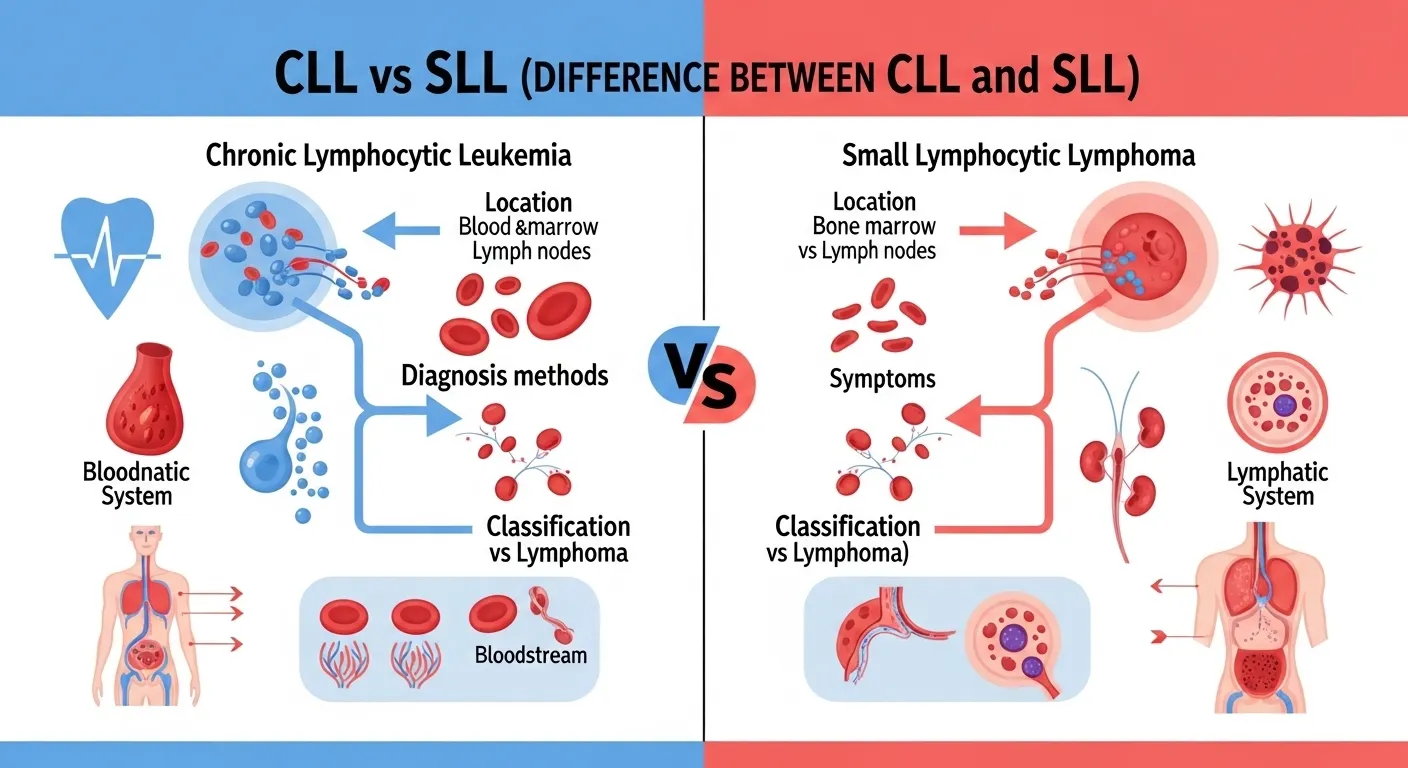
The main difference between CLL and SLL is where the cancerous cells are found:
- CLL mainly affects the blood and bone marrow.
- SLL mainly affects the lymph nodes and lymphatic tissues.
In other words, when doctors discuss CLL vs SLL, they are usually talking about the same type of cancer cells but located in different parts of the body.
Why Is Their Difference Necessary to Know for Learners and Experts?
Understanding CLL vs SLL is very important in medicine and society.
For medical students, learning the difference helps them understand how cancers of the immune system behave and spread.
For doctors and researchers, recognizing the difference guides diagnosis and treatment strategies. Blood tests are more useful for CLL, while imaging and lymph node biopsy are more common for SLL.
For patients and families, knowledge about CLL vs SLL reduces confusion and helps them understand medical reports and treatment plans.
In society, awareness of diseases like CLL and SLL improves early detection, supports research funding, and helps people recognize symptoms earlier.
Pronunciation of Both (US & UK)
| Term | US Pronunciation | UK Pronunciation |
| CLL | /siː-el-el/ | /siː-el-el/ |
| SLL | /es-el-el/ | /es-el-el/ |
Although the pronunciation is simple—just saying the letters—the meaning behind them is medically complex. Now that we understand how the terms sound, let’s explore the difference between CLL and SLL in greater detail.
Difference Between the Keywords
1. Location in the Body
CLL occurs mainly in the blood and bone marrow, while SLL appears primarily in lymph nodes.
Example 1:
A blood test reveals many abnormal lymphocytes, leading to a diagnosis of CLL.
Example 2:
A swollen lymph node biopsy confirms SLL.
2. Type of Diagnosis Test
CLL is usually diagnosed through blood tests, while SLL often requires lymph node biopsy.
Example 1:
Doctors detect CLL through abnormal white blood cell counts.
Example 2:
Doctors confirm SLL after examining lymph node tissue.
3. Visible Symptoms
CLL may show fewer visible symptoms at first, while SLL often causes swollen lymph nodes.
Example 1:
A routine blood test unexpectedly discovers CLL.
Example 2:
A patient notices enlarged neck lymph nodes and later receives an SLL diagnosis.
4. Disease Classification
CLL is categorized as leukemia, while SLL is classified as lymphoma.
Example 1:
CLL falls under blood cancers.
Example 2:
SLL belongs to lymphatic system cancers.
5. Disease Detection Stage
CLL may be detected early during routine blood tests.
Example 1:
Annual health screening reveals CLL.
Example 2:
SLL is often detected after noticeable lymph node swelling.
6. Laboratory Findings
CLL shows high lymphocyte counts in blood tests.
Example 1:
Blood reports show increased lymphocytes indicating CLL.
Example 2:
In SLL, lymphocyte levels may remain normal.
7. Medical Imaging
SLL frequently requires imaging scans.
Example 1:
CT scans reveal enlarged lymph nodes in SLL.
Example 2:
CLL diagnosis may not require scans initially.
8. Tissue Involvement
SLL mainly affects lymphatic tissues.
Example 1:
SLL develops in lymph node clusters.
Example 2:
CLL spreads through the bloodstream.
9. Monitoring Methods
CLL patients often undergo regular blood monitoring.
Example 1:
Doctors track lymphocyte counts every few months.
Example 2:
SLL monitoring includes physical exams for lymph nodes.
10. Disease Presentation
CLL often appears in blood reports first.
Example 1:
A patient without symptoms is diagnosed with CLL.
Example 2:
SLL patients usually notice swelling or lumps.
Nature and Behaviour of Both
CLL:
This disease develops slowly and often progresses gradually. Many patients live for years without severe symptoms. Doctors sometimes recommend “watch and wait” treatment strategies.
SLL:
SLL behaves similarly to CLL but mainly affects lymph nodes. The disease can also progress slowly and may remain stable for long periods.
Why People Are Confused About Their Use?
The confusion in CLL vs SLL occurs because:
- Both originate from the same B-cells
- Both share similar genetic features
- Both may transform into each other during progression
Difference and Similarity Table
| Feature | CLL | SLL |
| Disease type | Leukemia | Lymphoma |
| Main location | Blood & bone marrow | Lymph nodes |
| Cell origin | B-lymphocytes | B-lymphocytes |
| Symptoms | Often mild initially | Enlarged lymph nodes |
| Diagnosis | Blood tests | Lymph node biopsy |
Which Is Better in What Situation?
CLL Situation
CLL may be easier to detect early because it appears in routine blood tests. In many cases, patients can live with CLL for years without needing immediate treatment. Regular monitoring allows doctors to track the disease effectively.
SLL Situation
SLL diagnosis often occurs when lymph nodes become enlarged. In such cases, imaging and biopsy help doctors confirm the condition. Treatment plans may involve targeted therapy, chemotherapy, or immunotherapy depending on the stage.
How the Keywords Are Used in Metaphors and Similes
Although these are medical terms, writers sometimes use them metaphorically to describe slow-growing problems.
Examples
- “The issue spread through the organization like CLL through the bloodstream.”
- “The hidden conflict grew quietly like SLL inside lymph nodes.”
Connotative Meaning
| Term | Connotation | Example |
| CLL | Neutral to negative | “The doctor diagnosed CLL during routine testing.” |
| SLL | Neutral to negative | “SLL requires careful monitoring.” |
Both terms carry medical seriousness rather than emotional meaning.
Idioms or Proverbs Related to the Words
Since these are scientific terms, there are no traditional idioms. However, medical discussions often include phrases like:
- “Early detection saves lives.”
Example: Early blood tests helped doctors identify CLL. - “Knowledge is the best medicine.”
Example: Understanding SLL helps patients cope better.
Works in Literature Mentioning the Keywords
- Understanding Leukemia – Medical Guide, various authors, 2015
- Modern Hematology Studies – Academic text, 2019
- Blood Cancer Awareness – Medical awareness publication, 2021
Movies or Documentaries Related to the Keywords
- Living with Leukemia – 2016, USA
- The Lymphoma Journey – 2018, UK
- Cancer: The Emperor of All Maladies – 2015, USA
Frequently Asked Questions
1. Are CLL and SLL the same disease?
Yes, they involve the same cancer cells but appear in different parts of the body.
2. What is the main difference between CLL and SLL?
The main difference is location: CLL occurs in blood, while SLL occurs in lymph nodes.
3. Can CLL turn into SLL?
Yes, in some cases the disease may appear in both blood and lymph nodes.
4. Is treatment different for CLL vs SLL?
Treatment approaches are often similar because the cancer cells are the same.
5. Is CLL or SLL more dangerous?
Both conditions can vary widely in severity depending on the stage and patient health.
How Both Are Useful for Surroundings
Research into CLL and SLL helps scientists better understand the immune system and blood cancers. Medical discoveries in these areas contribute to improved cancer therapies, targeted drugs, and diagnostic technologies.
In society, awareness campaigns and research funding for leukemia and lymphoma improve survival rates and support patients worldwide.
Final Words for Both
When discussing CLL vs SLL, it is important to remember that they are closely related diseases. The difference is mainly about where the cancer cells appear rather than how they behave.
Medical research continues to improve treatment and understanding of these conditions.
Conclusion
Understanding the difference between CLL and SLL helps clarify one of the most commonly misunderstood topics in hematology. While both diseases originate from the same B-lymphocytes, their main distinction lies in where the abnormal cells accumulate blood for CLL and lymph nodes for SLL. This difference influences diagnosis methods, monitoring strategies, and sometimes treatment approaches. The discussion of CLL vs SLL highlights how small biological variations can lead to different medical classifications. For students, doctors, and patients, knowing the difference improves communication and awareness. As research advances, the medical community continues to develop better therapies and diagnostic tools to manage both conditions effectively.

My name is Ryan Mitchell, and I am a comparison content writer based in the United States. I specialize in creating clear and easy-to-understand articles that explain the differences between similar concepts, products, and ideas. My work focuses on helping readers quickly understand what makes two things different so they can make better decisions.