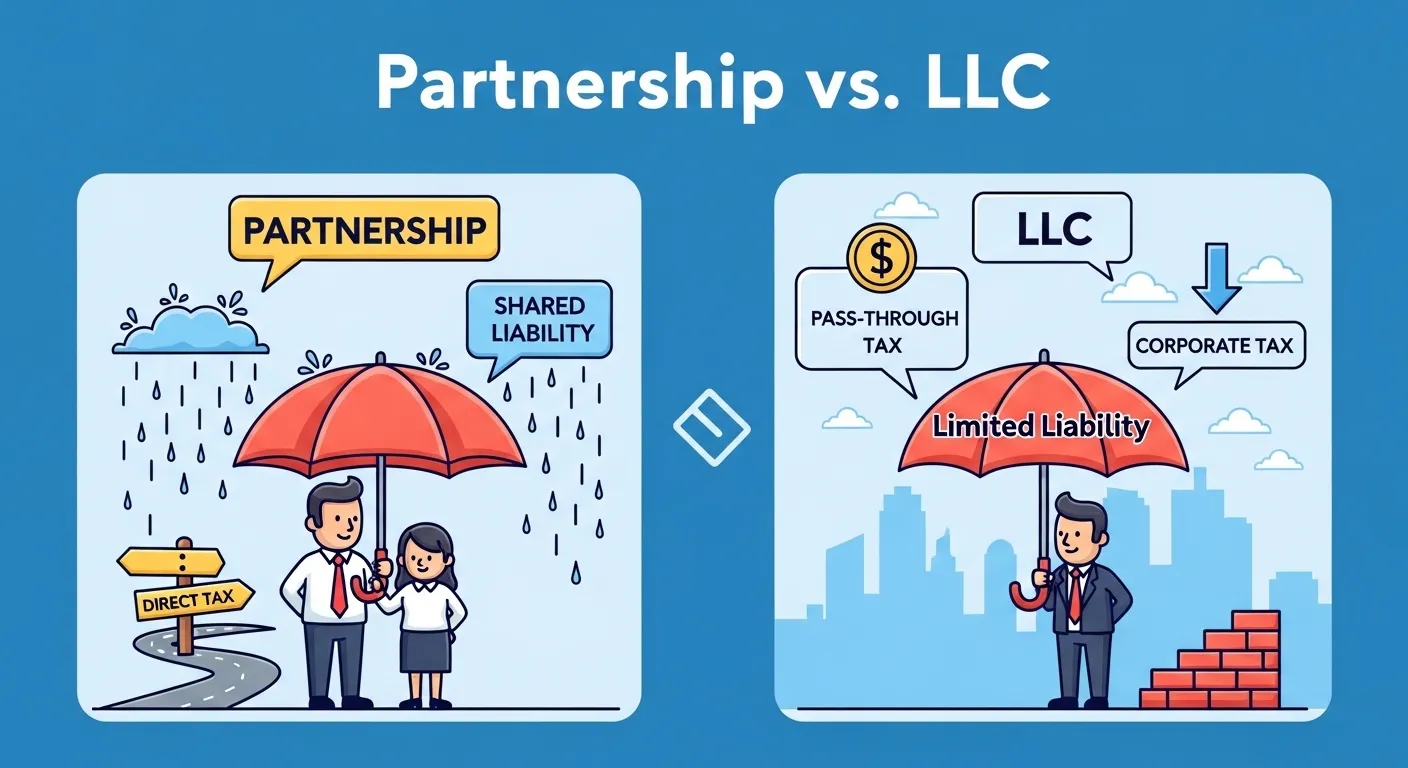
Understanding the Difference Between Partnership and LLC is essential for professionals, investors, and entrepreneurs who want to build legally sound and scalable businesses. While both structures offer flexibility and pass-through taxation, they differ significantly in areas such as liability protection, ownership structure, management control, state registration, and compliance obligations.
A Partnership is often chosen for its simplicity and low setup cost, making it ideal for small businesses or professional collaborations. However, it comes with varying levels of liability depending on its type such as General Partnerships, LPs (Limited Partnerships), LLPs (Limited Liability Partnerships), and LLLPs (Limited Liability Limited Partnerships).
On the other hand, a Limited Liability Company (LLC) is a more modern and structured business entity that provides strong liability protection, flexible management, and better scalability, making it attractive for startups and growing enterprises.
This in-depth guide explores every critical difference with a professional lens, helping you choose the right structure based on legal, financial, and operational priorities.
Understanding Partnership Structures
A Partnership is not a single uniform structure—it includes multiple variations, each with different liability and management implications.
1. General Partnership (GP)
- All partners manage the business
- Unlimited personal liability
- Simplest structure
Use Case: Small consulting firms
2. Limited Partnership (LP)
- General partners manage the business
- Limited partners act as investors
- Limited partners have restricted liability
Use Case: Investment or real estate projects
3. Limited Liability Partnership (LLP)
- All partners have limited liability
- Common among professionals
Use Case: Law firms, accounting firms
4. Limited Liability Limited Partnership (LLLP)
- Hybrid of LP and LLP
- Provides liability protection to general partners as well
👉 Use Case: Large-scale ventures requiring layered protection
What is an LLC and its Structure
A Limited Liability Company (LLC) is a hybrid business structure combining features of partnerships and corporations. It provides flexibility in management while offering strong liability protection.
Key Characteristics
- Separate legal entity
- Limited liability for members
- Flexible taxation options
- Customizable operating agreement
- Enhanced credibility
Types of LLCs
- Single-Member LLC
- Multi-Member LLC
- Professional LLC (PLLC)
Practical Example
A tech startup with multiple investors often forms an LLC to protect personal assets while maintaining flexible profit distribution.
Difference Between Partnership and LLC: Detailed Key Differences with Quick Comparison Table
Below is a deep, professional-level breakdown of the most important differences. These points are expanded to help professionals, consultants, and investors make informed decisions.
1. Liability Protection (Most Critical Difference)
Partnership:
Liability depends on the type of partnership:
- General Partnership (GP): Unlimited personal liability — partners are personally responsible for all debts and legal obligations.
- Limited Partnership (LP): General partners have unlimited liability, while limited partners are protected up to their investment.
- LLP & LLLP: Offer partial or full liability protection, but this varies by jurisdiction and legal structure.
👉 Risk Insight: In many cases, partners can be held liable for the actions of other partners, which significantly increases legal exposure.
LLC:
- Provides full limited liability protection
- Members are not personally responsible for business debts or lawsuits
👉 Expert Conclusion: LLC is the safer option for risk-heavy or growth-oriented businesses.
2. Ownership Structure
Partnership:
- Owners are called partners
- Ownership is defined through a partnership agreement
- LPs allow passive investors (limited partners)
👉 Limitation: Ownership transfer can be complex and may require approval from other partners.
LLC:
- Owners are called members
- No restriction on number or type of owners
- Can include individuals, corporations, or even foreign investors
👉 Advantage: Highly flexible ownership structure suitable for scaling businesses.
3. Management Structure
Partnership:
- Typically partner-managed
- All partners participate in decision-making (GP)
- In LPs, only general partners manage
👉 Challenge: Decision conflicts can arise without a well-defined agreement.
LLC:
- Can be:
- Member-managed (owners run the business)
- Manager-managed (professional managers run operations)
👉 Professional Insight: LLCs allow separation of ownership and management, which is ideal for larger or investor-backed businesses.
4. Taxation Flexibility
Partnership:
- Pass-through taxation
- Profits taxed at individual partner level
- Limited flexibility in tax structure
LLC:
- Default pass-through taxation
- Can elect to be taxed as:
- Sole proprietorship
- Partnership
- Corporation
👉 Strategic Advantage: LLCs offer better tax planning opportunities.
5. State Registration Requirements
Partnership:
- General Partnerships often require no formal registration
- LPs, LLPs, and LLLPs must register with the state
👉 Implication: Less paperwork for basic partnerships, but limited legal protection.
LLC:
- Must register with the state
- Requires Articles of Organization
- Legal recognition as a separate entity
👉 Conclusion: More formal but more secure.
6. Annual Reports & Compliance
Partnership:
- Minimal compliance requirements
- Some registered partnerships must file periodic reports
LLC:
- Required to file annual or biennial reports
- Must maintain records and comply with state laws
👉 Trade-Off: More administrative work, but stronger legal standing.
7. Legal Identity
Partnership:
- Not always a separate legal entity
- Owners and business may be legally the same
LLC:
- Completely separate legal entity
- Can own assets, sue, and be sued independently
8. Profit Distribution
Partnership:
- Based on partnership agreement
- Usually proportional to ownership
LLC:
- Flexible distribution — not necessarily based on ownership percentage
👉 Advantage: Better financial structuring options in LLCs.
9. Continuity & Business Stability
Partnership:
- May dissolve if a partner leaves or dies
- Requires restructuring
LLC:
- Continues independently of ownership changes
👉 Professional Insight: LLC ensures long-term stability.
10. Credibility & Investment Potential
Partnership:
- Often seen as informal
- Harder to attract investors
LLC:
- More professional image
- Easier to raise capital and attract investors
Quick Comparison Table (Parternship vs LLC)
| Feature | Partnership | LLC |
| Liability Protection | Unlimited (GP), limited in LP/LLP/LLLP | Full limited liability |
| Ownership | Partners (restricted flexibility) | Members (highly flexible) |
| Management | Partner-managed | Member or manager-managed |
| Taxation | Pass-through only | Flexible tax options |
| State Registration | Not required (GP), required for LP/LLP/LLLP | Mandatory |
| Annual Reports | Minimal or none | Required in most states |
| Legal Entity Status | Not always separate | Separate legal entity |
| Profit Distribution | Based on agreement | Highly flexible |
| Continuity | May dissolve | Continues independently |
| Credibility | Less formal | More professional |
| Scalability | Limited | High growth potential |
Advantages of Partnership
- Low startup cost
- Simple formation
- Flexible operations
- Direct control
- Shared expertise
Disadvantages of Partnership
- Unlimited liability (GP)
- Conflicts among partners
- Limited growth potential
- Legal risks
Advantages of LLC
- Strong liability protection
- Tax flexibility
- Professional image
- Better scalability
- Ownership flexibility
Disadvantages of LLC
- Higher setup costs
- Ongoing compliance
- State regulations
Strategic Decision Guide
✔️ Choose Partnership if:
- Business is small and low-risk
- You want minimal compliance
- You trust your partners
✔️ Choose LLC if:
- You want liability protection
- You plan to scale
- You need investor credibility
Real-World Professional Use Cases
✔️ Partnership
- Legal firms (LLPs)
- Small consulting groups
✔️ LLC
- Tech startups
- E-commerce businesses
- Investment firms
FAQs
What is the main difference between partnership and LLC?
The main difference is liability protection—LLCs protect personal assets, while partnerships may expose owners to personal liability.
Which is better for professionals, LLP or LLC?
LLPs are common for professional firms, but LLCs offer better scalability and flexibility.
Do LLCs require annual reports?
Yes, most states require LLCs to file annual or periodic reports.
Can partnerships register with the state?
Yes, LPs, LLPs, and LLLPs require state registration.
Which structure is best for startups?
LLCs are generally better due to liability protection and investment potential.
Conclusion
The Difference Between Partnership and LLC lies not only in structure but also in strategic business impact. Partnerships—whether General Partnerships, LPs, LLPs, or LLLPs—offer flexibility and simplicity but come with varying levels of liability and limitations.
In contrast, LLCs provide a balanced combination of protection, flexibility, and scalability, making them a preferred choice for modern businesses and professionals.
For long-term success, risk management, and growth, an LLC often stands out as the superior option. However, the final decision should always align with your business goals, operational complexity, and financial strategy.
Expert Summary Insight (Partnership vs LLC)
From a professional and strategic perspective, the Difference Between Partnership and LLC becomes clear when evaluating risk, scalability, and compliance:
- Partnerships (including General Partnerships, LPs, LLPs, and LLLPs) offer flexibility but come with varying levels of liability and limitations.
- LLCs provide a balanced, modern structure with strong protection, flexibility, and long-term growth potential.
Final Recommendation:
Choose LLC for scalable, professional, and risk-managed ventures
Choose Partnership for small, low-risk, and trust-based businesses

I am content creator and comparison blogger focused on analyzing key differences between terms, concepts, and ideas to deliver accurate, easy-to-understand information. So I decided to create a platform where these differences are explained in the simplest way possible.