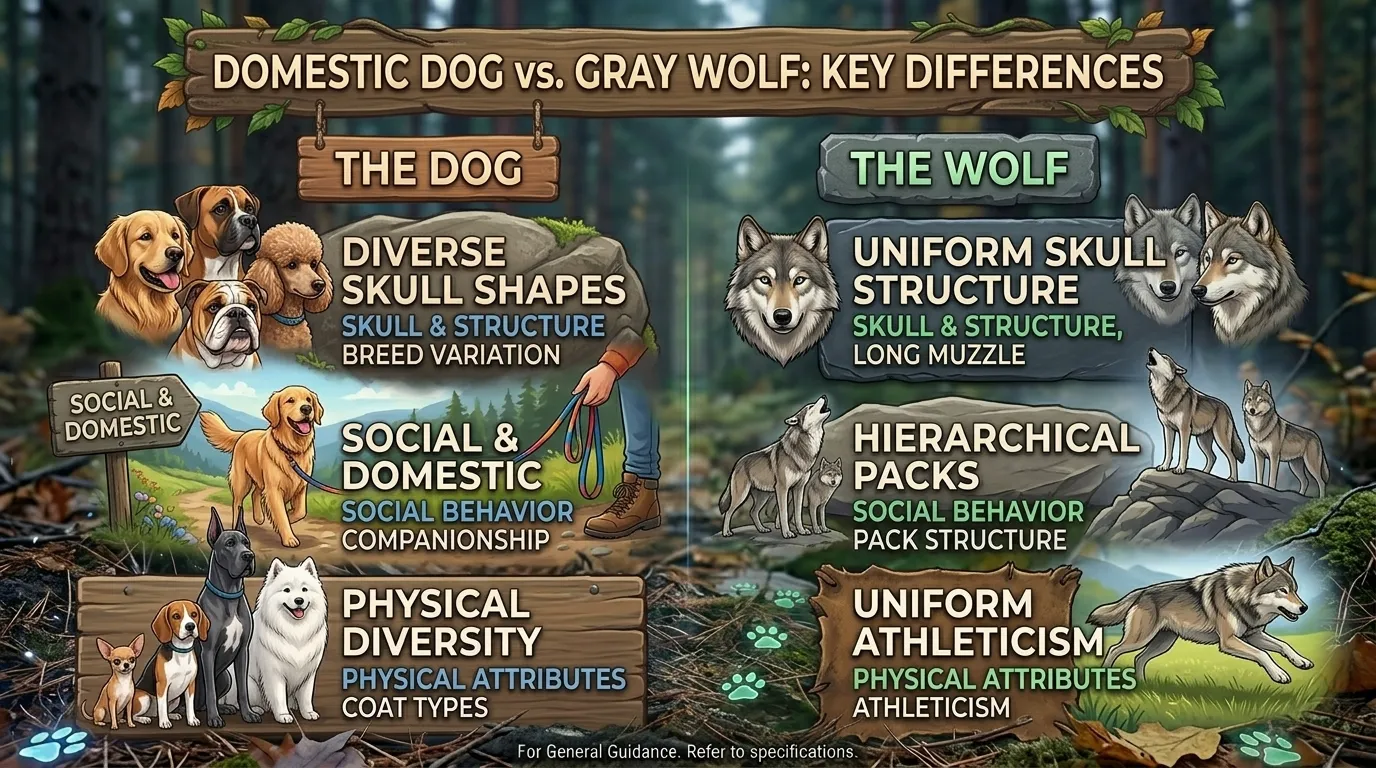
On a cold evening in a village, a family dog sat quietly beside its owner. In the distance, a wolf howled in the forest. The sound reminded everyone how closely these two animals are related. Yet, their lives are very different. Understanding the difference between dog and wolf helps people see how animals adapt to their environments.
A dog is a domesticated animal that lives with humans. A wolf is a wild animal that survives in forests and mountains. Many people confuse them because they look similar. However, when we study the wolf vs dog, we notice important distinctions in behavior, appearance, and lifestyle.
Scientists, animal lovers, and students often explore the difference between dog and wolf to understand evolution and domestication. Knowing the difference between dog and wolf also helps us respect wildlife and appreciate the role of dogs in human society.
Key Difference Between Dog and Wolf
The main difference between dog and wolf lies in domestication and behavior.
Dogs are domesticated animals that have lived with humans for thousands of years. They are friendly, trainable, and adapted to human life.
Wolves, on the other hand, are wild animals that live in packs and survive by hunting. They are independent and cautious around humans.
Dogs depend on humans for food and shelter, while wolves rely on their instincts and natural hunting skills.
Why Their Difference Is Important to Know
Understanding the difference between dog and wolf is important for both learners and experts.
For students and researchers, it helps explain the process of domestication and evolution. Dogs are believed to have evolved from wolves thousands of years ago.
For wildlife experts, knowing the difference between dog and wolf helps in conservation efforts. Wolves play an important role in maintaining the balance of ecosystems.
In society, dogs provide companionship, security, and assistance to humans. Wolves, meanwhile, maintain natural wildlife populations by hunting weaker animals.
Recognizing their differences helps humans treat both animals with respect and responsibility.
Pronunciation of Both Words
Dog
US: /dɔːɡ/
UK: /dɒɡ/
Wolf
US: /wʊlf/
UK: /wʊlf/
These simple pronunciations show how closely related the words sound. Now that we understand how to say them correctly, let’s explore the deeper difference between dog and wolf in detail.
Difference Between Dog and Wolf
1. Domestication
Dogs are domesticated animals that live with humans.
Wolves remain wild animals.
Examples:
A pet dog sleeps inside the house.
A wolf lives in forests or mountains.
Another example:
A dog waits for its owner at home.
A wolf travels long distances with its pack.
2. Behavior Toward Humans
Dogs are friendly and trusting.
Wolves are cautious and avoid humans.
Examples:
A dog happily greets visitors.
A wolf usually runs away from people.
Another example:
Dogs enjoy being petted.
Wolves rarely allow human contact.
3. Social Structure
Dogs often live with humans and sometimes other dogs.
Wolves live in organized packs.
Examples:
A dog may live alone with its owner.
Wolves depend on their pack for survival.
Another example:
Dogs adapt easily to human families.
Wolves follow strict pack leadership.
4. Diet
Dogs can eat different types of food, including human food.
Wolves are strict carnivores and hunt prey.
Examples:
A dog eats dog food or leftovers.
A wolf hunts deer or rabbits.
Another example:
Dogs may eat vegetables.
Wolves mainly eat meat.
5. Appearance
Dogs come in many shapes, sizes, and colors.
Wolves usually have a similar body structure.
Examples:
Some dogs are small like Chihuahuas.
Wolves are usually medium to large.
Another example:
Dogs can have curly or short hair.
Wolves have thick fur.
6. Communication
Dogs bark frequently.
Wolves mostly howl.
Examples:
A dog barks when someone knocks on the door.
A wolf howls to communicate with its pack.
Another example:
Dogs bark to show excitement.
Wolves howl across long distances.
7. Hunting Skills
Dogs depend on humans for food.
Wolves hunt in coordinated packs.
Examples:
A dog waits for feeding time.
Wolves chase prey together.
Another example:
A dog may play with toys.
A wolf practices hunting with its pack.
8. Independence
Dogs rely on humans.
Wolves rely on themselves and their pack.
Examples:
A dog cannot easily survive alone in the wild.
A wolf survives by hunting.
Another example:
Dogs need human care.
Wolves depend on natural instincts.
9. Reproduction
Dogs breed multiple times a year.
Wolves usually breed once a year.
Examples:
Domestic dogs can have many litters.
Wolves have seasonal breeding.
Another example:
Dogs breed under human care.
Wolves breed naturally in the wild.
10. Relationship with Humans
Dogs are companions to humans.
Wolves remain distant from human society.
Examples:
Dogs work as guide dogs and police dogs.
Wolves rarely interact with humans.
Another example:
Dogs live in homes.
Wolves live in wilderness.
Nature and Behaviour of Both
Dogs are generally friendly, loyal, and protective. They adapt easily to human environments and often show affection toward their owners.
Wolves are intelligent, cautious, and highly social within their packs. They are skilled hunters and survive in challenging natural environments.
Why People Are Confused About Dog vs Wolf?
Many people confuse dogs and wolves because they share similar physical features. Dogs evolved from wolves thousands of years ago, which explains their resemblance.
| Feature | Dog | Wolf |
| Habitat | Human homes | Forests and wilderness |
| Behavior | Friendly to humans | Cautious of humans |
| Diet | Omnivorous | Carnivorous |
| Communication | Barking | Howling |
| Social Structure | Human family | Pack hierarchy |
Which Is Better in What Situation?
Dogs are better companions for humans. They help people in daily life by providing security, assistance, and emotional support. Guide dogs help blind people, and police dogs assist law enforcement.
Wolves are better suited to natural ecosystems. They help control animal populations and keep ecosystems balanced. In wilderness environments, wolves play an important ecological role that dogs cannot fulfill.
Metaphors and Similes
Dogs and wolves often appear in figurative language.
Examples:
“Loyal as a dog” – describing a faithful person.
“Hungry like a wolf” – describing someone extremely hungry.
“Wolf in sheep’s clothing” – someone pretending to be harmless.
Connotative Meaning
Dog
Positive: loyalty and friendship
Example: “He is loyal like a dog.”
Negative: insult in some contexts
Example: “They called him a lazy dog.”
Neutral: simply refers to the animal.
Wolf
Positive: strength and independence
Example: “He has the spirit of a wolf.”
Negative: danger or aggression
Example: “A wolf among sheep.”
Neutral: wild animal in nature.
Idioms and Proverbs
Every dog has its day
Example: Even quiet people succeed someday. Every dog has its day.
A lone wolf
Example: He prefers working alone like a lone wolf.
Cry wolf
Example: If you lie too often, people will think you cry wolf.
Works in Literature
Dog
- The Call of the Wild — Adventure — Jack London — 1903
- White Fang — Adventure — Jack London — 1906
Wolf
- The Three Little Pigs — Fairy Tale — Various — 19th century
- Little Red Riding Hood — Fairy Tale — Charles Perrault — 1697
Movies About Dogs and Wolves
Dog Movies
- Hachi: A Dog’s Tale — 2009 — USA
- Beethoven — 1992 — USA
Wolf Movies
- The Grey — 2011 — USA
- Alpha — 2018 — USA
Frequently Asked Questions
Are dogs descended from wolves?
Yes. Modern dogs evolved from wolves thousands of years ago through domestication.
Can wolves become pets?
Wolves are wild animals and usually cannot adapt to domestic life.
Why do wolves howl?
Wolves howl to communicate with their pack and mark territory.
Why do dogs bark more than wolves?
Dogs bark because they evolved to communicate with humans.
Can dogs survive in the wild like wolves?
Most domestic dogs struggle to survive in the wild because they depend on humans.
How Both Are Useful for Surroundings
Dogs help humans in many ways. They guard homes, assist police, help disabled people, and provide emotional support.
Wolves help maintain ecological balance by controlling populations of animals like deer. This keeps ecosystems healthy.
Final Words for Both
Dogs and wolves share a common ancestry, but their paths have diverged. Dogs became human companions, while wolves remained powerful symbols of the wild.
Understanding both animals helps us appreciate their unique roles in nature and human life.
Conclusion
The difference between dog and wolf becomes clear when we study their behavior, lifestyle, and relationship with humans. Dogs are domesticated companions that provide loyalty, security, and emotional support. Wolves are wild animals that play an important role in maintaining ecological balance. By understanding the difference between dog and wolf, students, researchers, and animal lovers can appreciate both species more deeply. Dogs remind us of companionship, while wolves represent the strength and mystery of nature. Learning about both animals helps us respect wildlife and care responsibly for domestic animals.

I am content creator and comparison blogger focused on analyzing key differences between terms, concepts, and ideas to deliver accurate, easy-to-understand information. So I decided to create a platform where these differences are explained in the simplest way possible.