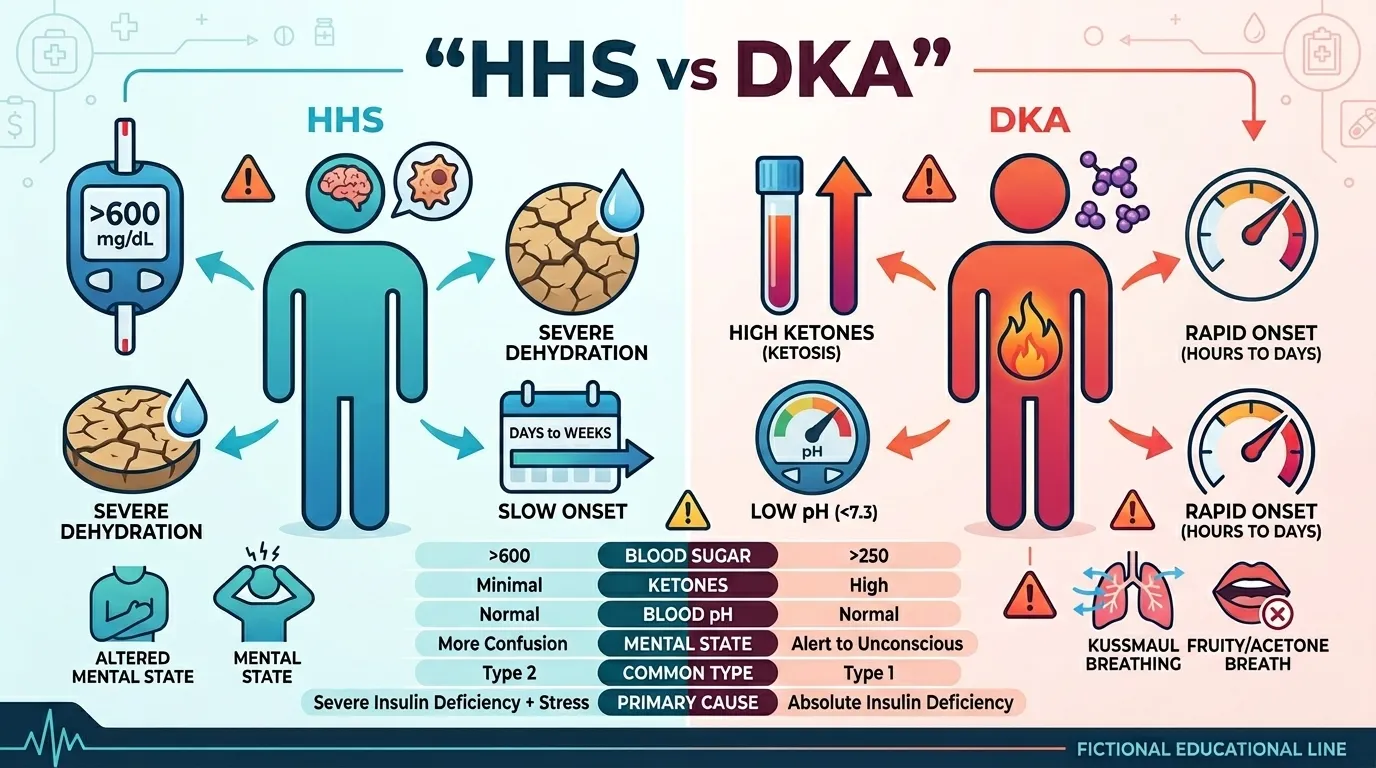
Imagine a patient arriving at the emergency room extremely weak, confused, and dehydrated. The doctor must quickly decide whether it’s Hyperosmolar Hyperglycemic State or Diabetic Ketoacidosis, because the treatment path depends on this crucial distinction. Understanding the difference between HHS and DKA can literally save lives.
In real-world medical practice, the terms difference between HHS and DKA often arise when dealing with severe diabetes complications. While both conditions result from uncontrolled blood sugar, they behave very differently. For students, healthcare workers, and even patients, knowing the difference between both is essential.
The phrase HHS vs DKA is commonly used to compare these emergencies, and understanding it can improve diagnosis, treatment, and outcomes. This guide will break down the difference between both in a simple, structured, and practical way.
Key Difference Between the Both
The main difference between both lies in ketone production and blood acidity.
- HHS involves extremely high blood sugar without significant ketone buildup.
- DKA includes high blood sugar along with ketones, causing blood to become acidic.
Why Is Their Difference Important?
Understanding the difference between both is critical for both learners and professionals. These conditions require different treatment strategies, especially regarding insulin use and fluid replacement. In society, awareness helps patients seek timely care, reducing complications and mortality. For healthcare systems, distinguishing both ensures efficient emergency management and resource use.
Pronunciation of Both (US & UK)
- HHS (Hyperosmolar Hyperglycemic State)
- US: /ˌhaɪpərɒzˈmoʊlər haɪpərɡlaɪˈsiːmɪk steɪt/
- UK: /ˌhaɪpəˈrɒzmələ haɪpəɡlaɪˈsiːmɪk steɪt/
- DKA (Diabetic Ketoacidosis)
- US: /ˌdaɪəˈbɛtɪk ˌkiːtoʊæsɪˈdoʊsɪs/
- UK: /ˌdaɪəˈbɛtɪk ˌkiːtəʊæsɪˈdəʊsɪs/
Difference Between the HHS and DKA
1. Blood Sugar Levels
HHS: Extremely high (often >600 mg/dL)
DKA: High but usually lower than HHS
Examples:
- A patient with 800 mg/dL likely has HHS.
- A patient with 350 mg/dL may have DKA.
2. Ketone Production
HHS: Minimal or none
DKA: High ketone levels
Examples:
- Urine test negative → HHS.
- Strong ketone smell → DKA.
3. Blood Acidity (pH)
HHS: Normal pH
DKA: Acidic blood
Examples:
- pH 7.4 → HHS.
- pH 7.2 → DKA.
4. Onset Speed
HHS: Develops slowly (days)
DKA: Rapid onset (hours)
Examples:
- Gradual confusion → HHS.
- Sudden vomiting → DKA.
5. Dehydration Level
HHS: Severe dehydration
DKA: Moderate dehydration
Examples:
- Dry skin and extreme thirst → HHS.
- Mild dehydration → DKA.
6. Patient Type
HHS: Common in Type 2 diabetes
DKA: Common in Type 1 diabetes
Examples:
- Young insulin-dependent → DKA.
7. Breathing Pattern
HHS: Normal breathing
DKA: Deep, rapid breathing
Examples:
- Calm breathing → HHS.
- Kussmaul breathing → DKA.
8. Mental State
HHS: Confusion, coma common
DKA: Alert to mildly confused
Examples:
- Unconscious patient → HHS.
- Irritable but awake → DKA.
9. Mortality Rate
HHS: Higher risk
DKA: Lower risk (if treated)
Examples:
- Delayed treatment → fatal HHS.
- Early insulin → DKA recovery.
10. Treatment Focus
HHS: Fluids first
DKA: Insulin and ketone correction
Examples:
- IV fluids critical → HHS.
- Insulin drip → DKA.
Nature and Behaviour of Both
HHS is a slow-progressing, dehydration-driven condition. It mainly affects older adults and develops due to prolonged high blood sugar without insulin deficiency.
DKA is a rapid, acid-producing condition. It results from insulin deficiency, causing the body to break down fat and produce ketones.
Why People Are Confused About Their Use?(HHS vs DKA)
| Feature | HHS | DKA | Similarity |
|---|---|---|---|
| Blood sugar | Very high | High | Both involve hyperglycemia |
| Ketones | None | Present | Both linked to diabetes |
| Onset | Slow | Rapid | Both are emergencies |
| Patients | Type 2 | Type 1 | Both need urgent care |
Confusion arises because both are diabetes complications with overlapping symptoms.
Which Is Better in What Situation?
HHS is not “better,” but it is more manageable when detected early, especially in older than 60 patients. It responds well to hydration and controlled care.
DKA, while more dramatic, is easier to identify quickly due to clear symptoms like rapid breathing and ketone presence. Early insulin treatment makes recovery faster in many cases.
Use in Metaphors and Similes
- “His stress built up like DKA—fast and overwhelming.”
- “Her exhaustion spread slowly like HHS.”
Connotative Meaning
- HHS: Neutral to negative (linked with slow, dangerous progression)
- Example: “The situation worsened like HHS.”
- DKA: Strong negative (acute crisis)
- Example: “The crisis hit like DKA—sudden and severe.”
Idioms or Proverbs Related
(No direct idioms exist, but adapted usage)
- “A slow burn” → HHS
- “A ticking time bomb” → DKA
Examples:
- “His illness was a slow burn like HHS.”
- “The issue became a ticking time bomb like DKA.”
Works in Literature (Related Themes)
- The Death of Ivan Ilyich – Leo Tolstoy (Fiction, 1886)
- The Plague – Albert Camus (Philosophical novel, 1947)
Movies Related to Medical Emergencies
- Contagion (2011, USA)
- Outbreak (1995, USA)
Frequently Asked Questions
1. What is the main difference between both?
HHS lacks ketones, while DKA includes ketone buildup and acidity.
2. Which is more dangerous?
HHS has a higher mortality rate due to delayed symptoms.
3. Can both occur in the same patient?
Yes, in rare cases overlapping features appear.
4. How is DKA treated?
With insulin, fluids, and electrolyte correction.
5. Why is HHS slower than DKA?
Because insulin is still partially present, preventing ketone formation.
How Both Are Useful for Surroundings
Understanding both helps healthcare systems improve emergency response. It also raises awareness among diabetic patients, reducing hospital admissions and saving lives.
Final Words for the Both
The difference between both is not just academic it’s lifesaving knowledge. Recognizing their unique patterns helps ensure timely treatment and better outcomes.
Conclusion
The difference between HHS and DKA highlights two distinct but equally serious diabetic emergencies. While HHS develops slowly with extreme dehydration, DKA progresses rapidly with acid buildup. Understanding both enables accurate diagnosis and effective treatment. For students, professionals, and patients alike, this knowledge is essential in preventing complications and improving survival. Ultimately, awareness and early action are the keys to managing both conditions successfully.

My name is Ryan Mitchell, and I am a comparison content writer based in the United States. I specialize in creating clear and easy-to-understand articles that explain the differences between similar concepts, products, and ideas. My work focuses on helping readers quickly understand what makes two things different so they can make better decisions.