Many people hear the words mass and tumor during a medical examination and assume they mean exactly the same thing. However, understanding the difference between mass and tumor is important because these terms are not always interchangeable.
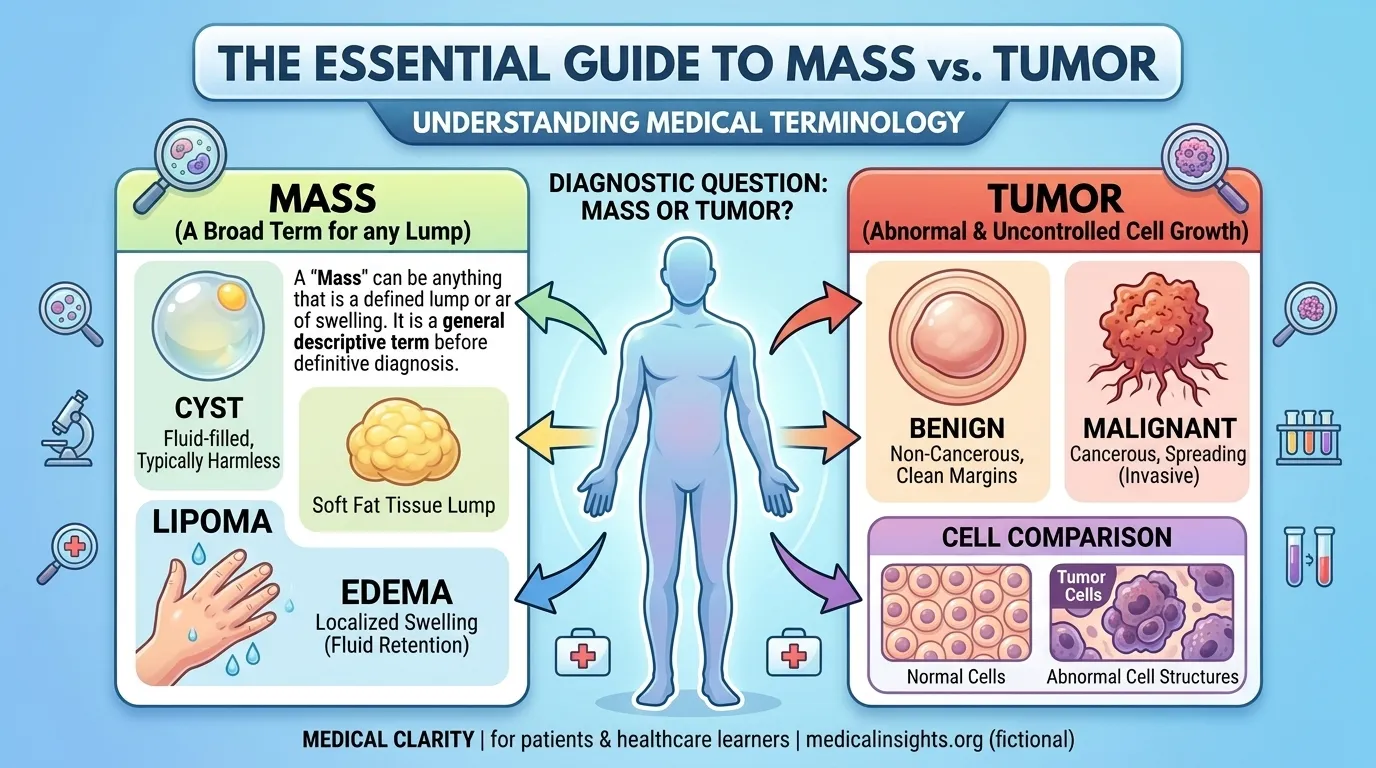
In simple words, a mass is any abnormal lump, growth, or area of tissue found in the body, while a tumor is a specific type of mass caused by abnormal cell growth. This is why doctors often investigate a mass further before determining whether it is a tumor.
If you are searching for the difference between mass and tumor, wondering what each term means, or trying to understand a medical report, this guide will explain everything clearly. You’ll learn definitions, symptoms, causes, diagnosis methods, similarities, differences, and real-life examples.
Quick Answer: Difference Between Mass and Tumor
A mass is a general medical term for any abnormal lump or growth detected in the body.
A tumor is a type of mass that develops because cells grow and divide abnormally.
Example: A fluid-filled cyst in the breast may be called a mass but is not necessarily a tumor. A growth made of abnormal cells may be classified as a tumor after testing.
Definition of Mass and Tumor
- Mass: An abnormal lump, swelling, or area of tissue that appears different from surrounding tissue. It may be caused by infection, inflammation, fluid buildup, cysts, or tumors.
- Tumor: A growth formed by abnormal cell multiplication. Tumors can be benign (non-cancerous) or malignant (cancerous).
Example: A breast cyst is a mass, while a benign lipoma is a tumor made of fatty tissue.
Pronunciation of Both Terms (US & UK)
| Term | US Pronunciation | UK Pronunciation |
|---|---|---|
| Mass | /mæs/ | /mæs/ |
| Tumor | /ˈtuːmər/ | /ˈtjuːmə/ |
Now that the definitions are clear, let’s explore the key differences in greater detail.
Mass vs Tumor Comparison Table
| Feature | Mass | Tumor |
|---|---|---|
| Definition | General term for an abnormal lump | Specific growth caused by abnormal cells |
| Cause | Many possible causes | Abnormal cell proliferation |
| Cancer Risk | May or may not be cancerous | May be benign or malignant |
| Composition | Fluid, tissue, inflammation, or cells | Primarily abnormal cells |
| Diagnosis | Initial finding | Confirmed after evaluation |
| Medical Usage | Broad descriptive term | More specific pathological term |
| Treatment | Depends on cause | Depends on tumor type |
| Examples | Cyst, abscess, swelling | Lipoma, adenoma, carcinoma |
Deep Explanation of the Comparison
| Comparison Point | Mass | Tumor |
|---|---|---|
| Discovery | Often found during scans or physical exams | Usually diagnosed after further investigation |
| Nature | Describes appearance | Describes biological behavior |
| Imaging Results | Appears as an abnormal area | Appears as a cellular growth |
| Growth Pattern | May remain unchanged | Often grows due to cell division |
| Medical Concern | Requires evaluation | Requires classification and monitoring |
| Tissue Structure | Can contain fluid, pus, fat, or tissue | Consists of proliferating cells |
| Diagnostic Testing | Ultrasound, CT, MRI | Imaging plus biopsy often needed |
| Classification | Not categorized as benign/malignant alone | Categorized as benign or malignant |
KEY DIFFERENCES EXPLAINED BETWEEN MASS AND TUMOR
1. Scope of the Term
A mass is a broader medical term. Tumor is a more specific diagnosis.
Example: Every tumor can be considered a mass, but not every mass is a tumor.
2. Underlying Cause
Masses may develop due to infections, cysts, inflammation, injuries, or tumors.
Tumors specifically arise from abnormal cell growth.
3. Cell Growth
Tumors involve uncontrolled or abnormal cell multiplication.
Some masses contain fluid or inflammatory tissue rather than excess cells.
4. Cancer Connection
Many people automatically associate tumors with cancer.
In reality, both masses and tumors can be non-cancerous.
5. Diagnostic Process
Doctors often identify a mass first through imaging.
Additional testing determines whether it is a tumor and whether it is benign or malignant.
6. Medical Reporting
Radiologists commonly use the term “mass” when describing imaging findings before a final diagnosis is known.
7. Treatment Approach
Treatment depends on the cause of the mass or the type of tumor.
Some require only monitoring, while others need surgery, medication, or cancer treatment.
What Is a Mass in Medical Terms?
A mass is simply an abnormal area that differs from surrounding tissue.
Doctors frequently use the term when interpreting:
- Ultrasound scans
- CT scans
- MRI scans
- Mammograms
- Physical examinations
A mass may be:
- A cyst filled with fluid
- An abscess containing infection
- Scar tissue
- Inflammation
- A benign growth
- A malignant growth
This broad definition explains why finding a mass does not automatically mean cancer.
What Is a Tumor and How Does It Develop?
A tumor develops when cells begin growing and dividing abnormally.
Normally, the body controls cell growth carefully. When this regulation fails, extra cells accumulate and form a tumor.
Tumors are generally classified into two categories:
Benign Tumors
Benign tumors:
- Do not spread to other organs
- Usually grow slowly
- Are often treatable through surgery
- Rarely become life-threatening
Examples include:
- Lipomas
- Fibromas
- Adenomas
Malignant Tumors
Malignant tumors:
- Are cancerous
- Can invade nearby tissues
- May spread through the bloodstream or lymphatic system
- Require prompt medical treatment
Examples include:
- Carcinoma
- Sarcoma
- Lymphoma
Why Do Doctors Use the Word “Mass” First?
Many users get confused when medical reports mention a “mass.”
Doctors intentionally use this neutral term because imaging alone cannot always determine the exact nature of a finding.
For example:
A mammogram may reveal a breast mass. Further testing such as ultrasound or biopsy determines whether it is:
- A cyst
- Fibrous tissue
- A benign tumor
- Breast cancer
This cautious approach helps avoid premature conclusions.
How Are Masses and Tumors Diagnosed?
Several diagnostic methods help identify the nature of a mass or tumor.
Physical Examination
Doctors evaluate:
- Size
- Shape
- Texture
- Mobility
Imaging Tests
Common imaging technologies include:
- X-rays
- Ultrasound
- MRI
- CT scans
- PET scans
Biopsy
A biopsy is often the most accurate method.
A tissue sample is examined under a microscope to determine:
- Cell type
- Growth pattern
- Cancer presence
Laboratory Testing
Blood tests may help identify markers associated with certain tumors.
Difference and Similarity Table Between Mass and Tumor
| Feature | Mass | Tumor | Similarity |
|---|---|---|---|
| Meaning | General abnormal lump | Abnormal cellular growth | Both describe abnormal findings |
| Medical Use | Descriptive term | Diagnostic term | Used in healthcare evaluation |
| Cause | Multiple causes possible | Cell overgrowth | Both require investigation |
| Cancer Potential | Not automatically cancerous | May be benign or malignant | Neither guarantees cancer |
| Detection | Found on exams or imaging | Found through imaging and pathology | Both can be detected medically |
| Treatment | Depends on underlying cause | Depends on tumor type | Treatment is individualized |
| Symptoms | Vary widely | Vary widely | Can produce similar symptoms |
| Monitoring | Sometimes enough | Often requires classification | Both may need follow-up care |
This table clearly shows the difference and similarity between mass and tumor for quick understanding.
Common Mistakes with Mass and Tumor
Mistake 1: Assuming Every Mass Is Cancer
Correction: Many masses are harmless cysts or inflammatory conditions.
Mistake 2: Thinking Tumor Always Means Cancer
Correction: Benign tumors are not cancerous.
Mistake 3: Using the Terms Interchangeably
Correction: A tumor is one type of mass, not the entire category.
Mistake 4: Ignoring Small Masses
Correction: Any new unexplained growth should be medically evaluated.
Mistake 5: Relying Only on Imaging
Correction: Biopsy often provides the definitive diagnosis.
Real-Life Examples with Mass and Tumor
Scenario 1: Breast Screening
A mammogram identifies a breast mass. Further ultrasound reveals a harmless cyst.
Scenario 2: Fatty Growth
A person notices a soft lump under the skin. It is diagnosed as a benign lipoma tumor.
Scenario 3: Thyroid Examination
An ultrasound discovers a thyroid mass requiring biopsy.
Scenario 4: Lung Scan
A CT scan reveals a lung mass that later proves to be a malignant tumor.
Scenario 5: Infection-Related Swelling
An abscess forms due to bacterial infection and appears as a mass but is not a tumor.
When to Use Each Term
Use “Mass” When:
- Referring to an unidentified lump
- Discussing imaging findings
- Describing a physical abnormality before diagnosis
Use “Tumor” When:
- Abnormal cell growth has been identified
- Pathology supports the diagnosis
- Discussing benign or malignant growths
Why People Get Confused About Mass and Tumor
Several factors contribute to confusion:
Medical Language
Healthcare professionals often use technical terminology that sounds similar.
Media Influence
Television shows and news reports frequently use “tumor” and “cancer” interchangeably.
Early Diagnostic Reports
Imaging reports commonly mention masses before a final diagnosis is available.
Fear of Cancer
Many people immediately associate any abnormal growth with cancer, even though numerous masses are benign.
Expert Insight
From a clinical perspective, the most important concept is that “mass” describes what doctors see, while “tumor” describes what doctors determine after evaluation.
In real scenarios, physicians often discover a mass first and then use imaging, laboratory studies, and biopsy results to identify whether the mass is a benign tumor, malignant tumor, cyst, infection, or another condition.
Most beginners focus only on whether a finding is cancerous. Medical specialists focus first on identifying the exact nature of the abnormality because treatment decisions depend entirely on the diagnosis.
Frequently Asked Questions (FAQs)
Is a mass always a tumor?
No. A mass can be a cyst, abscess, scar tissue, inflammation, or a tumor.
Can a tumor be harmless?
Yes. Benign tumors are non-cancerous and often pose little risk.
Is every tumor cancer?
No. Tumors may be benign or malignant.
Which is more serious, a mass or a tumor?
Neither term alone indicates severity. The underlying diagnosis determines seriousness.
Can imaging tell if a mass is cancerous?
Imaging can provide clues, but a biopsy is often needed for confirmation.
What causes masses in the body?
Possible causes include infection, inflammation, cysts, injury, and abnormal tissue growth.
Can a benign tumor become malignant?
Some types can, but many benign tumors never become cancerous.
Why do radiology reports use the word mass?
Because imaging findings are often preliminary and require further evaluation.
Is a cyst considered a mass?
Yes. A cyst is commonly classified as a mass because it forms an abnormal lump.
When should I see a doctor about a mass?
Any new, growing, painful, or unexplained lump should be evaluated by a healthcare professional.
Conclusion
Understanding the difference between mass and tumor can help reduce confusion and unnecessary fear. A mass is a broad medical term describing any abnormal lump, swelling, or growth found in the body. A tumor, on the other hand, is a specific type of mass caused by abnormal cell growth.
The key point is simple: all tumors are masses, but not all masses are tumors. Some masses result from cysts, infections, inflammation, or other non-cancerous conditions. Because imaging alone cannot always determine the cause, doctors often use the term “mass” first and then perform additional tests such as ultrasound, MRI, CT scans, or biopsy to reach a final diagnosis.

I am content creator and comparison blogger focused on analyzing key differences between terms, concepts, and ideas to deliver accurate, easy-to-understand information. So I decided to create a platform where these differences are explained in the simplest way possible.