A few months ago, Ali and his colleague Sara both lost their jobs but under very different circumstances. Ali was told his company was downsizing due to financial pressure, while Sara was dismissed for repeated policy violations. Although both situations resulted in unemployment, the reasons and implications were not the same. This real-life scenario highlights the importance of understanding the difference between layoff and termination.
The terms layoff vs termination are often used interchangeably, but they carry distinct meanings in professional and legal contexts. Knowing the difference between layoff and termination helps employees protect their rights and enables employers to communicate decisions clearly. Whether you’re a job seeker or an HR professional, understanding layoff vs termination can shape your career decisions and workplace awareness.
In today’s evolving job market, the conversation around both is more relevant than ever, making it essential to fully understand the difference between layoff and termination.
Key Difference Between Layoff and Termination
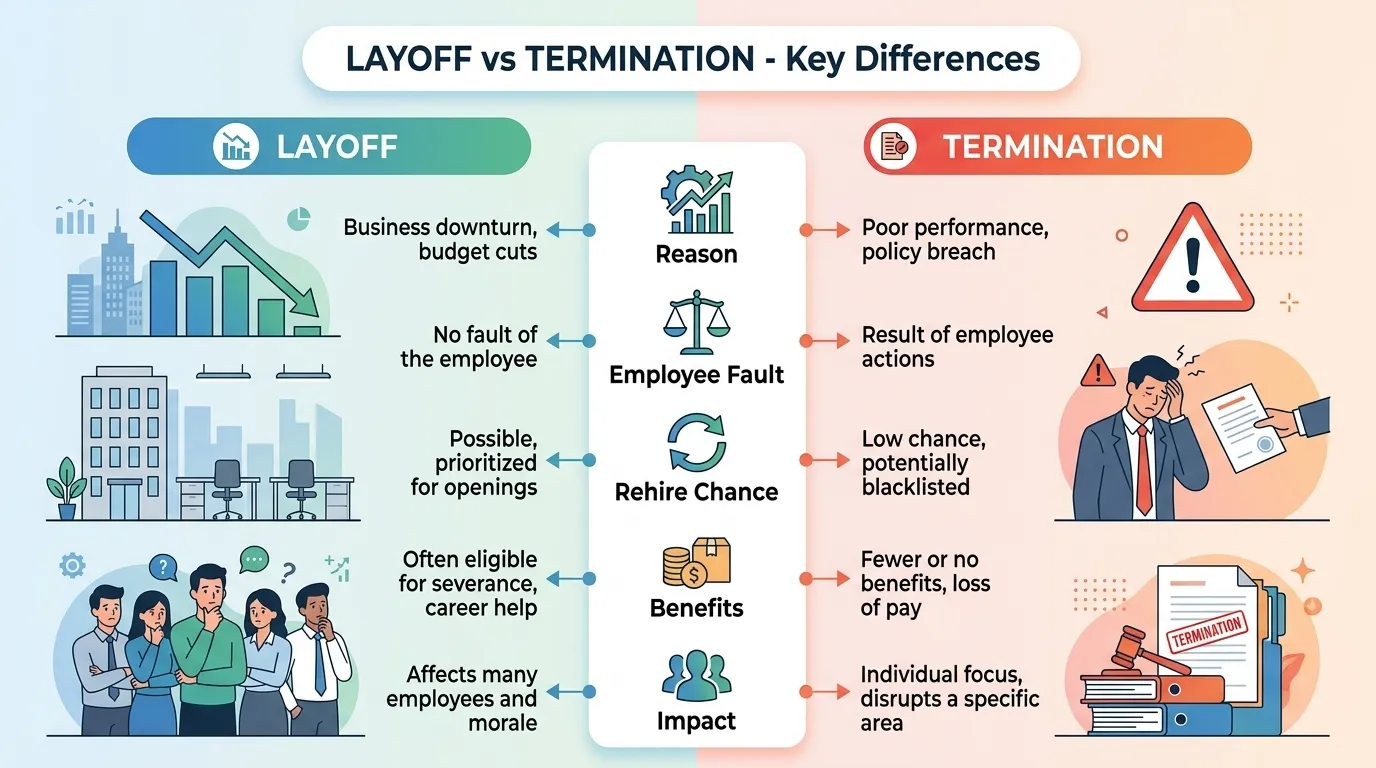
The primary difference between a layoff and a termination lies in the reason behind the job loss. A layoff usually occurs due to external factors like economic downturns, restructuring, or lack of work, while termination happens because of employee-related issues such as poor performance or misconduct.
Why Is This Difference Important to Know?
Understanding the difference between layoff and termination is crucial for both learners and professionals. For employees, it determines eligibility for benefits like unemployment compensation, severance packages, and future job opportunities. For employers, it ensures legal compliance and helps maintain organizational transparency.
In society, this distinction prevents misunderstandings and stigma. A layoff often carries no fault on the employee’s part, while termination may impact reputation. Recognizing this difference helps promote fairness, empathy, and better communication in workplaces.
Pronunciation (US & UK)
- Layoff
- US: /ˈleɪˌɔːf/
- UK: /ˈleɪ.ɒf/
- Termination
- US: /ˌtɝː.məˈneɪ.ʃən/
- UK: /ˌtɜː.mɪˈneɪ.ʃən/
Understanding how to pronounce these terms correctly sets the stage for deeper clarity—so now, let’s explore their differences in detail.
Difference Between the Layoff and Termination
1. Reason for Job Loss
- Layoff: Due to business reasons like downsizing
- Example 1: Company cuts staff due to recession
- Example 2: Seasonal business closes temporarily
- Termination: Due to employee performance or behavior
- Example 1: Employee violates company policy
- Example 2: Consistent poor performance
2. Employee Fault
- Layoff: Not the employee’s fault
- Example 1: Budget cuts affect entire department
- Example 2: Automation replaces roles
- Termination: Usually employee’s fault
- Example 1: Repeated tardiness
- Example 2: Workplace misconduct
3. Rehire Possibility
- Layoff: High chance of rehire
- Example 1: Called back after business improves
- Example 2: Temporary layoffs during off-season
- Termination: Low chance of rehire
- Example 1: Fired for dishonesty
- Example 2: Terminated for violating rules
4. Notice Period
- Layoff: May include notice or severance
- Example 1: 2-week notice before layoff
- Example 2: Compensation offered
- Termination: May be immediate
- Example 1: Instant dismissal
- Example 2: Fired without warning
5. Impact on Resume
- Layoff: Neutral or acceptable
- Example 1: “Laid off due to downsizing”
- Example 2: Industry-wide layoffs
- Termination: Potentially negative
- Example 1: Fired for poor performance
- Example 2: Dismissed for misconduct
6. Legal Implications
- Layoff: Usually legally safe
- Example 1: Economic layoffs
- Example 2: Organizational restructuring
- Termination: May involve disputes
- Example 1: Wrongful termination claims
- Example 2: Legal action by employee
7. Benefits Eligibility
- Layoff: Often eligible for benefits
- Example 1: Unemployment benefits
- Example 2: Severance packages
- Termination: May not qualify
- Example 1: Fired for misconduct
- Example 2: Violation of company rules
8. Emotional Impact
- Layoff: Less personal
- Example 1: Group layoffs
- Example 2: External reasons
- Termination: More personal
- Example 1: Individual performance issue
- Example 2: Conflict with management
9. Company Perspective
- Layoff: Cost-saving strategy
- Example 1: Reduce expenses
- Example 2: Improve efficiency
- Termination: Discipline measure
- Example 1: Maintain standards
- Example 2: Enforce policies
10. Duration
- Layoff: Temporary or permanent
- Example 1: Temporary shutdown
- Example 2: Seasonal layoffs
- Termination: Permanent
- Example 1: Fired employee replaced
- Example 2: No return to position
Nature and Behaviour of Both
A layoff is impersonal and often strategic, reflecting the organization’s financial health or structural changes. It is usually handled with formal communication and sometimes compassion.
A termination, on the other hand, is personal and performance-driven. It reflects an issue between the employee and employer, often involving warnings, evaluations, and final decisions.
Why People Are Confused About Their Use?
People often confuse these terms because both result in job loss. Additionally, companies sometimes use softer language like “let go” to avoid harshness, blurring the distinction.
Comparison Table
| Aspect | Layoff | Termination | Similarity |
| Reason | Business-related | Employee-related | Both end employment |
| Fault | Not employee’s fault | Often employee’s fault | Job loss outcome |
| Rehire | Possible | Rare | Affects career |
| Benefits | Usually eligible | May not be | Financial impact |
| Emotional Impact | Less personal | More personal | Stressful situation |
Which Is Better in What Situation?
A layoff is generally better when job loss is unavoidable due to economic or organizational changes. It protects the employee’s reputation and often comes with benefits. Employees can explain layoffs easily in future interviews without negative consequences.
Termination may be necessary when an employee violates company rules or fails to meet expectations. While it is not favorable for the employee, it helps organizations maintain discipline and performance standards. In some cases, termination is essential for workplace safety and productivity.
Use in Metaphors and Similes
- Layoff: “The company trimmed its branches like a tree in winter.”
- Termination: “He was cut off like a broken wire.”
Connotative Meaning
- Layoff: Neutral to slightly negative
- Example: “She was laid off due to budget cuts.”
- Termination: Negative
- Example: “He was terminated for misconduct.”
Idioms and Proverbs
- “Cut loose” (similar to layoff)
- Example: The company cut loose several workers.
- “Give someone the boot” (termination)
- Example: He was given the boot after repeated warnings.
Works in Literature
- Death of a Salesman (Play, Arthur Miller, 1949) – themes of job loss
- The Grapes of Wrath (Novel, John Steinbeck, 1939) – layoffs during economic crisis
Movies Related to the Both
- Up in the Air (2009, USA) – focuses on layoffs
- Office Space (1999, USA) – workplace terminations and layoffs
- The Company Men (2010, USA) – corporate layoffs
FAQs
1. Is layoff the same as termination?
No, layoffs are business-driven, while termination is performance-related.
2. Can a laid-off employee return?
Yes, layoffs often allow rehiring when conditions improve.
3. Does termination always mean misconduct?
Not always, but it usually involves performance or behavioral issues.
4. Which is worse: layoff or termination?
Termination is generally worse due to its negative impact on reputation.
5. Do both affect future jobs?
Yes, but layoffs are easier to explain than termination.
How Both Are Useful for Surroundings
Both concepts help maintain workplace balance. Layoffs allow companies to survive financial crises, while terminations ensure discipline and productivity. Together, they shape a fair and efficient work environment.
Final Words for Both
Understanding layoff vs termination is essential in today’s professional world. It helps individuals respond wisely to career challenges and prepares them for real-world job scenarios.
Conclusion
In summary, the difference between layoff and termination lies in intent, cause, and impact. While layoffs are driven by external business factors and often temporary, terminations are usually permanent and based on employee performance or behavior. Recognizing these differences empowers individuals to better navigate their careers and workplace dynamics. Whether you are an employee or employer, understanding layoff vs termination ensures clearer communication, fair decisions, and informed career planning.

I am content creator and comparison blogger focused on analyzing key differences between terms, concepts, and ideas to deliver accurate, easy-to-understand information. So I decided to create a platform where these differences are explained in the simplest way possible.