In the professional world, contracts are the backbone of successful business relationships. Imagine a company hiring a software development firm to build a custom app. Before any coding begins, both parties must clearly define expectations, responsibilities, and deliverables. This is where terms like MSA (Master Service Agreement) and SOW (Statement of Work) come into play. Understanding the difference between MSA and SOW is essential for avoiding confusion and ensuring smooth collaboration.
When businesses discuss msa vs sow, they are essentially comparing a broad, overarching agreement with a detailed, task-specific document. In real-world scenarios, companies often use both together.
The difference between msa and sow becomes clear when you see how one sets the rules while the other defines the work. If you’re navigating contracts, knowing both can save time, reduce risk, and improve clarity in any project.
Key Difference Between the Both
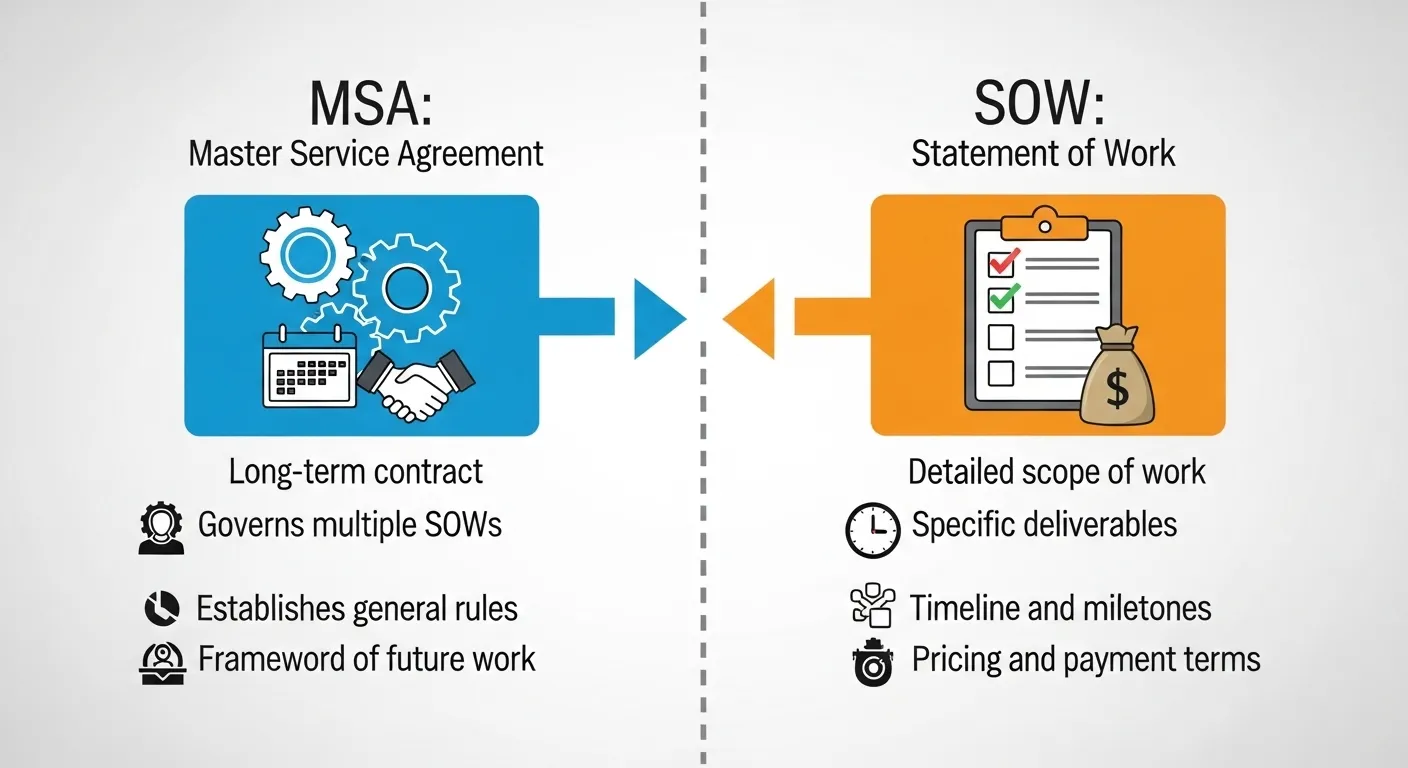
The primary difference between MSA and SOW lies in their purpose:
- MSA (Master Service Agreement): A general contract that outlines the overall terms and conditions governing a long-term business relationship.
- SOW (Statement of Work): A detailed document that specifies the scope, tasks, timelines, and deliverables for a specific project.
Why Is Their Difference Important for Learners and Experts?
Understanding the difference between msa and sow is crucial for both beginners and professionals.
For learners, it builds a strong foundation in contract management. It helps them understand how businesses operate legally and structurally. Without this knowledge, misinterpretations can lead to costly mistakes.
For experts, especially project managers, lawyers, and business owners, the distinction ensures clarity in execution. It prevents disputes by clearly defining expectations. In society, where business transactions are increasing daily, knowing msa vs sow helps maintain trust, transparency, and efficiency in professional relationships.
Pronunciation of Both (US & UK)
- MSA
- US: /ˌɛm ˌɛs ˈeɪ/
- UK: /ˌɛm ˌɛs ˈeɪ/
- SOW
- US: /saʊ/ (like “now”)
- UK: /saʊ/
Now that you know how to pronounce them, let’s move deeper into understanding their practical differences.
Difference Between MSA and SOW
1. Purpose
- MSA: Defines general terms of the relationship.
Example 1: A company signs an MSA with a vendor for future projects.
Example 2: It includes payment terms and legal clauses. - SOW: Defines specific project details.
Example 1: A SOW outlines a website redesign project.
Example 2: It lists deadlines and deliverables.
2. Scope
- MSA: Broad and general.
Example 1: Covers all future collaborations.
Example 2: Applies to multiple projects. - SOW: Narrow and specific.
Example 1: Focuses on one project only.
Example 2: Details one service task.
3. Usage Timing
- MSA: Signed before any work begins.
Example 1: Used at the start of a partnership.
Example 2: Sets long-term rules. - SOW: Created after MSA for each project.
Example 1: Used when a new project starts.
Example 2: Updated per task.
4. Flexibility
- MSA: Less frequently changed.
Example 1: Remains constant over years.
Example 2: Covers multiple deals. - SOW: Easily modified.
Example 1: Adjusted for new requirements.
Example 2: Updated with project scope.
5. Detail Level
- MSA: High-level overview.
Example 1: Includes legal terms.
Example 2: Defines dispute resolution. - SOW: Highly detailed.
Example 1: Includes tasks and milestones.
Example 2: Lists deliverables.
6. Legal Role
- MSA: Legal foundation.
Example 1: Governs relationship.
Example 2: Defines liabilities. - SOW: Operational guide.
Example 1: Defines what work will be done.
Example 2: Specifies outcomes.
7. Duration
- MSA: Long-term.
Example 1: Lasts several years.
Example 2: Covers ongoing work. - SOW: Short-term.
Example 1: Ends after project completion.
Example 2: Temporary agreement.
8. Reusability
- MSA: Reusable.
Example 1: Used for multiple SOWs.
Example 2: One MSA supports many projects. - SOW: Not reusable.
Example 1: Specific to one job.
Example 2: Needs rewriting for new tasks.
9. Content
- MSA: Terms, conditions, policies.
Example 1: Confidentiality clauses.
Example 2: Payment structures. - SOW: Tasks, timelines, deliverables.
Example 1: Work schedule.
Example 2: Project milestones.
10. Dependency
- MSA: Independent agreement.
Example 1: Exists without SOW.
Example 2: Base contract. - SOW: Depends on MSA.
Example 1: References MSA terms.
Example 2: Cannot stand alone effectively.
Nature and Behaviour of Both
- MSA: Formal, structured, and stable. It behaves as a legal backbone for business relationships.
- SOW: Dynamic, flexible, and task-oriented. It adapts to project needs and changes frequently.
Why Are People Confused About Their Use?
Many people confuse MSA and SOW because both are contractual documents and often used together. Their overlapping nature creates misunderstanding.
Comparison Table
| Aspect | MSA | SOW | Similarity |
| Purpose | General terms | Specific tasks | Both define agreements |
| Scope | Broad | Narrow | Used in business contracts |
| Duration | Long-term | Short-term | Legally binding |
| Detail Level | General | Detailed | Part of same framework |
| Usage | One-time | Multiple times | Used together |
Which Is Better in What Situation?
An MSA is better when establishing a long-term relationship between two parties. It simplifies future agreements because terms are already set. Businesses working on multiple projects benefit from it as it saves time and ensures consistency.
A SOW is better when defining a specific project. It provides clarity, prevents misunderstandings, and ensures everyone knows their responsibilities. For short-term or one-time projects, a SOW is essential.
Use in Metaphors and Similes
- MSA as a “foundation” – Like a building’s base, it supports everything.
- SOW as a “blueprint” – It shows exactly what will be built.
Example:
“The MSA was the foundation, and the SOW was the blueprint guiding the project.”
Connotative Meaning
- MSA: Neutral to positive (stability, trust)
Example: “The MSA ensured a secure partnership.” - SOW: Neutral (clarity, precision)
Example: “The SOW clarified every project detail.”
Idioms or Proverbs Related
- “Lay the groundwork” (MSA)
Example: “The company laid the groundwork with a solid MSA.” - “Get down to business” (SOW)
Example: “After signing the MSA, they got down to business with a SOW.”
Works in Literature
- Contract Law Basics (Non-fiction, various authors, ongoing)
- Business Agreements Guide (Non-fiction, 2018)
- Legal Frameworks in Commerce (Academic, 2020)
Movie Names (Related Themes)
- The Social Network (2010, USA)
- Moneyball (2011, USA)
- The Big Short (2015, USA)
FAQs
1. What is the main difference between both?
MSA defines general terms, while SOW outlines specific project details.
2. Can a SOW exist without an MSA?
Yes, but it is less effective and may lack legal clarity.
3. Why are both used together?
They provide both legal structure and project clarity.
4. Is MSA legally binding?
Yes, it is a formal legal agreement.
5. How often is a SOW updated?
It is updated for each new project or task.
How Both Are Useful for Surroundings
MSA ensures stable business relationships, promoting trust in professional environments. SOW ensures clarity in project execution, reducing conflicts. Together, they improve efficiency and accountability in organizations.
Final Words for Both
MSA and SOW are not competitors but partners. While one builds the legal framework, the other brings projects to life. Understanding msa vs sow ensures smoother workflows and stronger business relationships.
Conclusion
The difference between msa and sow is essential for anyone involved in business or project management. MSA provides the legal structure, while SOW delivers the operational clarity needed for successful execution. Together, they create a complete system that ensures efficiency, transparency, and accountability. Whether you are a beginner or an expert, understanding msa vs sow will help you navigate contracts with confidence and avoid unnecessary complications in professional dealings.

I am content creator and comparison blogger focused on analyzing key differences between terms, concepts, and ideas to deliver accurate, easy-to-understand information. So I decided to create a platform where these differences are explained in the simplest way possible.