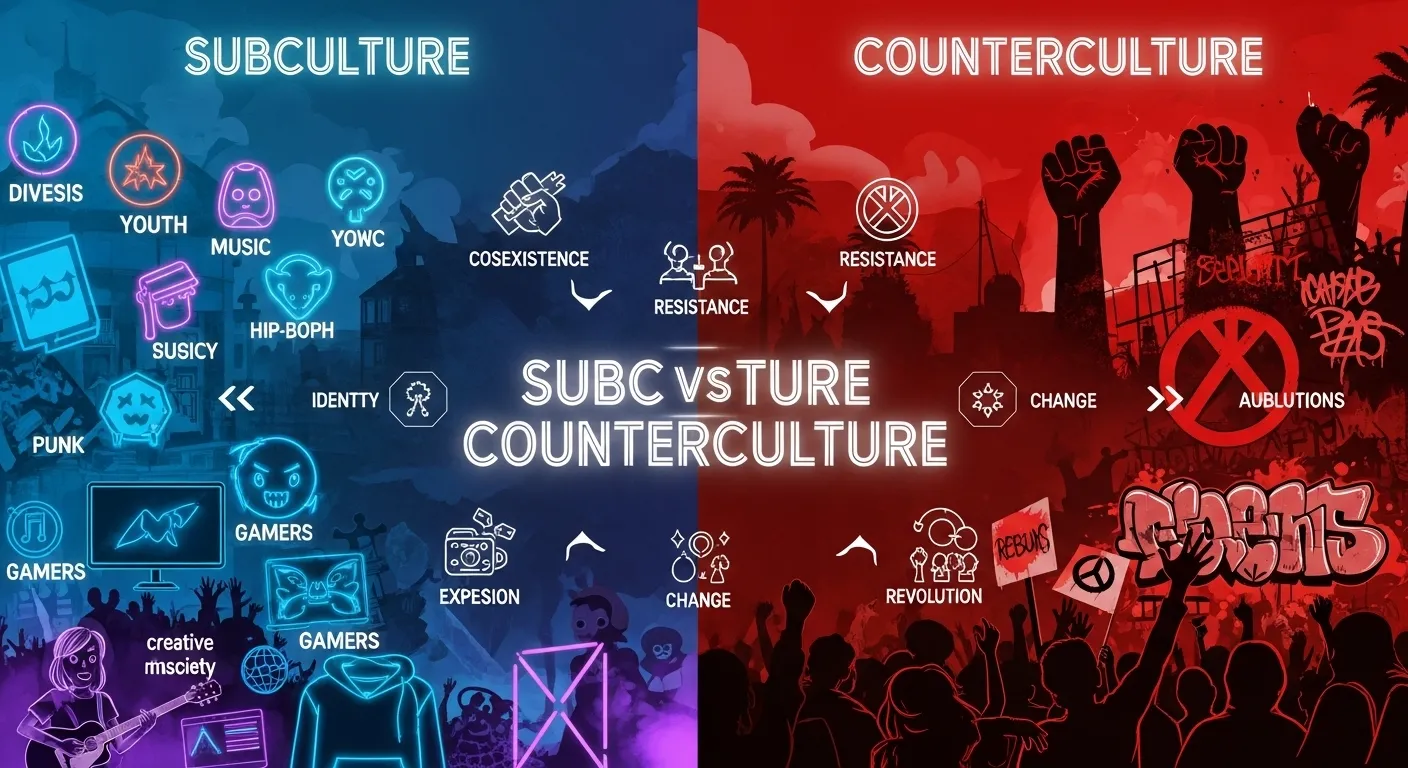
On a busy city street, you might notice a group of teenagers dressed in gothic fashion, listening to alternative music and expressing a unique identity. Just around the corner, another group protests against societal norms, demanding radical change. These two scenes perfectly capture the essence of difference between subculture and counterculture. While both involve groups that differ from mainstream society, their intentions and impact are very different.
Understanding subculture vs counterculture helps us see how people express identity and challenge norms in society. A subculture creates its own space within the larger culture, while a counterculture actively resists and seeks to change it.
In discussions of subculture vs counterculture, it becomes clear that one coexists peacefully, while the other often challenges authority. Exploring difference between both not only deepens cultural awareness but also helps learners and experts interpret social behavior more effectively.
Key Difference Between the Both
The main difference lies in their relationship with mainstream culture. A subculture exists within society and develops its own identity without opposing the dominant culture. A counterculture, however, actively rejects and challenges mainstream beliefs, often seeking change or revolution.
Why Is Their Difference Necessary to Know?
Understanding the distinction is essential for both learners and experts because it helps decode social dynamics and cultural evolution. Subcultures contribute to diversity, creativity, and innovation without disrupting societal stability. Countercultures, on the other hand, play a crucial role in social reform, questioning outdated norms and inspiring progress.
In fields like sociology, media studies, and anthropology, recognizing subculture vs counterculture helps analyze trends, movements, and public behavior. It also enables policymakers and educators to respond effectively to social changes and cultural expressions.
Pronunciation of Both (US & UK)
- Subculture
- US: /ˈsʌbˌkʌltʃər/
- UK: /ˈsʌbˌkʌltʃə/
- Counterculture
- US: /ˈkaʊntərˌkʌltʃər/
- UK: /ˈkaʊntəˌkʌltʃə/
Now that you know how to say them correctly, let’s explore their differences in depth.
Difference between Subculture and Counterculture
1. Definition
- Subculture: A group within a larger culture with distinct values or practices.
- Example 1: Skateboarders forming a lifestyle community.
- Example 2: Gamers sharing common interests online.
- Counterculture: A group that opposes and seeks to change mainstream culture.
- Example 1: Protest movements against government policies.
- Example 2: Activists rejecting consumerism.
2. Relationship with Society
- Subculture: Coexists peacefully.
- Example 1: Hip-hop communities expressing music and fashion.
- Example 2: Anime fans creating conventions.
- Counterculture: Challenges and resists norms.
- Example 1: Anti-war protests.
- Example 2: Environmental activism movements.
3. Purpose
- Subculture: Identity and belonging.
- Example 1: Punk fashion as self-expression.
- Example 2: Book clubs forming intellectual communities.
- Counterculture: Social change.
- Example 1: Feminist movements demanding equality.
- Example 2: Civil rights activism.
4. Acceptance
- Subculture: Often tolerated or accepted.
- Example 1: Cosplay communities.
- Example 2: Fitness enthusiasts.
- Counterculture: Often controversial.
- Example 1: Radical protests.
- Example 2: Anti-establishment groups.
5. Impact
- Subculture: Influences trends.
- Example 1: Streetwear fashion becoming mainstream.
- Example 2: Gaming culture shaping entertainment.
- Counterculture: Drives change.
- Example 1: Ending wars through protests.
- Example 2: Legal reforms from activism.
6. Stability
- Subculture: Stable and long-lasting.
- Example 1: Religious communities.
- Example 2: Musical fan groups.
- Counterculture: Often temporary but powerful.
- Example 1: 1960s protests.
- Example 2: Revolutionary movements.
7. Behavior
- Subculture: Expressive but non-disruptive.
- Example 1: Art communities.
- Example 2: Food culture groups.
- Counterculture: Disruptive and bold.
- Example 1: Civil disobedience.
- Example 2: Public demonstrations.
8. Goals
- Subculture: Personal expression.
- Example 1: Tattoo culture.
- Counterculture: Collective reform.
- Example 1: Political revolutions.
- Example 2: Social justice campaigns.
9. Size
- Subculture: Can be small or large.
- Example 1: Online niche communities.
- Example 2: Global fandoms.
- Counterculture: Often large movements.
- Example 1: Mass protests.
- Example 2: National activism groups.
10. Cultural Role
- Subculture: Adds diversity.
- Example 1: Music genres.
- Example 2: Lifestyle choices.
- Counterculture: Challenges authority.
- Example 1: Anti-government protests.
- Example 2: Reform movements.
Nature and Behaviour of Both
Subcultures are generally creative, expressive, and community-focused. They emphasize belonging and shared identity without disrupting the larger system.
Countercultures are bold, revolutionary, and often confrontational. Their behavior is driven by dissatisfaction with societal norms and a desire to bring change.
Why People Are Confused About Their Use?
| Aspect | Subculture | Counterculture | Similarity |
| Definition | Exists within culture | Opposes culture | Both are groups |
| Purpose | Identity | Change | Both express ideas |
| Behavior | Peaceful | Challenging | Both differ from mainstream |
| Impact | Influences trends | Creates change | Both affect society |
Which Is Better in What Situation?
Subcultures are better in situations where individuals seek identity, creativity, and belonging without conflict. They allow people to express themselves freely while maintaining harmony within society.
Countercultures are better when change is necessary. When societal norms are unjust or outdated, countercultures challenge them and push for reform, making them essential for progress.
Use in Metaphors and Similes
- Subculture: “A subculture is like a colorful thread in a large fabric.”
- Counterculture: “A counterculture is like a storm shaking the system.”
Connotative Meaning
- Subculture: Neutral to positive
- Example: A creative youth subculture.
- Counterculture: Can be positive or negative
- Example (positive): A movement for equality.
- Example (negative): Radical opposition causing unrest.
Idioms or Proverbs Related
- “Go against the grain” (counterculture)
- Example: They went against the grain to demand justice.
- “March to the beat of your own drum” (subculture)
- Example: Artists in subcultures march to their own beat.
Works in Literature
- On the Road – Novel, Jack Kerouac, 1957
- The Catcher in the Rye – Novel, J. D. Salinger, 1951
- 1984 – Dystopian fiction, George Orwell, 1949
Movies Based on the Both
- Easy Rider (1969, USA)
- The Matrix (1999, USA)
- Fight Club (1999, USA)
FAQs
1. What is the main difference between subculture and counterculture?
Subculture coexists within society, while counterculture challenges it.
2. Can a subculture become a counterculture?
Yes, if it starts opposing mainstream values.
3. Are countercultures always negative?
No, they often lead to positive social change.
4. Do subcultures influence mainstream culture?
Yes, many trends originate from subcultures.
5. Why is understanding them important?
It helps analyze social behavior and cultural shifts.
How Both Are Useful for Surroundings
Subcultures enrich society by adding diversity, creativity, and innovation. Countercultures push society forward by questioning norms and inspiring reforms. Together, they create a balance between stability and change.
Final Words for the Both
Subculture and counterculture are two sides of cultural expression. One builds identity within society, while the other challenges it for improvement.
Conclusion
In conclusion, understanding subculture vs counterculture provides valuable insight into how societies function and evolve. Subcultures allow individuals to express identity and creativity without disrupting social harmony, while countercultures challenge existing systems and drive meaningful change. Both play essential roles in shaping culture, influencing trends, and inspiring progress. By recognizing their differences and similarities, learners and experts can better interpret human behavior and societal transformations. Ultimately, the balance between subculture and counterculture ensures a dynamic and evolving cultural landscape.

My name is Ryan Mitchell, and I am a comparison content writer based in the United States. I specialize in creating clear and easy-to-understand articles that explain the differences between similar concepts, products, and ideas. My work focuses on helping readers quickly understand what makes two things different so they can make better decisions.