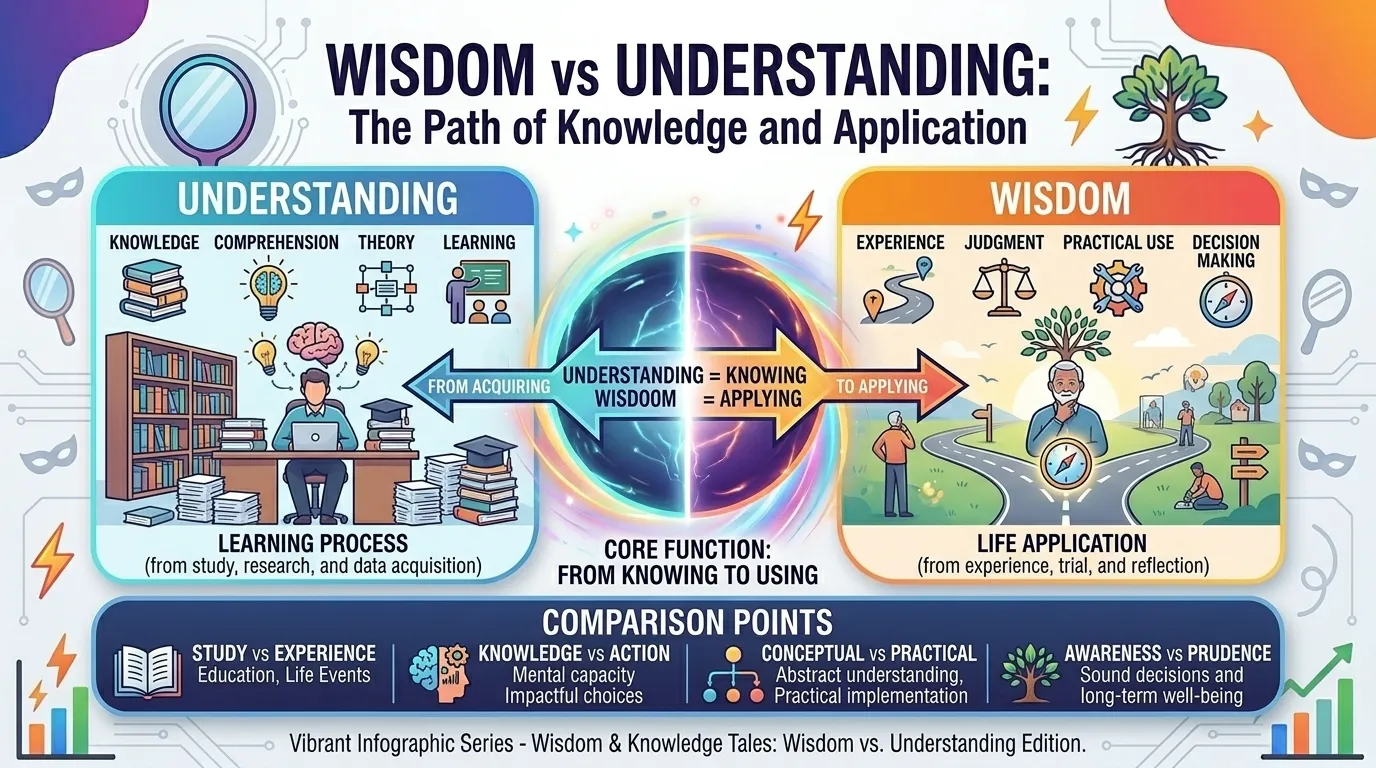
Imagine a young professional who reads dozens of books about success but still struggles to make the right decisions in life. One day, they meet a mentor who doesn’t just explain theories but helps them apply those ideas practically. This simple encounter reveals the true difference between wisdom and understanding. While understanding is about knowing facts, wisdom is about using that knowledge effectively in real-life situations.
The concept of wisdom vs understanding often confuses people because both seem closely related. However, understanding is the foundation, while wisdom is the application. In everyday life, we constantly face situations where we must choose between simply knowing something and acting wisely upon it.
Exploring the difference between them helps us grow intellectually and emotionally. Whether in personal decisions, relationships, or professional life, mastering the balance between the two can lead to a more meaningful and successful life.
Key Difference Between Wisdom and Understanding
The primary difference lies in their function. Understanding is the ability to comprehend information, concepts, or situations, while wisdom is the ability to apply that understanding effectively with good judgment.
Why Is Their Difference Important for Learners and Experts?
Understanding the difference between wisdom and understanding is essential for both learners and experts because it shapes how knowledge is used in society. Learners often focus on gathering information, but without wisdom, that knowledge may remain unused or misapplied.
Experts, on the other hand, are expected not only to understand complex ideas but also to make sound decisions based on them. In society, wise individuals contribute to better leadership, ethical decisions, and problem-solving.
Recognizing wisdom vs understanding helps individuals become more balanced thinkers. It encourages not only intellectual growth but also emotional intelligence, which is crucial for building relationships and contributing positively to the community.
Pronunciation of Both (US & UK)
Before diving deeper, let’s understand how these words are pronounced:
- Wisdom
- US: /ˈwɪz.dəm/
- UK: /ˈwɪz.dəm/
- Understanding
- US: /ˌʌn.dərˈstæn.dɪŋ/
- UK: /ˌʌn.dəˈstæn.dɪŋ/
Now that you know how to say them correctly, let’s explore their deeper meanings and differences.
Difference Between the Wisdom and Understanding
1. Definition
- Wisdom: The ability to make sound judgments.
- Example 1: A leader choosing peace over conflict shows wisdom.
- Example 2: Saving money for the future is wise decision-making.
- Understanding: The ability to grasp meaning or knowledge.
- Example 1: Understanding a math formula helps solve problems.
- Example 2: Knowing why something happens shows understanding.
2. Nature
- Wisdom: Practical and experience-based.
- Example 1: A farmer predicting weather from experience.
- Example 2: A parent guiding a child through life choices.
- Understanding: Theoretical and knowledge-based.
- Example 1: Learning science concepts in school.
- Example 2: Reading about history events.
3. Source
- Wisdom: Comes from life experience.
- Example 1: Learning from past mistakes.
- Example 2: Observing others’ successes and failures.
- Understanding: Comes from study and learning.
- Example 1: Studying books.
- Example 2: Listening to lectures.
4. Application
- Wisdom: Applied in real-life decisions.
- Example 1: Choosing the right career path.
- Example 2: Handling conflicts calmly.
- Understanding: May or may not be applied.
- Example 1: Knowing rules but not following them.
- Example 2: Understanding health advice but ignoring it.
5. Depth
- Wisdom: Deep and insightful.
- Example 1: Seeing long-term consequences.
- Example 2: Making ethical choices.
- Understanding: Surface-level or deep depending on learning.
- Example 1: Basic understanding of a topic.
- Example 2: Advanced academic knowledge.
6. Emotional Connection
- Wisdom: Involves emotional intelligence.
- Example 1: Comforting someone in distress.
- Example 2: Showing patience in difficult situations.
- Understanding: Mostly intellectual.
- Example 1: Knowing someone is sad.
- Example 2: Recognizing emotional cues.
7. Decision-Making
- Wisdom: Leads to good decisions.
- Example 1: Avoiding risky investments.
- Example 2: Choosing honesty over lies.
- Understanding: Provides information for decisions.
- Example 1: Analyzing pros and cons.
- Example 2: Studying possible outcomes.
8. Time Factor
- Wisdom: Develops slowly over time.
- Example 1: Gained through years of experience.
- Example 2: Built through life lessons.
- Understanding: Can be gained quickly.
- Example 1: Learning a concept in minutes.
- Example 2: Watching an educational video.
9. Role in Life
- Wisdom: Guides life choices.
- Example 1: Maintaining work-life balance.
- Example 2: Building strong relationships.
- Understanding: Supports learning and growth.
- Example 1: Gaining knowledge in school.
- Example 2: Improving skills.
10. Outcome
- Wisdom: Leads to success and fulfillment.
- Example 1: Living a balanced life.
- Example 2: Making meaningful contributions.
- Understanding: Leads to awareness.
- Example 1: Knowing facts about the world.
- Example 2: Being informed about issues.
Nature and Behaviour of Both
Wisdom behaves like a guiding force. It is calm, patient, and thoughtful. Wise people often think before acting and consider long-term consequences.
Understanding, on the other hand, behaves like a tool. It processes information and helps in analyzing situations. However, it does not guarantee wise actions unless combined with judgment.
Why People Are Confused About Their Use?
| Aspect | Wisdom | Understanding | Similarity |
|---|---|---|---|
| Meaning | Practical judgment | Knowledge comprehension | Both involve knowledge |
| Source | Experience | Learning | Both develop over time |
| Use | Decision-making | Analysis | Used in thinking |
| Nature | Emotional + practical | Intellectual | Both involve the brain |
| Outcome | Better actions | Better knowledge | Both improve life |
People confuse them because both are connected to knowledge and thinking, but their roles differ significantly.
Which Is Better in What Situation?
Wisdom is better in real-life decision-making situations. When facing moral dilemmas, personal challenges, or leadership roles, wisdom helps you choose the best path. It considers emotions, consequences, and long-term effects, making it essential for practical life.
Understanding is better in learning and academic situations. It helps in gaining knowledge, analyzing problems, and building a strong intellectual foundation. Without understanding, wisdom cannot develop, making both equally important in different contexts.
Use in Metaphors and Similes
- Wisdom
- “Wisdom is like a guiding light in the darkness.”
- “He is as wise as an old owl.”
- Understanding
- “Understanding is like a bridge connecting ideas.”
- “Her understanding is as deep as the ocean.”
Connotative Meaning of Both
- Wisdom
- Positive: Associated with maturity and good judgment.
- Example: “Her wisdom helped solve the problem.”
- Neutral: Used generally without strong emotion.
- Example: “Wisdom comes with age.”
- Positive: Associated with maturity and good judgment.
- Understanding
- Positive: Associated with knowledge and empathy.
- Example: “He showed great understanding.”
- Neutral: Used in general context.
- Example: “Understanding the rules is important.”
- Positive: Associated with knowledge and empathy.
Idioms or Proverbs Related to the Words
- “Wisdom comes with age.”
- Example: My grandfather proves that wisdom comes with age.
- “Knowledge is power.”
- Example: Understanding facts shows that knowledge is power.
- “A wise man learns from others’ mistakes.”
- Example: She followed this proverb and avoided failure.
Works in Literature
- Wisdom
- Meditations – Philosophy – Marcus Aurelius – 180 AD
- The Wisdom of Solomon – Religious – Unknown – Ancient
- Understanding
- An Essay Concerning Human Understanding – Philosophy – John Locke – 1689
- Thinking, Fast and Slow – Psychology – Daniel Kahneman – 2011
Movies Based on These Concepts
- Wisdom
- The Pursuit of Happyness – 2006 – USA
- Life of Pi – 2012 – USA/India
- Understanding
- A Beautiful Mind – 2001 – USA
- Good Will Hunting – 1997 – USA
Frequently Asked Questions
1. What is the main difference between wisdom and understanding?
Wisdom is the ability to apply knowledge, while understanding is the ability to comprehend it.
2. Can someone have understanding without wisdom?
Yes, a person can understand concepts but still make poor decisions without wisdom.
3. Is wisdom more important than understanding?
Both are important; understanding builds knowledge, and wisdom applies it effectively.
4. How can we develop wisdom?
Through experience, reflection, and learning from mistakes.
5. Why is wisdom vs understanding often confused?
Because both involve knowledge and thinking, but they serve different purposes.
How Both Are Useful for Surroundings
Wisdom helps create harmony in society by guiding ethical decisions and promoting peace. Understanding helps spread knowledge and awareness, leading to innovation and progress. Together, they build a balanced and progressive environment.
Final Words for Both
Wisdom and understanding are not opposites but partners. One provides knowledge, and the other ensures its proper use. Mastering both leads to a meaningful and successful life.
Conclusion
In conclusion, the difference between wisdom and understanding lies in how knowledge is used. Understanding helps us learn and comprehend the world, while wisdom guides us in applying that knowledge effectively. Both are essential for personal growth, decision-making, and societal development.
The concept of wisdom vs understanding teaches us that knowledge alone is not enough; it must be paired with good judgment. By developing both qualities, individuals can achieve balance, success, and a deeper sense of purpose in life.

I am content creator and comparison blogger focused on analyzing key differences between terms, concepts, and ideas to deliver accurate, easy-to-understand information. So I decided to create a platform where these differences are explained in the simplest way possible.