In a small industrial town, two engineers were discussing materials used in high-impact environments. One mentioned MDX, while the other insisted RDX was more powerful. Their debate highlighted a common confusion the difference between MDX and RDX.
At first glance, the names sound similar. However, the difference between MDX and RDX lies in their composition, strength, and application. Understanding the difference between MDX and RDX is not just technical knowledge; it is essential for students, researchers, and defense experts.
In chemistry labs and industrial discussions, the difference between MDX and RDX often determines safety protocols and usage decisions. Therefore, learning about these two energetic materials is important for both academic growth and professional accuracy.
Key Difference Between the Both
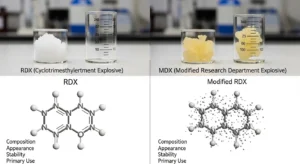
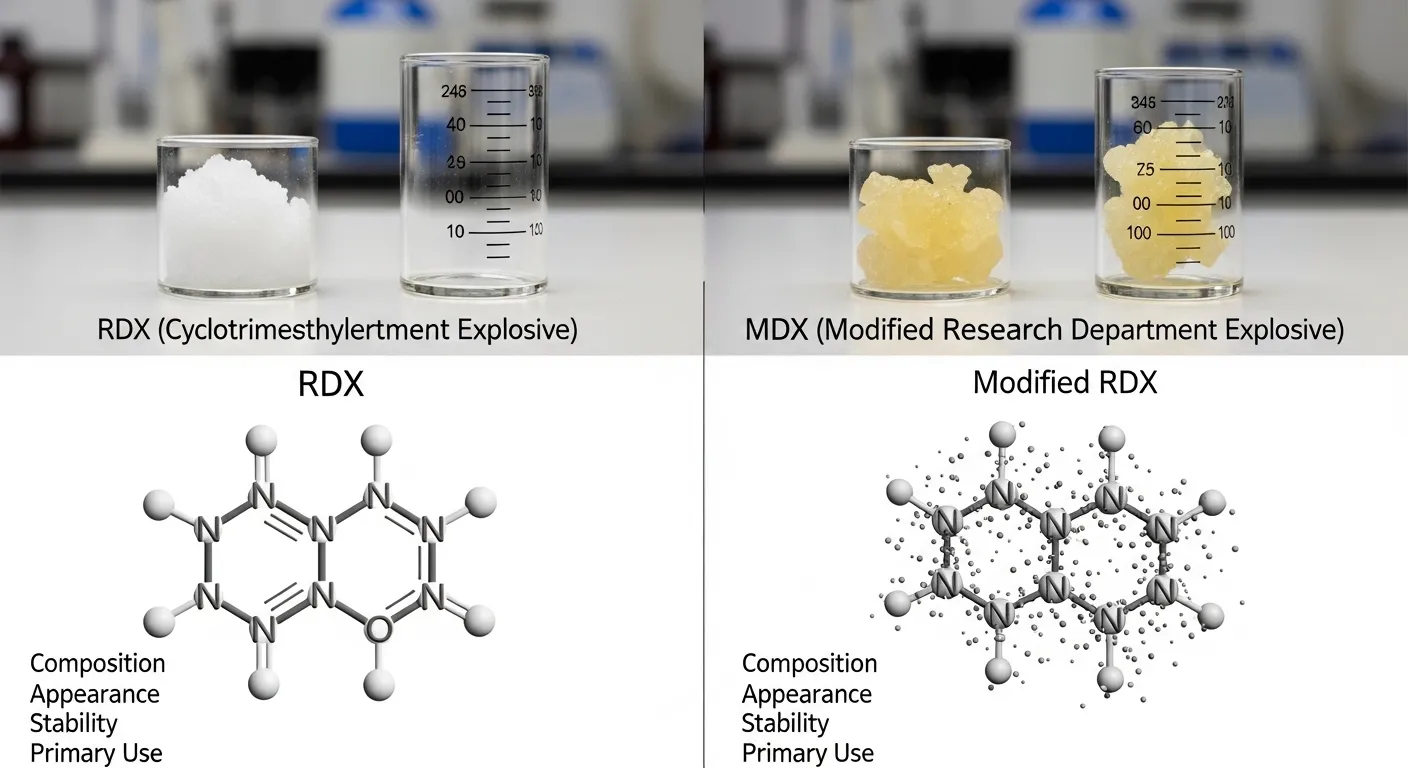
The main difference is that RDX is a pure high explosive compound, while MDX is typically a mixed explosive composition that contains RDX along with other substances to modify performance.
Why Is Their Difference Necessary to Know for Learners and Experts?
Understanding the distinction is essential for safety, research, military applications, and industrial use. Students studying chemistry or material science must know how energetic materials behave under pressure and heat. Experts in defense and engineering rely on this knowledge to ensure controlled performance.
In society, safe handling of energetic materials prevents accidents. Engineers design protective systems based on material behavior. Therefore, clarity about these substances supports technological advancement and public safety.
Pronunciation
- MDX
- US: /ˌɛm diː ˈɛks/
- UK: /ˌɛm diː ˈɛks/
- RDX
- US: /ˌɑːr diː ˈɛks/
- UK: /ˌɑː diː ˈɛks/
Before moving deeper, let us now explore the detailed difference between MDX and RDX in a structured and practical way.
Difference Between the Keywords
1. Chemical Composition
RDX (Research Department Explosive) is a single chemical compound known scientifically as cyclotrimethylenetrinitramine.
MDX is usually a mixture containing RDX combined with TNT or wax.
Examples:
- RDX used alone in detonators.
- MDX used in shaped charges.
2. Nature of Material
RDX is a crystalline solid explosive.
MDX is a composite material.
Examples:
- RDX crystals visible under microscope.
- MDX appears as a blended mass.
3. Explosive Power
RDX is highly powerful.
MDX power depends on its composition.
Examples:
- RDX stronger than TNT.
- MDX modified for controlled blasts.
4. Stability
RDX is sensitive to shock.
MDX is more stable due to additives.
Examples:
- Pure RDX requires careful handling.
- MDX safer during transport.
5. Usage
RDX widely used in military explosives.
MDX used where adjusted strength is needed.
Examples:
- RDX in plastic explosives.
- MDX in demolition engineering.
6. Manufacturing
RDX produced by nitration of hexamine.
MDX prepared by mixing RDX with other materials.
Examples:
- Chemical plant production of RDX.
- Blending facility prepares MDX.
7. Sensitivity
RDX highly sensitive to friction.
MDX less sensitive.
Examples:
- RDX ignites under impact.
- MDX withstands minor shock.
8. Cost
RDX more expensive.
MDX cost varies.
Examples:
- Pure RDX costly in defense contracts.
- MDX economical in large projects.
9. Storage Conditions
RDX requires strict storage.
MDX relatively easier to store.
Examples:
- Temperature-controlled RDX storage.
- MDX stored in reinforced containers.
10. Application Flexibility
RDX limited in pure form.
MDX customizable.
Examples:
- RDX fixed chemical structure.
- MDX tailored for mining needs.
Nature and Behaviour
RDX is a high-energy nitramine explosive. It reacts violently under heat or shock. Its detonation velocity is very high.
MDX behaves according to its mixed components. It may burn slower or explode depending on formulation.
Why People Are Confused About Their Use?
Confusion arises because MDX contains RDX. The similar names also cause misunderstanding. Additionally, both are used in defense industries. Without chemical background knowledge, people assume they are identical.
Table Showing Difference and Similarity
| Feature | MDX | RDX | Similarity |
| Type | Mixture | Pure compound | Both explosive materials |
| Power | Adjustable | Very high | High-energy |
| Stability | More stable | Less stable | Sensitive materials |
| Usage | Controlled demolition | Military explosives | Industrial application |
| Composition | Contains RDX | Single compound | Nitramine based |
Which Is Better in What Situation?
RDX is better when maximum explosive strength is required. In military operations or high-impact detonations, its strong and fast reaction makes it highly effective. However, it demands strict safety control.
MDX is better in controlled environments like mining or engineering demolitions. Its modified composition allows safer handling and adjustable power. Therefore, when flexibility and stability matter more than raw power, MDX is preferred.
Use in Metaphors and Similes
Though technical terms, they can be used metaphorically.
- “His anger exploded like RDX.”
- “The team’s strategy was layered like MDX.”
These comparisons emphasize intensity and composition.
Connotative Meaning
RDX
- Negative: Associated with destruction.
- Example: “The conflict spread like RDX.”
- Neutral: Technical term in chemistry.
MDX
- Neutral: Technical material term.
- Slightly positive: Symbol of engineered precision.
- Example: “Her plan was structured like MDX.”
Idioms or Proverbs Related
There are no direct idioms using these words because they are scientific terms. However:
- “Playing with fire” – relates to handling RDX.
- “Handle with care” – applies to both.
Example: “Working with RDX is truly playing with fire.”
Works in Literature
There are no major classical literary works titled exactly MDX or RDX. However:
- “RDX: Explosive Secrets” (Non-fiction, Military Analysis, 1998)
- “The Chemistry of Explosives” (Science, J. Meyer, 2007)
Movies Made on Keywords
- “RDX” (2023, India) – Action thriller.
- Documentaries discussing military explosives often reference RDX.
Frequently Asked Questions
1. Is MDX stronger than RDX?
No, RDX is generally stronger in pure form.
2. Is MDX made from RDX?
Yes, MDX usually contains RDX mixed with other materials.
3. Why is RDX more dangerous?
Because it is highly sensitive and powerful.
4. Can MDX replace RDX?
Not completely. It depends on required application.
5. Are both used in military applications?
Yes, but RDX is more common.
How Both Are Useful for Surroundings
Both materials contribute to mining, infrastructure development, and national defense. Controlled use supports construction projects. Proper management ensures safety and technological progress.
Final Words for the Both
RDX represents raw power and high energy.
MDX represents engineered balance and control.
Both have importance when used responsibly.
Conclusion
The difference between MDX and RDX lies mainly in composition, strength, and stability. RDX is a pure and powerful explosive compound, while MDX is a modified mixture designed for controlled performance. Understanding the difference between MDX and RDX is essential for students, engineers, and defense experts. Although both materials belong to the same energetic category, their applications differ based on safety and power requirements. Therefore, knowledge of their properties promotes responsible usage and scientific awareness.

I am content creator and comparison blogger focused on analyzing key differences between terms, concepts, and ideas to deliver accurate, easy-to-understand information. So I decided to create a platform where these differences are explained in the simplest way possible.