Many people who start investing eventually hear about two popular options: VOO and FXAIX. Imagine a beginner investor opening a brokerage account and searching for a simple way to invest in the top companies in the United States. Very quickly, they encounter these two names. Both appear to follow the S&P 500 index, both promise diversified exposure, and both are considered low-cost investments. This similarity often leads to confusion.
Understanding the difference between VOO and FXAIX is important for anyone building a long-term portfolio. Although they track the same index, their structure and usage can differ in meaningful ways. When investors compare the difference between VOO and FXAIX, they often focus on fees, flexibility, and trading style.
Learning the difference between VOO and FXAIX can help investors choose the option that matches their financial goals. In fact, recognizing the difference between VOO and FXAIX allows beginners and experts alike to make smarter investment decisions.
Key Difference Between the Both
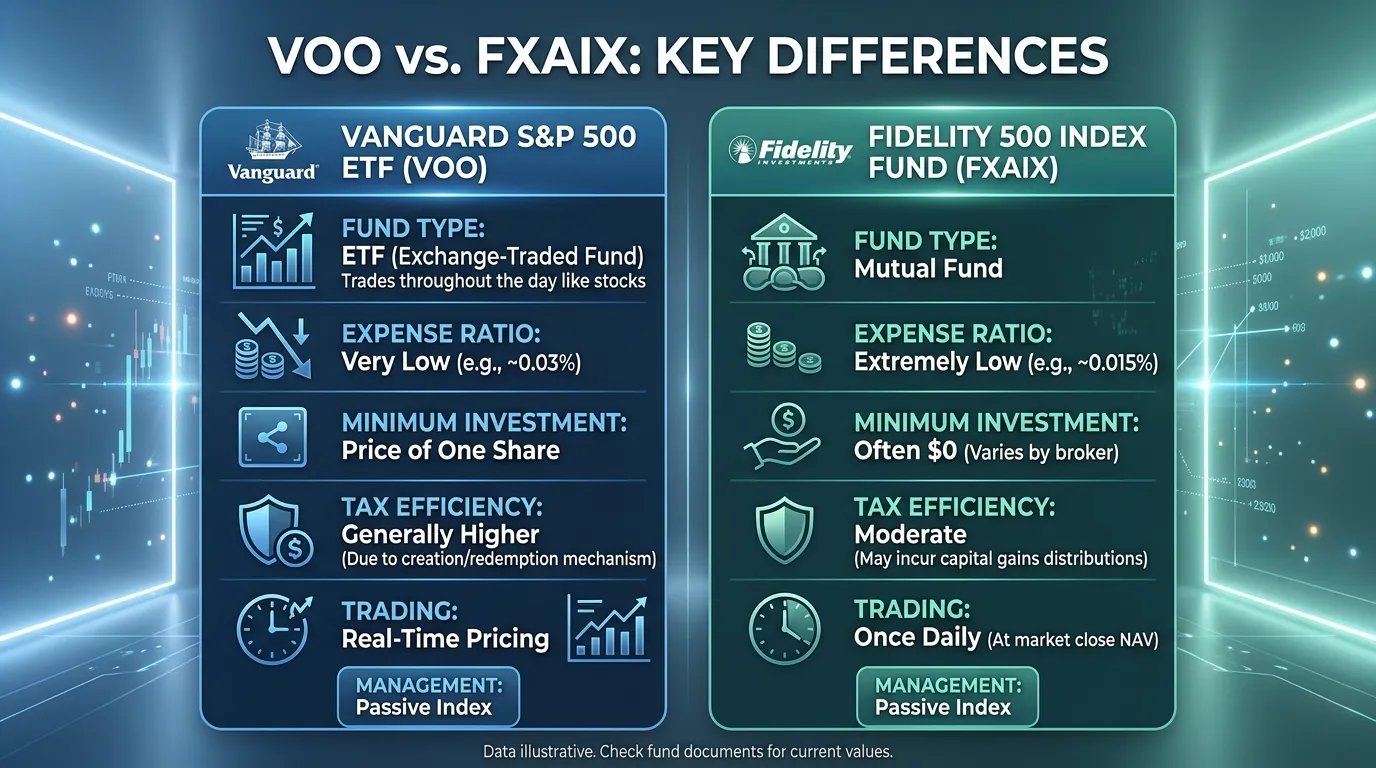
The core difference lies in their investment structure.
- VOO is an Exchange-Traded Fund (ETF) offered by Vanguard.
- FXAIX is a mutual fund offered by Fidelity Investments.
Both funds track the S&P 500 index, which represents 500 of the largest publicly traded companies in the United States. However, ETFs trade like stocks during market hours, while mutual funds are priced once daily after the market closes.
Why Is Their Difference Necessary to Know for Learners and Experts?
Understanding the difference between VOO and FXAIX is valuable for both beginners and experienced investors.
For learners, it helps them understand the broader financial concepts of ETFs versus mutual funds. Knowing how each investment works can improve financial literacy and prevent mistakes when building portfolios.
For experts and professional investors, these differences affect strategies such as tax planning, liquidity management, and portfolio diversification. Financial advisors, analysts, and fund managers often need to decide which investment vehicle suits a specific client’s financial goals.
In society, investment knowledge empowers individuals to grow wealth responsibly. Learning about funds like VOO and FXAIX contributes to better financial stability and encourages long-term saving habits.
Pronunciation of the Both
- VOO
- US pronunciation: /vuː/
- UK pronunciation: /vuː/
- FXAIX
- US pronunciation: /ɛf-eks-eɪ-aɪ-eks/ (spoken as individual letters)
- UK pronunciation: /ɛf-eks-eɪ-aɪ-eks/
Now that the pronunciation is clear, let’s move toward the deeper comparison to understand how these investment options actually differ.
Difference Between the Keywords
1. Investment Structure
VOO is an ETF, while FXAIX is a mutual fund.
Example 1:
An investor buys VOO shares during market hours like a stock.
Example 2:
Another investor buys FXAIX shares, but the price is calculated after the market closes.
2. Trading Method
VOO trades throughout the day on stock exchanges. FXAIX trades once per day.
Example 1:
If the market suddenly drops at noon, a VOO investor can sell immediately.
Example 2:
An FXAIX investor must wait until the end-of-day price to sell.
3. Minimum Investment
VOO requires only the price of one share, while FXAIX may require minimum investment rules depending on the brokerage.
Example 1:
An investor buys one VOO share for the current market price.
Example 2:
Another investor deposits a required amount to start investing in FXAIX.
4. Expense Ratio
Both funds are low cost, but FXAIX typically has a slightly lower expense ratio.
Example 1:
An investor choosing FXAIX might save a small amount in yearly fees.
Example 2:
Another investor still chooses VOO because the difference is minimal.
5. Tax Efficiency
ETFs like VOO are often more tax-efficient.
Example 1:
VOO investors may experience fewer capital gains distributions.
Example 2:
FXAIX investors may occasionally receive taxable distributions.
6. Brokerage Flexibility
VOO can be purchased through most brokerages.
Example 1:
An investor buys VOO on multiple platforms.
Example 2:
FXAIX is commonly purchased through Fidelity accounts.
7. Liquidity
VOO generally offers higher liquidity because it trades on exchanges.
Example 1:
Large institutional traders can buy large amounts quickly.
Example 2:
Mutual funds process trades only once daily.
8. Pricing Transparency
VOO price changes constantly during the trading day.
Example 1:
An investor can see the live price of VOO.
Example 2:
FXAIX price updates only once after market close.
9. Fractional Investing
Some platforms allow fractional ETF shares, but mutual funds already allow fractional investment.
Example 1:
FXAIX investors automatically invest exact dollar amounts.
Example 2:
Some brokerages now allow partial shares of VOO.
10. Use in Active Trading
VOO can be used for trading strategies.
Example 1:
Day traders sometimes buy and sell VOO during market hours.
Example 2:
FXAIX investors usually hold the fund long term.
Nature and Behaviour of Both
VOO behaves like a stock market instrument. It provides flexibility, liquidity, and real-time trading opportunities. Investors often prefer it when they want immediate market access.
FXAIX, on the other hand, behaves like a traditional mutual fund. It is designed mainly for long-term investors who regularly contribute to retirement or savings accounts.
Both funds are stable and diversified because they track the same market index.
Why People Are Confused About Their Use?
| Aspect | VOO | FXAIX | Similarity |
| Type | ETF | Mutual Fund | Both track S&P 500 |
| Trading | Real-time trading | End-of-day trading | Both are passive funds |
| Fees | Low | Slightly lower | Both inexpensive |
| Platform | Many brokerages | Mostly Fidelity | Both widely accessible |
People are confused because both funds track the same index and have similar performance over time.
Which Is Better in What Situation?
VOO
VOO is better for investors who want flexibility. Because it trades like a stock, it allows buying and selling during market hours. It is ideal for investors who use multiple brokerages or want the ability to trade quickly.
FXAIX
FXAIX is often better for long-term investors who prefer simplicity. Many retirement investors choose it because it allows automatic investments and slightly lower expense ratios. People who invest through Fidelity accounts often prefer FXAIX.
How the Keywords Are Used in Metaphors and Similes
Although these are financial terms, they can appear metaphorically.
Example metaphors
- “VOO is the highway of investing, offering fast and flexible movement.”
- “FXAIX is the steady train, moving slowly but reliably toward long-term growth.”
Connotative Meaning
VOO
Positive: flexibility, liquidity, accessibility
Example: “Investors admire VOO for its flexibility.”
Neutral: simply a market ETF
Example: “VOO represents an ETF tracking the S&P 500.”
FXAIX
Positive: stability, simplicity, reliability
Example: “Many retirement investors trust FXAIX for its steady growth.”
Neutral: traditional mutual fund structure.
Idioms or Proverbs Related to the Words
Direct idioms do not exist, but related investment idioms include:
1. “Don’t put all your eggs in one basket.”
Example: Investors buy funds like VOO or FXAIX to diversify.
2. “Slow and steady wins the race.”
Example: Long-term FXAIX investors follow this principle.
Works in Literature Featuring the Keywords
Because these are financial ticker symbols, they rarely appear in traditional literature. However, they are frequently mentioned in finance books and investing guides discussing index investing.
Movies Related to the Keywords
No major movies have been produced specifically about VOO or FXAIX. However, films about stock markets and investing often discuss index investing concepts.
Frequently Asked Questions
1. What is the main difference between VOO and FXAIX?
VOO is an ETF, while FXAIX is a mutual fund.
2. Do VOO and FXAIX track the same index?
Yes, both track the S&P 500 index.
3. Which fund has lower fees?
FXAIX generally has a slightly lower expense ratio.
4. Can I trade VOO during market hours?
Yes, VOO trades like a stock throughout the day.
5. Is FXAIX good for retirement accounts?
Yes, many retirement investors use FXAIX for long-term growth.
How Both Are Useful for Surroundings
Both funds contribute to financial growth and economic stability. By investing in diversified funds like VOO and FXAIX, individuals indirectly support large businesses and economic development.
Additionally, widespread investing encourages financial awareness and responsible wealth management in society.
Final Words for the Both
VOO and FXAIX are among the most trusted investment options for gaining exposure to the U.S. stock market. Although they follow the same index, their structures make them suitable for different types of investors.
Conclusion
The difference between VOO and FXAIX mainly lies in their structure and trading style. VOO is an ETF that trades throughout the day and offers flexibility, while FXAIX is a mutual fund designed for steady long-term investment. Despite these structural differences, both funds track the same S&P 500 index and provide similar long-term performance.
Investors should consider factors such as brokerage preference, trading flexibility, and investment strategy before choosing between them. Understanding the difference between VOO and FXAIX helps investors make informed financial decisions and build diversified portfolios that support long-term wealth creation.

I am content creator and comparison blogger focused on analyzing key differences between terms, concepts, and ideas to deliver accurate, easy-to-understand information. So I decided to create a platform where these differences are explained in the simplest way possible.