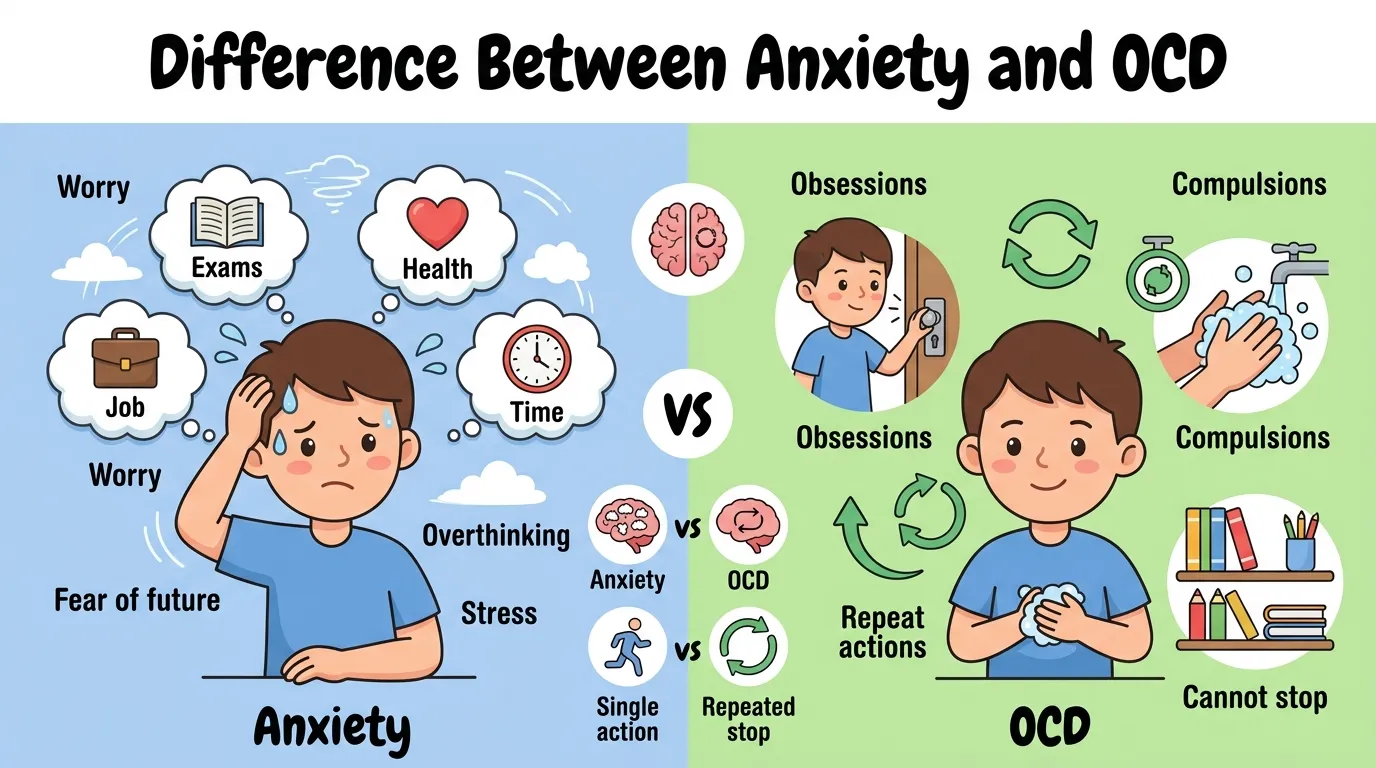
Ali leaves his home for work. After a few steps, he feels uneasy. He goes back to check the door lock. He checks it again and again. Still, he is not sure. On the other hand, Sara feels worried before her exams. Her heart beats fast, and she cannot sleep well. But she does not repeat actions like Ali. This is where the difference between anxiety and OCD becomes clear.
Many people think both are the same. But they are different in how they work and affect life. Understanding the difference between anxiety and OCD helps you know your feelings better. It also helps you support others.
In this guide, you will learn everything in very simple English. We will use daily examples. So, you can understand quickly and clearly.
What is “Anxiety”?
Anxiety is a feeling of fear, worry, or nervousness. It often comes when you think something bad may happen.
History (Anxiety)
Anxiety has been known for thousands of years. Ancient Greek doctors like Hippocrates talked about fear and emotional stress. In the 1900s, psychologists studied anxiety deeply. Today, it is one of the most common mental health conditions. Mild anxiety is normal, but strong anxiety can disturb daily life and needs attention.
Key Features of Anxiety
- Constant worry
- Fast heartbeat
- Sweating
- Trouble sleeping
- Fear of future events
What is “OCD”?
OCD means Obsessive-Compulsive Disorder. It includes repeated thoughts (obsessions) and repeated actions (compulsions).
History (OCD)
OCD was first studied in the 19th century. Early doctors called it a “doubt disorder.” Later, scientists understood that it includes both thoughts and behaviors. Today, OCD is well studied and treated with therapy and medicine. It is considered a serious mental health condition if untreated.
Key Features of OCD
- Repeated unwanted thoughts
- Strong urge to act
- Repetitive behaviors
- Temporary relief after action
Anxiety vs OCD
Anxiety: General fear or worry about life
OCD: Repeated thoughts and actions driven by fear
Now let’s explore how both work in detail.
How “Anxiety” Works
Key Features:
- Triggered by stress or fear
- Thoughts keep changing
- No fixed behavior pattern
- Can reduce with rest or reassurance
🔵 I feel anxious before my interview.
🔵 She feels nervous in crowded places.
Uses in Life:
- Education: exam stress
- Work: deadlines
- Daily life: health concerns
How “OCD” Works
Key Features:
- Fixed and repeated thoughts
- Strong urge to perform actions
- Actions reduce stress for a short time
- Cycle repeats again
🟢 He washes his hands many times a day.
🟢 She checks the door lock again and again.
Uses in Life:
- Mental health studies
- Therapy practices
- Behavior understanding
Which one should you use?
Use anxiety for general worry. Use OCD when worry leads to repeated actions.
People with OCD typically:
- Repeat actions many times
- Feel forced to act
- Know the action is not logical
- Still cannot stop
- Spend a lot of time on rituals
People with anxiety:
- Feel worried or scared
- Think about future problems
- Avoid stressful situations
- Can calm down with rest
- Do not repeat actions
Can anxiety be misdiagnosed as OCD?
Yes, it can happen. When anxiety becomes very strong, it may look like OCD. But OCD always includes repeated actions. Doctors need careful study to diagnose correctly.
How do you know if you have OCD or anxiety?
If you mainly feel worry and fear, it is likely anxiety. If you experience repeated, intrusive thoughts and feel compelled to perform certain actions you cannot control, it may indicate a condition called Obsessive-Compulsive Disorder (OCD). A mental health expert can give the correct answer.
Can you have both anxiety and OCD?
Yes, some people have both. They feel constant worry and also perform repeated actions. This makes life harder, so proper treatment is very important.
OCD and Anxiety Treatment
OCD treatments include
It needs strong and structured treatment.
- Cognitive Behavioral Therapy (CBT):
This helps change negative thinking patterns. - Exposure and Response Prevention (ERP):
The person faces fear but does not perform the action. Over time, fear reduces. - Medication:
Doctors may give medicines like SSRIs to control thoughts. - Routine Management:
Creating daily structure helps reduce compulsions. - Support System:
Family support improves recovery speed.
Anxiety treatments include
Anxiety treatment is often simpler but still important.
- Relaxation Techniques:
Deep breathing and muscle relaxation help calm the body. - Exercise:
Physical activity reduces stress hormones. - Talking Therapy:
Sharing thoughts with a therapist reduces fear. - Meditation and Mindfulness:
Helps focus on the present moment. - Lifestyle Changes:
Good sleep, healthy food, and less caffeine improve anxiety.
15 Differences Between Anxiety and OCD
1. Nature
Anxiety: General worry about many things
🔴 I worry about my future career.
🔴 She fears failing exams.
OCD: Specific repeated thoughts and actions
🔴 He checks locks again and again.
🔴 She repeats cleaning many times.
2. Thought Pattern
Anxiety: Thoughts change over time
🔴 I worry today but feel okay tomorrow.
🔴 My fear depends on the situation.
OCD: Thoughts stay fixed
🔴 I must clean or something bad will happen.
🔴 I cannot stop this thought.
3. Behavior
Anxiety: No repeated actions
🔴 I sit and think only.
🔴 I feel nervous but do nothing.
OCD: Repetitive actions
🔴 I wash hands again and again.
🔴 I check the door multiple times.
4. Control Level
Anxiety: Some control possible
🔴 I calm myself with breathing.
🔴 I distract my mind.
OCD: Very hard to control
🔴 I try to stop but fail.
🔴 I must complete the action.
5. Cause
Anxiety: External stress
🔴 Exams
🔴 Work pressure
OCD: Internal obsession
🔴 Fear of germs
🔴 Fear of mistakes
6. Duration
Anxiety: Short-term or situational
🔴 Before exam
🔴 During stress
OCD: Long-term and repetitive
🔴 Daily routine
🔴 Ongoing behavior
7. Relief Method
Anxiety: Rest or reassurance helps
🔴 Talking to a friend helps
🔴 Sleeping reduces stress
OCD: Action gives relief
🔴 Washing reduces fear
🔴 Checking feels safe
8. Focus Area
Anxiety: Multiple worries
🔴 Health
🔴 Money
OCD: One main obsession
🔴 Cleanliness
🔴 Safety
9. Awareness
Anxiety: Fully aware
🔴 I know I am worried
🔴 I understand my fear
OCD: Aware but trapped
🔴 I know it is wrong
🔴 Still cannot stop
10. Pattern
Anxiety: Irregular
🔴 Comes and goes
🔴 Not fixed
OCD: Fixed pattern
🔴 Same actions daily
🔴 Same routine
11. Trigger
Anxiety: Situation-based
🔴 Interview
🔴 Public speaking
OCD: Thought-based
🔴 Fear idea
🔴 Obsession
12. Impact on Life
Anxiety: Manageable
🔴 Still work
🔴 Still study
OCD: Disruptive
🔴 Delays tasks
🔴 Affects routine
13. Emotional Effect
Anxiety: Nervousness
🔴 Feeling uneasy
🔴 Feeling tense
OCD: Intense stress
🔴 Panic if action not done
🔴 Strong discomfort
14. Flexibility
Anxiety: Flexible thinking
🔴 Can change thoughts
🔴 Can shift focus
OCD: Rigid thinking
🔴 Fixed ideas
🔴 No flexibility
15. Treatment Need
Anxiety: Mild to moderate care
🔴 Relaxation
🔴 Therapy
OCD: Strong treatment needed
🔴 CBT + ERP
🔴 Medication
Why People Get Confused About Their Use
Both include fear and stress. Both affect the brain. That is why people mix them. But OCD always includes repeated actions, while anxiety does not.
Table: Difference and Similarity (Anxiety vs OCD)
| Feature | Anxiety | OCD | Similarity |
| Nature | General worry | Repeated thoughts/actions | Both involve fear |
| Control | Some control | Less control | Hard to manage |
| Behavior | No repetition | Repetition | Mental stress |
| Duration | Short-term | Long-term | Affect daily life |
Which is Better in What Situation?
Anxiety:
Anxiety is useful in small amounts. It helps you stay alert before exams or interviews. It pushes you to prepare and perform better.
OCD:
OCD is not helpful. It affects daily life and takes time and energy. It needs proper treatment and care for improvement.
How Are “Anxiety” and “OCD” Used in Metaphors and Similes?
🟣 Anxiety is like a storm in the mind.
🟣 OCD is like a loop that never ends.
Connotative Meaning
🟣 Anxiety (negative): I feel anxiety before results.
🟣 OCD (negative): His OCD controls his life.
🟣 Anxiety (neutral): Some anxiety is normal.
Idioms or Proverbs
🟣 “A worried mind never rests” – anxiety keeps thinking active
🟣 “Old habits die hard” – OCD habits are strong
Works in Literature
🟣 Hamlet by William Shakespeare (1603)
🟣 Macbeth by William Shakespeare (1606)
Movies Related to the Keywords
🟣 The Aviator (2004, USA)
🟣 A Beautiful Mind (2001, USA)
Frequently Asked Questions
1. Is anxiety same as OCD?
No, both are different.
2. Can anxiety become OCD?
Sometimes, but not always.
3. Is OCD state serious?
Yes, it affects daily life strongly.
4. Can anxiety be treated easily?
Yes, with simple methods.
5. Can OCD be cured?
It can be managed well with treatment.
Quick Summary
- Anxiety = general worry
- OCD = repeated thoughts + actions
- Anxiety is flexible
- OCD is fixed and repetitive
- Anxiety is easier to manage
- OCD needs structured treatment
Conclusion
The difference between anxiety and OCD is clear when you look closely. Anxiety is a general feeling of fear that comes and goes. It is often linked to real-life situations like exams or work. OCD, on the other hand, is deeper and more complex. It includes repeated thoughts and actions that are hard to control.
Both conditions affect mental health, but OCD usually needs more structured treatment like therapy and medication. Anxiety can often improve with simple lifestyle changes. When you understand the difference between anxiety and OCD, you can respond better to your own feelings and help others too. Awareness is the first step toward a healthier mind.

I am content creator and comparison blogger focused on analyzing key differences between terms, concepts, and ideas to deliver accurate, easy-to-understand information. So I decided to create a platform where these differences are explained in the simplest way possible.