Last week, Ali got his English test back. He said, “This is the worst day ever.” Later, he looked at his friend’s marks and said, “My score is worse than yours.” His teacher smiled because Ali used both words correctly. The Difference Between Worst and Worse is simple, but many English learners still get confused.
Worse is used when comparing two things, while worst is used for the most bad thing among many things. For example, one movie can be worse than another movie, but one movie can also be the worst movie of the year.
Learning the Difference Between Worst and Worse is useful for students, beginners, and daily English users. These words are common in conversations, schoolwork, social media, and writing. In this guide, you will learn easy meanings, grammar rules, and real-life examples to use both words correctly and confidently.
What is “Worst”?
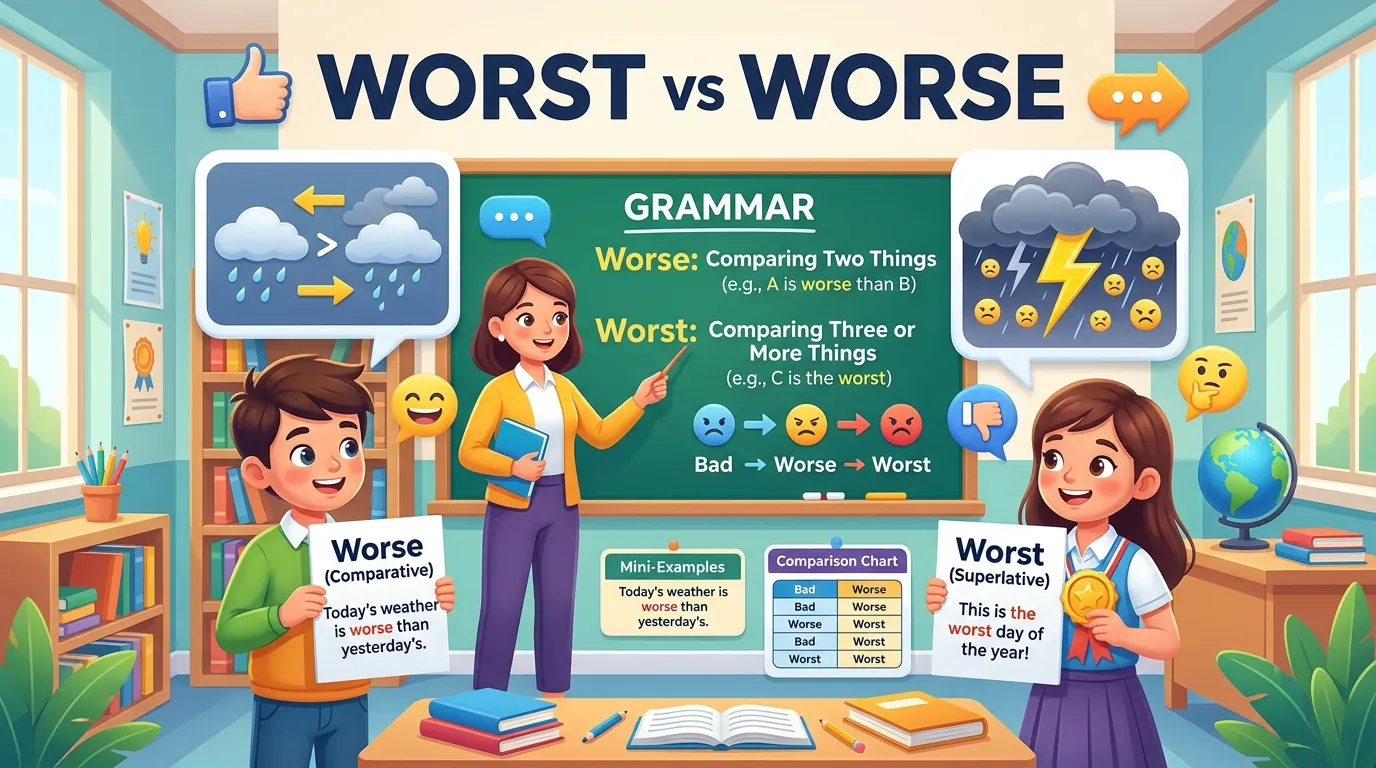
“Worst” means the most bad out of all.
It is used when comparing three or more things.
Example:
Sara had the worst result in the class.
Key Features of “Worst”
- Superlative form of “bad”
- Shows the lowest level
- Used for three or more people or things
- Often used with “the”
What is “Worse”?
“Worse” means more bad than another thing.
It is used when comparing two things.
Example:
Today’s weather is worse than yesterday’s.
Key Features of “Worse”
- Comparative form of “bad”
- Compares two things
- Shows a lower condition
- Often used with “than”
Worst vs Worse
- Worst = the most bad
- Worse = more bad than something else
Now let’s learn how to use them in real life.
How “Worst” Used
Key Features
- Used for three or more things
- Shows the lowest rank
- Comes with “the”
- Common in daily speech
Examples
🔵 This is the worst movie I have ever seen.
🔵 Monday was the worst day of my week.
Uses
- In school results
- In sports rankings
- In reviews and opinions
- In daily conversations
How “Worse” Used
Key Features
- Compares two things
- Often used before “than”
- Describes a lower quality
- Common in spoken English
Examples
🟢 My headache is worse today.
🟢 His cooking is worse than mine.
Uses
- Comparing health
- Comparing weather
- Comparing work quality
- Comparing situations
Which One Should You Use?
Use worse when comparing two things.
Use worst when talking about the lowest level among many things.
Example:
- This phone is worse than my old one.
- This is the worst phone in the shop.
15 Key Differences Between Worst and Worse with Examples
1. Type of Comparison
Worst
Means the lowest among many.
🔴 This was the worst meal at the party.
🔴 He had the worst performance in the team.
Worse
Means lower than another thing.
🔴 This tea tastes worse than coffee.
🔴 My cold feels worse today.
2. Grammar Form
Worst
Superlative form of “bad”.
🔴 She picked the worst option.
🔴 It was the worst storm this year.
Worse
Comparative form of “bad”.
🔴 His grade is worse than mine.
🔴 The traffic became worse after rain.
3. Number of Things Compared
Worst
Used for three or more things.
🔴 This is the worst seat in the hall.
🔴 January was the worst month.
Worse
Used for two things.
🔴 Today is worse than yesterday.
🔴 Tea is worse than juice for me.
4. Use of “Than”
Worst
Usually does not use “than”.
🔴 That was the worst joke ever.
🔴 It was the worst hotel in town.
Worse
Often uses “than”.
🔴 My pain is worse than before.
🔴 Her score is worse than his.
5. Ranking
Worst
Shows last position.
🔴 He was the worst player.
🔴 This is the worst road here.
Worse
Shows lower quality only.
🔴 This road is worse after rain.
🔴 Her mood became worse.
6. Daily Conversations
Worst
Used for extreme situations.
🔴 That was the worst day ever.
🔴 It is the worst smell.
Worse
Used for changes or comparisons.
🔴 The smell became worse.
🔴 My cough feels worse tonight.
7. Emotional Use
Worst
Stronger feeling.
🔴 Losing my wallet was the worst moment.
🔴 This is the worst news.
Worse
Less extreme feeling.
🔴 The news became worse later.
🔴 His anger got worse.
8. Sentence Position
Worst
Often after “the”.
🔴 She is the worst singer here.
🔴 It was the worst experience.
Worse
Often before “than”.
🔴 This pizza is worse than pasta.
🔴 My fever is worse today.
9. Writing Style
Worst
Common in dramatic writing.
🔴 That was the worst nightmare.
🔴 It became the worst mistake.
Worse
Common in comparisons.
🔴 The second plan is worse.
🔴 His second idea was worse than the first.
10. Health Situations
Worst
Shows the most serious condition.
🔴 Yesterday was the worst day of my illness.
🔴 This is the worst pain ever.
Worse
Shows a bad change.
🔴 My fever got worse.
🔴 Her cough became worse today.
11. School Examples
Worst
Lowest result in a group.
🔴 He got the worst marks.
🔴 This was the worst project.
Worse
Lower than another student.
🔴 My marks are worse than yours.
🔴 His writing is worse than hers.
12. Work Situations
Worst
Used for the poorest result.
🔴 That was the worst meeting.
🔴 It is the worst office in town.
Worse
Used for comparison.
🔴 This report is worse than the last one.
🔴 Sales became worse this month.
13. Weather Use
Worst
Extreme weather situation.
🔴 Last winter was the worst.
🔴 That was the worst storm.
Worse
Comparing weather conditions.
🔴 Today’s weather is worse than yesterday’s.
🔴 The wind became worse at night.
14. Sports Examples
Worst
Lowest player or team.
🔴 They were the worst team.
🔴 He gave the worst performance.
Worse
Comparing two performances.
🔴 Today’s game was worse than last week’s.
🔴 His second match was worse.
15. Memory Trick
Worst
Think “most bad”.
🔴 This is the worst cake here.
🔴 He had the worst luck.
Worse
Think “more bad”.
🔴 This cake is worse than that one.
🔴 Her mood is worse today.
Why People Get Confused About Their Use
People get confused because both words come from “bad.” They also look and sound similar. Another reason is that learners forget the rule about comparing two things and many things. Remember this easy trick:
- Worse = two things
- Worst = many things
Table: Difference and Similarity (Worst vs Worse)
| Feature | Worst | Worse | Similarity |
| Meaning | Most bad | More bad | Both come from “bad” |
| Grammar Type | Superlative | Comparative | Both describe negative quality |
| Comparison | Three or more | Two things | Both compare |
| Common Word | The | Than | Both common in English |
| Strength | Stronger | Less strong | Both negative |
| Use | Final rank | Lower condition | Both used daily |
Which is Better in What Situation?
Use worse when comparing two people, things, or situations. It helps show that one thing is more negative than another. This word is very common in school, work, and daily life.
Use worst when talking about the lowest or most negative thing in a group. It gives a stronger feeling and is useful when talking about extreme situations or final rankings.
How Are “Worst” and “Worse” Used in Metaphors and Similes?
🟣 “It went from bad to worse.”
Meaning: A situation became more difficult.
🟣 “That was the worst storm of my life.”
Meaning: Very terrible experience.
🟣 “Her mood was worse than a rainy day.”
Meaning: She felt very unhappy.
Connotative Meaning
Worst
- Negative meaning
- Strong emotion
🟣 “This is the worst mistake.”
🟣 “He had the worst luck.”
Worse
- Negative meaning
- Softer than “worst”
🟣 “Things became worse.”
🟣 “Her pain got worse.”
Idioms or Proverbs
🟣 From bad to worse
Meaning: A problem becomes more serious.
Example: The weather went from bad to worse.
🟣 Prepare for the worst
Meaning: Be ready for a difficult situation.
Example: We packed extra food and prepared for the worst.
Frequently Asked Questions
1. Is “worst” stronger than “worse”?
Yes. “Worst” shows the most negative level.
2. Can I use “worse” for many things?
No. “Worse” is mainly for comparing two things.
3. Do we use “the” with “worst”?
Yes, very often.
4. Is “worse” followed by “than”?
Usually yes.
5. Which word is more common in daily speech?
Both are very common in English conversations.
Difference Between Worst and Worse (Quick Summary)
- Worse = compares two things
Example: This weather is worse than yesterday’s. - Worst = shows the most bad among many things
Example: This is the worst day of my week.
Easy Memory Trick
- Worse = more bad
- Worst = most bad
Practice these simple rules daily, and you will use both words correctly and confidently in English conversations and writing.
Conclusion
The difference between worst and worse is simple when you know the basic rule. Use worse when comparing two things. Use worst when talking about the lowest level among many things. Both words come from “bad,” but they have different grammar uses. Daily practice and simple examples can help you remember them easily. Now, when you hear or read these words, you will understand exactly how to use them in the right way.

My name is Ryan Mitchell, and I am a comparison content writer based in the United States. I specialize in creating clear and easy-to-understand articles that explain the differences between similar concepts, products, and ideas. My work focuses on helping readers quickly understand what makes two things different so they can make better decisions.