Royal titles have always captured people’s curiosity, especially when we hear names like duke and prince in famous monarchies such as the United Kingdom. At first glance, both titles seem equally prestigious and powerful. However, the difference between duke and prince goes much deeper than just status—it involves rank in the hierarchy, method of inheritance, roles within the monarchy, and overall royal significance.
A prince is typically a member of the royal family by birth, directly connected to the throne, while a duke is a high-ranking noble title, often granted by the monarch and not always tied to royal blood. This distinction becomes especially important when understanding how royal systems function and how authority is structured within them.
In this detailed guide, you will gain a clear understanding of what a duke and a prince are, along with their meanings and roles within a monarchy. The article also explores 15 key differences with practical examples, advantages, significance, and commonly asked questions to give you a complete and well-rounded understanding of the topic.
What Is a Prince?
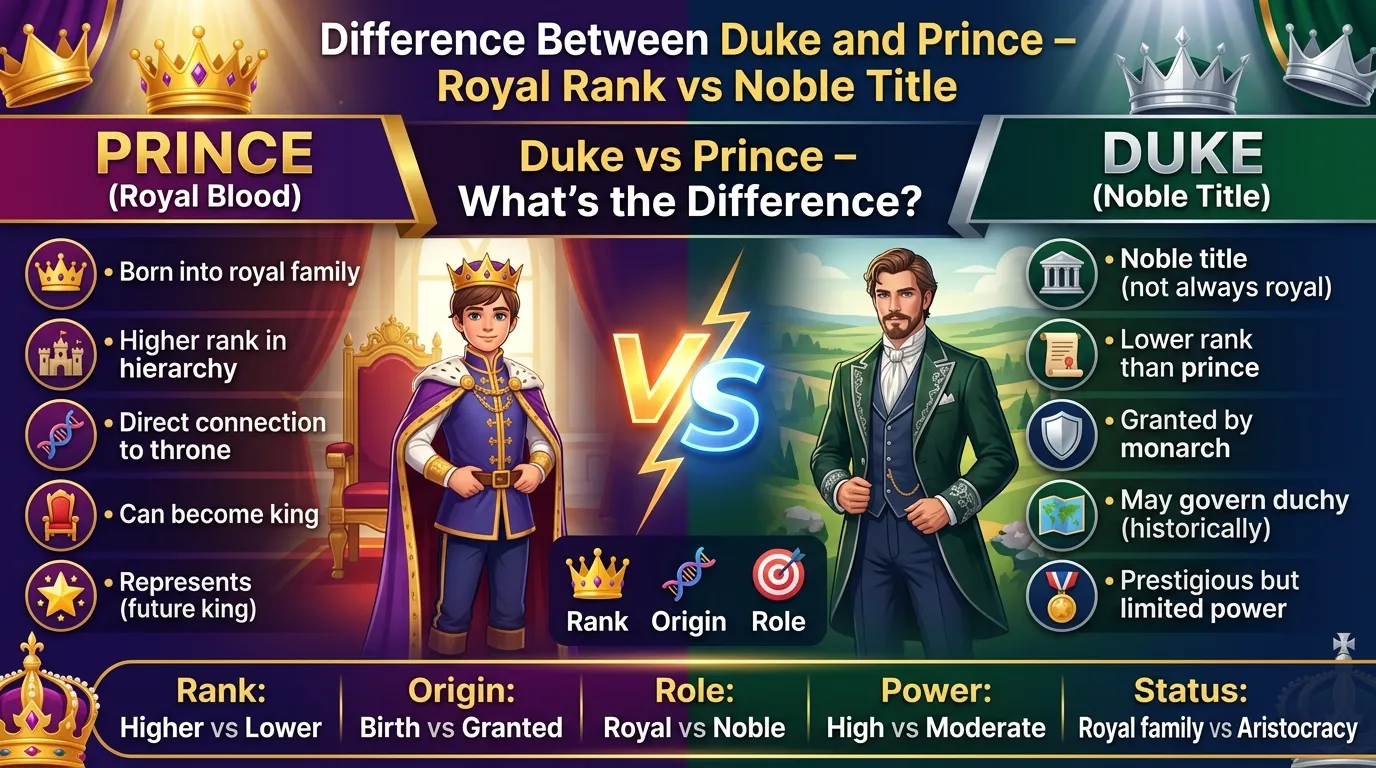
A prince is typically a male member of a royal family, usually the son or grandson of a king or queen. The title represents royal bloodline and direct connection to the monarchy.
In many countries, princes are considered part of the core royal hierarchy and may even be heirs to the throne.
Key Features of a Prince:
- Born into a royal family
- Holds higher royal status
- May become king in the future
- Represents the monarchy
Example:
- Prince William is a prince by birth and is next in line to become king.
Simple idea:
Prince = royal blood + potential ruler
What Is a Duke?
A duke is a high-ranking noble title, usually below a prince in rank. Unlike princes, dukes are not always born into royalty—they may be granted the title by a monarch.
Historically, dukes ruled over regions called duchies and had administrative responsibilities.
Key Features of a Duke:
- A noble rank (not always royal)
- Often granted by a king or queen
- May govern land (historically)
- Below prince in hierarchy
Simple idea:
Duke = noble title + granted authority
Is a Duke Higher Than a Prince?
No. A prince ranks higher than a duke in royal hierarchy.
However, sometimes:
- A prince can also hold the title of duke
- But a duke is not necessarily a prince
Quick Comparison Table
| Feature | Prince | Duke |
| Definition | Royal family member | Noble title holder |
| Rank | Higher | Lower |
| Origin | By birth | Granted or inherited |
| Royal Status | Always royal | Not always royal |
| Succession Rights | Yes (often) | No (usually) |
| Authority | Symbolic + national | Regional (historically) |
| Territory | Represents kingdom | Governs duchy |
| Title Type | Royal | Noble |
| Appointment | Automatic (birth) | Given by monarch |
| Prestige | Very high | High |
| Public Role | Major royal duties | Limited roles |
| Global Use | Worldwide | Mostly Europe |
| Combination | Can be duke also | Cannot be prince automatically |
| Historical Role | Heir to throne | Regional ruler |
| Example | Prince William | Duke of Sussex |
15 Key Differences Between Duke and Prince with Examples
1. Definition
A prince is a member of a royal family, usually by birth, while a duke is a high-ranking noble title that may be granted or inherited.
2. Rank in Hierarchy
Princes rank higher than dukes in royal and noble hierarchies.
Example:
A prince is closer to the throne than a duke in systems like the **United Kingdom monarchy.
3. Birth vs Appointment
Princes are typically born into royalty, while dukes can be appointed by a monarch.
Example:
A king’s son becomes a prince automatically, but a duke title may be granted later.
4. Royal Status
All princes are royal, but not all dukes are royal—many are simply nobles.
Example:
Prince Harry is both royal and a duke, but some dukes have no royal blood.
5. Succession Rights
Princes often have a place in the line of succession, while dukes generally do not.
Example:
Prince William is in line for the throne, but a duke without royal blood is not.
6. Territorial Authority
Historically, dukes ruled over regions called duchies, while princes represented royal authority.
Example:
A duke might govern land, while a prince represents the crown.
7. Purpose of Title
The title “prince” reflects royal lineage, while “duke” reflects noble rank and honor.
8. Dual Titles
A prince can also hold the title of duke, but a duke is not necessarily a prince.
9. Historical Origin
The title of prince comes from royal bloodlines, while duke originates from feudal systems of governance.
10. Global Usage
The title prince is used worldwide in monarchies, while duke is mainly found in European nobility systems.
11. Authority Type
Princes often hold symbolic and national authority, while dukes historically held administrative or regional power.
12. Wealth & Privileges
Both titles carry wealth and privilege, but princes usually enjoy greater influence and resources.
13. Social Status
Princes are considered higher in prestige, while dukes are respected but ranked below.
14. Public Role
Princes represent the monarchy in official duties, while dukes may have more limited ceremonial roles.
15. Overall Nature
- Prince = Royal blood + higher authority
- Duke = Noble title + supportive role
When to Use Duke vs Prince
Use “Prince” when:
- Referring to royal family members
- Talking about succession or monarchy
Use “Duke” when:
- Referring to noble titles
- Talking about land or honorary ranks
Advantages and Disadvantages
Prince
✔ Higher status
✔ Royal inheritance
✔ Greater influence
❌ More public responsibility
❌ Less personal freedom
Duke
✔ Prestigious title
✔ May hold land or honors
✔ Less pressure than princes
❌ Lower rank than prince
❌ Limited royal power
Conclusion
The difference between duke and prince is rooted in hierarchy, origin, and function. A prince is a core member of the royal family, often born into privilege and positioned close to the throne. A duke, on the other hand, is a noble title holder, sometimes royal but often appointed, with a role that historically focused on land governance and support of the monarchy.
In modern times, the distinction still matters, especially in royal systems like the United Kingdom, where titles define status, responsibility, and public role. While both titles carry prestige, the prince holds greater authority and symbolic importance, whereas the duke represents noble honor and tradition.
Final takeaway:
- Prince = Royal blood, higher rank, future leadership
- Duke = Noble title, supportive role, historical governance
FAQs
1. Is a duke a prince?
No, but a prince can also be a duke.
2. Who is higher, duke or prince?
A prince is higher in rank.
3. Can a duke become king?
Usually no, unless he is also a prince.
4. Why do princes have duke titles?
To give them additional roles and honors.
5. Are all dukes royal?
No, some are nobles without royal blood.

I am content creator and comparison blogger focused on analyzing key differences between terms, concepts, and ideas to deliver accurate, easy-to-understand information. So I decided to create a platform where these differences are explained in the simplest way possible.