Imagine visiting a gallery where one wall displays a beautiful painting, while another showcases handmade pottery. Both are creative, both are visually appealing—but are they the same? This is where the difference between art and craft becomes important.
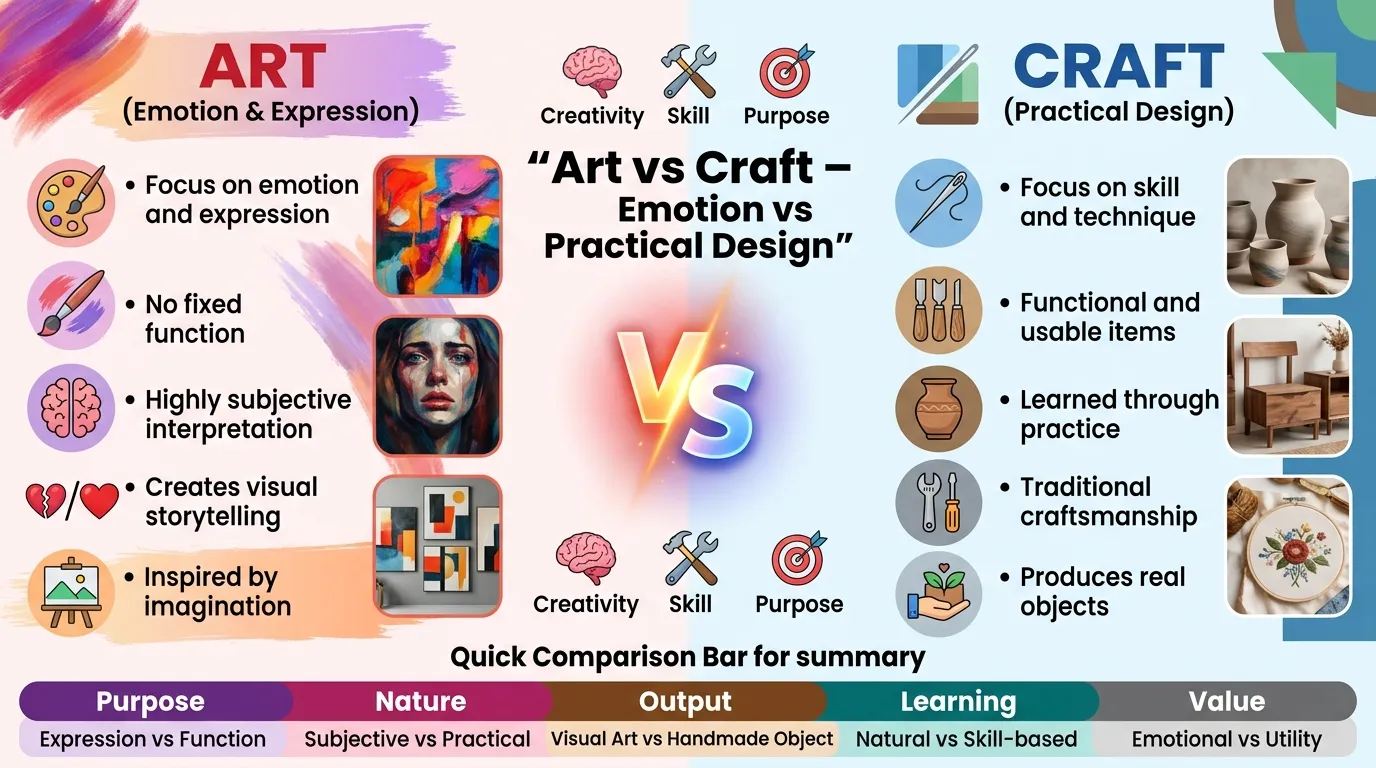
Although many people use these terms interchangeably, art and craft have distinct purposes, processes, and meanings. Art is often about self-expression and emotion, while craft focuses more on skill, technique, and functionality.
In this detailed guide, we’ll explore definitions, similarities, differences, real-life examples, and practical usage, while also addressing common confusion between these two creative fields.
What Is Art?
Art is the creative expression of human thoughts, emotions, imagination, and ideas presented in a visual, auditory, or conceptual form. It is not limited to beauty alone—modern art often focuses on meaning, message, and emotional impact rather than just appearance.
Art allows an individual (artist) to communicate something personal or universal, such as love, pain, culture, identity, or social issues. Unlike functional objects, art is usually created to be experienced, interpreted, and appreciated, not necessarily used.
Another important aspect of art is that it is highly subjective. What one person considers meaningful or beautiful, another may not. This makes art open-ended and constantly evolving over time.
Key Features of Art:
- Focuses on expression and creativity
- Often non-functional
- Open to interpretation
- Can be abstract or realistic
- Driven by emotion, concept, or message
Examples of Art:
- A painting expressing loneliness
- A sculpture representing freedom
- A photograph capturing human emotion
Example:
A modern abstract painting may look simple, but it can represent deep emotions like anxiety or hope.
What Is Craft?
Craft is the process of creating physical objects using skill, technique, and hands-on methods, often with a functional or decorative purpose. It is usually based on learned skills, practice, and precision, rather than purely emotional expression.
Craft involves making items that are useful, decorative, or both, such as textiles, pottery, furniture, or handmade accessories. Unlike art, craft typically follows structured techniques and traditional methods, which can be improved over time through training.
Craft is often associated with handmade work (handicrafts), where the maker applies skill and attention to detail to produce high-quality items.
Key Features of Craft:
- Focuses on skill and technique
- Produces tangible, usable items
- Often functional or decorative
- Can be learned and mastered
- Based on tradition and practice
Examples of Craft:
- Handmade pottery bowl
- Embroidered fabric
- Wooden furniture
- Handmade jewelry
Example:
A beautifully designed ceramic mug is a craft because it is both useful and skillfully made.
Is Craft Considered Art?
This is one of the most debated questions. The answer is not absolute.
- Traditionally, craft was seen as separate from art
- Today, many experts believe craft can also be art, especially when it involves creativity and expression
Modern view:
The line between art and craft is becoming increasingly blurred
What Is the Difference Between Fine Art and Craft?
Fine art refers to traditional high arts such as:
- Painting
- Sculpture
- Architecture
Craft, on the other hand:
- Focuses on useful or decorative objects
- Includes textiles, ceramics, woodworking, etc.
Modern trend:
The boundary between fine art and craft is becoming less strict, as many artists now combine both.
Quick Comparison Table (Art vs Craft)
| Feature | Art | Craft |
| Purpose | Expression | Function + decoration |
| Nature | Subjective | Practical |
| Skill Type | Creative | Technical |
| Output | Visual/emotional | Physical object |
| Learning | Natural + developed | Learned skill |
| Value | Conceptual | Functional + aesthetic |
| Flexibility | High | Moderate |
15 key differences between Art and Craft, with simple explanations and examples:
1. Definition
Art is a form of expression where a person shares ideas, emotions, or imagination.
Craft is the creation of objects using skill, often with a specific purpose.
Example: A painting showing sadness = Art; a clay bowl used in the kitchen = Craft
2. Purpose
Art mainly aims to communicate meaning or provoke thought.
Craft is usually made for use or decoration.
Example: A sculpture expressing freedom vs a decorated lamp
3. Creativity vs Skill
Art depends more on creativity and originality.
Craft depends more on learned skills and techniques.
Example: Abstract painting vs hand embroidery
4. Functionality
Art is mostly non-functional (not used in daily life).
Craft is often functional.
Example: Wall painting vs handmade chair
5. Subjectivity
Art is judged based on personal interpretation—everyone may see it differently.
Craft is judged based on quality, neatness, and technique.
Example: One person may love a painting, another may not; but a well-made basket is appreciated by most
6. Learning Process
Art can be natural and self-expressive; some artists are self-taught.
Craft usually requires training and practice to master techniques.
Example: A self-taught painter vs a trained carpenter
7. Expression
Art focuses on expressing inner feelings and thoughts.
Craft focuses more on making something correctly and beautifully.
Example: Emotional sketch vs perfectly stitched dress
8. Output Type
Art creates emotional or visual experiences.
Craft creates physical, usable items.
Example: Digital artwork vs handmade pottery
9. Tradition
Craft often follows traditional methods passed down through generations.
Art changes with time and trends.
Example: Traditional weaving vs modern digital art
10. Commercial Aspect
Craft is often made for selling or daily use.
Art may or may not be commercial—it can be purely expressive.
Example: Handmade jewelry for sale vs a personal painting not meant for selling
11. Creator Role
An artist focuses on ideas and expression.
A craftsperson focuses on skill, precision, and technique.
Example: Painter vs woodworker
12. Social Perception
Historically, art was considered more prestigious.
Craft was seen as practical work or labor.
Example: Fine art in galleries vs handmade household items
13. Reproducibility
Art is usually unique and one-of-a-kind.
Craft items can often be reproduced in the same design.
Example: Original painting vs multiple identical pottery cups
14. Complexity
Art focuses on deep ideas, meaning, and concepts.
Craft focuses on technical perfection and detail.
Example: Conceptual art vs finely carved woodwork
15. Overall Nature
Art = emotional, expressive, imaginative
Craft = practical, skill-based, structured
When to Use Art vs Craft
Use “Art” when:
- You are talking about expression and creativity
- The work has no practical function
- Focus is on ideas or emotions
Use “Craft” when:
- The object is functional or decorative
- It involves skill and technique
- It is handmade
Advantages and Disadvantages
Art
✔ Encourages creativity
✔ Expresses emotions
✔ Unique and original
❌ Can be difficult to understand
❌ Not always practical
Craft
✔ Useful and functional
✔ Skill-based and teachable
❌ Less focus on expression
❌ Sometimes undervalued
Conclusion
The difference between art and craft lies mainly in purpose, process, and perception. Art is about expression and emotion, while craft focuses on skill and functionality.
However, in today’s creative world, the line between the two is becoming less clear. Many modern creators combine both, producing works that are both meaningful and functional.
Final takeaway:
- Art = Expression + Emotion
- Craft = Skill + Function
FAQs
1. Is craft a type of art?
Sometimes yes. In modern contexts, craft can also be considered art.
2. Which is more valuable, art or craft?
It depends on context—art may have higher conceptual value, while craft has practical value.
3. Can something be both art and craft?
Yes, many modern works combine both elements.
4. Why is art considered subjective?
Because people interpret it differently based on personal views.
5. Is craft easier than art?
Not necessarily—craft requires high technical skill.

I am content creator and comparison blogger focused on analyzing key differences between terms, concepts, and ideas to deliver accurate, easy-to-understand information. So I decided to create a platform where these differences are explained in the simplest way possible.