Imagine you’re scrolling a website and suddenly see an ad that feels like it was made just for you. That’s not magic it’s programmatic advertising working behind the scenes. Two powerful systems make this possible: SSP (Supply-Side Platform) and DSP (Demand-Side Platform). While they sound technical, their concept is actually very simple when broken down correctly.
Many beginners confuse these two terms because both operate in the same ecosystem, but their roles are completely opposite. One helps publishers sell ad space, while the other helps advertisers buy the best ad placements.
Understanding the difference between SSP and DSP is essential if you want to earn from ads or run successful campaigns. Whether you’re a blogger, marketer, or business owner, this knowledge can directly impact your revenue and ad performance. Let’s simplify everything step by step in this article.
What is an Ad Exchange?
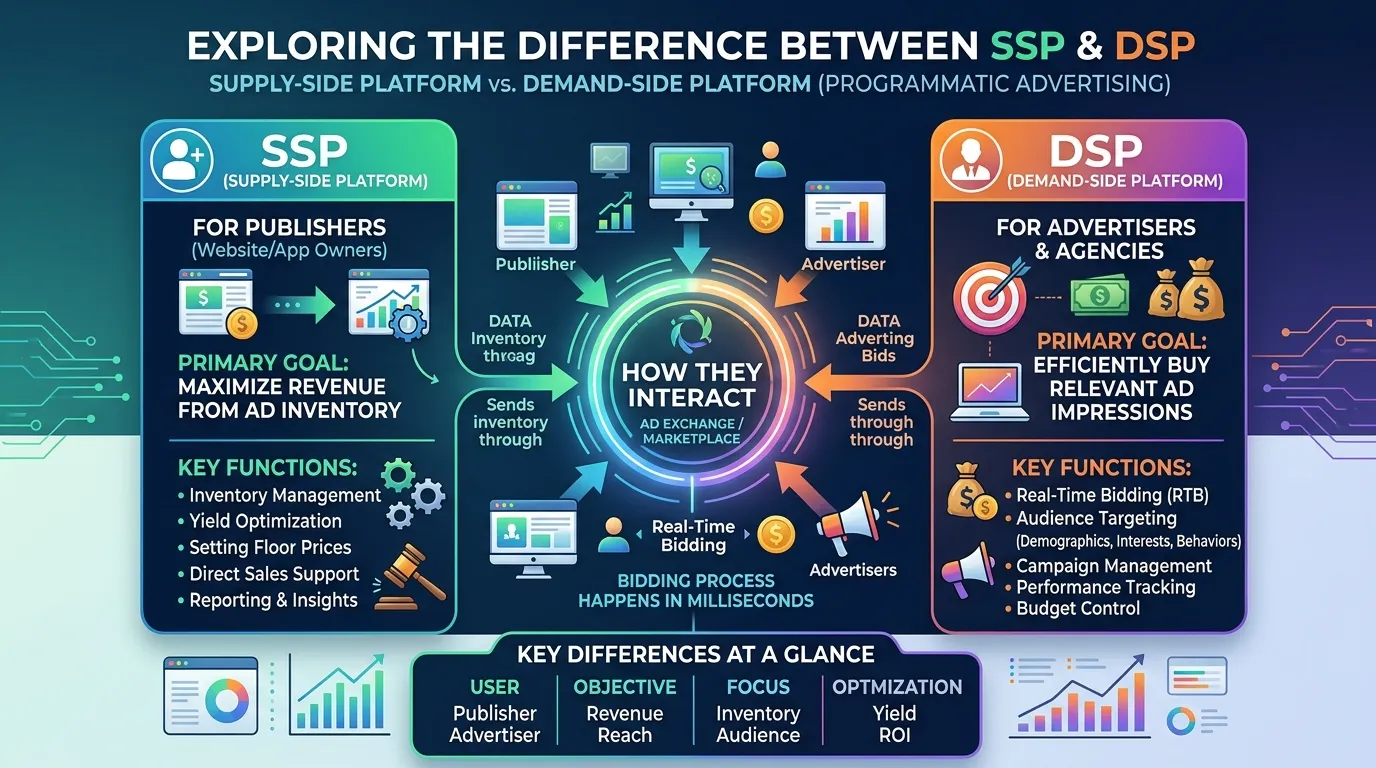
An ad exchange is a digital marketplace where buying and selling of ads happens automatically. It connects SSPs and DSPs in real time.
Simple Example:
- SSP = Seller (shop owner)
- DSP = Buyer (customer)
- Ad Exchange = Marketplace (shopping mall)
Definitions for Both
SSP (Supply-Side Platform)
An SSP (Supply-Side Platform) is a powerful technology used by publishers (website owners, bloggers, app developers) to manage, sell, and optimize their available ad space automatically.
Instead of manually finding advertisers, the SSP connects the publisher’s website to multiple ad exchanges and demand sources, allowing different advertisers to compete in real time. This competition helps the publisher get the highest possible price for each ad impression.
Realistic Example:
Imagine you run a blog that gets 50,000 visitors daily. Instead of contacting companies one by one to place ads, you use an SSP. When a visitor opens your page, the SSP instantly sends your available ad space to an ad exchange, where multiple advertisers bid for it. Within milliseconds, the highest-paying ad is displayed on your site—maximizing your revenue automatically.
Simple Understanding:
SSP is like a smart sales manager that sells your ad space to the best-paying buyer without any manual effort.
DSP (Demand-Side Platform)
A DSP (Demand-Side Platform) is a system used by advertisers and marketers to buy ad space across multiple websites and apps in an automated and data-driven way.
It allows advertisers to set budgets, define target audiences (age, location, interests), and bid for ad placements in real time. The DSP analyzes user data and decides whether showing an ad to a specific user is worth the cost.
Realistic Example:
Suppose you own an online shoe store. You want to show ads only to people interested in sports shoes. Using a DSP, you set your campaign targeting (e.g., males aged 18–35 who like fitness). When such a user visits a website, the DSP instantly bids for that ad space. If it wins, your shoe ad is shown to that exact user—improving chances of a sale.
Simple Understanding:
DSP is like a smart buyer that finds the best place to show your ads to the right audience at the right time.
Ad Exchange
An ad exchange is the central digital marketplace where SSPs and DSPs meet and interact. It runs auctions in real time and ensures fair buying and selling of ad space.
Realistic Example:
Think of it like a stock market—but instead of stocks, ads are being traded. Publishers (via SSP) offer ad space, advertisers (via DSP) bid for it, and the ad exchange completes the deal instantly.
Quick Comparison Table (SSP vs DSP)
| Feature | SSP (Supply-Side Platform) | DSP (Demand-Side Platform) |
|---|---|---|
| Main Role | Sell ad inventory | Buy ad inventory |
| Used By | Publishers | Advertisers |
| Goal | Maximize revenue | Maximize ROI |
| Focus | Selling ad space | Buying best placements |
| Control | Floor pricing | Bidding & targeting |
| Side | Supply side | Demand side |
15 Key Differences Between SSP and DSP (With Examples)
1. 🎯 Core Purpose
- SSP: Helps sell ad space
- DSP: Helps buy ad space
👉 Example: A blog uses SSP to sell banners; a brand uses DSP to buy them
2. 👥 Users
- SSP: Publishers (website/app owners)
- DSP: Advertisers & marketers
👉 Example: News website vs clothing brand
3. 💰 Revenue vs ROI
- SSP: Focus on earning money
- DSP: Focus on performance & conversions
👉 Example: SSP chooses highest bid; DSP chooses best ROI ad
4. ⚙️ Control
- SSP: Controls pricing & inventory
- DSP: Controls budget & targeting
👉 Example: DSP sets audience filters
5. 🔄 Workflow Role
- SSP: Publisher side
- DSP: Advertiser side
👉 They connect through ad exchanges
6. 📊 Data Usage
- SSP: Uses data to increase ad value
- DSP: Uses data for targeting users
👉 Example: DSP targets “sports lovers”
7. 🧠 Decision Making
- SSP: Picks highest paying ad
- DSP: Picks best audience match
👉 Example: Shoe ad shown to shoe lovers
8. 📢 Objective
- SSP: Fill ad inventory
- DSP: Run effective campaigns
👉 Example: SSP avoids empty ad slots
9. 🏷️ Pricing Strategy
- SSP: Sets minimum price (floor price)
- DSP: Bids dynamically
👉 Example: DSP competes in auctions
10. ⏱️ Real-Time Bidding Role
- SSP: Sends inventory to auction
- DSP: Participates in auction
👉 Example: SSP = seller in auction, DSP = bidder
11. 📦 Inventory Management
- SSP: Manages available ad space
- DSP: Chooses where to place ads
👉 Example: SSP organizes ad slots
12. 🎯 Targeting Capability
- SSP: Limited targeting
- DSP: Advanced targeting options
👉 Example: DSP targets age, location, interests
13. 🧩 Integration
- SSP: Connects with multiple ad exchanges
- DSP: Connects with multiple SSPs
👉 Example: DSP accesses many websites
14. 📈 Optimization Goal
- SSP: Increase revenue per impression
- DSP: Increase conversions
👉 Example: DSP tracks clicks & sales
15. 🔐 Transparency & Control
- SSP: Gives control to publishers
- DSP: Gives control to advertisers
👉 Example: Advertiser controls campaign strategy
🕒 When to Use Each
✅ Use SSP When:
- You own a website or app
- You want to monetize traffic
- You need better ad revenue
✅ Use DSP When:
- You are running paid ads
- You want targeted audiences
- You want better ROI
⚠️ Common Mistakes
- Confusing SSP with DSP ❌
- Not using targeting in DSP ❌
- Ignoring floor price in SSP ❌
🤝 Similarities
- Both are part of programmatic advertising
- Both use automation
- Both rely on real-time bidding
- Both improve ad efficiency
FAQs
1. What is the main difference between SSP and DSP?
SSP sells ad space, while DSP buys it.
2. Do SSP and DSP work together?
Yes, they connect through ad exchanges to complete transactions.
3. Is Google Ads a DSP?
Yes, it works like a DSP for advertisers.
4. Which is better, SSP or DSP?
Neither—they serve different purposes.
5. Can beginners use SSP or DSP?
Yes, depending on their goal (earning vs advertising).
6. Is SSP used in mobile apps?
Yes, SSP works for both apps and websites.
Conclusion
The difference between SSP and DSP becomes very clear when you see their roles:
👉 SSP is for selling ad space
👉 DSP is for buying ad space smartly
Both platforms are essential in digital advertising and work together to deliver the right ad at the right time. Understanding this system helps you make smarter decisions whether you’re earning or investing in ads. If you’re a publisher, SSP helps you maximize revenue efficiently. If you’re an advertiser, DSP helps you reach the right audience with precision. Mastering both can give you a serious competitive advantage in the online marketing world.

I am content creator and comparison blogger focused on analyzing key differences between terms, concepts, and ideas to deliver accurate, easy-to-understand information. So I decided to create a platform where these differences are explained in the simplest way possible.