Imagine waking up in the morning and being able to see clearly without reaching for your glasses or contact lenses. For many people, this feels like a life-changing upgrade. That’s why laser eye surgeries have become so popular in recent years. But when you start researching, you quickly run into two common options: PRK eye surgery and LASIK eye surgery.
At first glance, they seem almost identical. Both use lasers, both correct vision problems, and both promise long-term results. So naturally, many people assume they are the same. But here’s the reality: The procedure method, recovery experience, comfort level, and even eligibility criteria are quite different.
This confusion often leads to the wrong choice—or unnecessary fear. In this guide, you’ll get a clear, simple, and detailed comparison of PRK vs LASIK, including real-life examples, so you can confidently decide which option suits you best.
What Is the Difference Between PRK and LASIK?
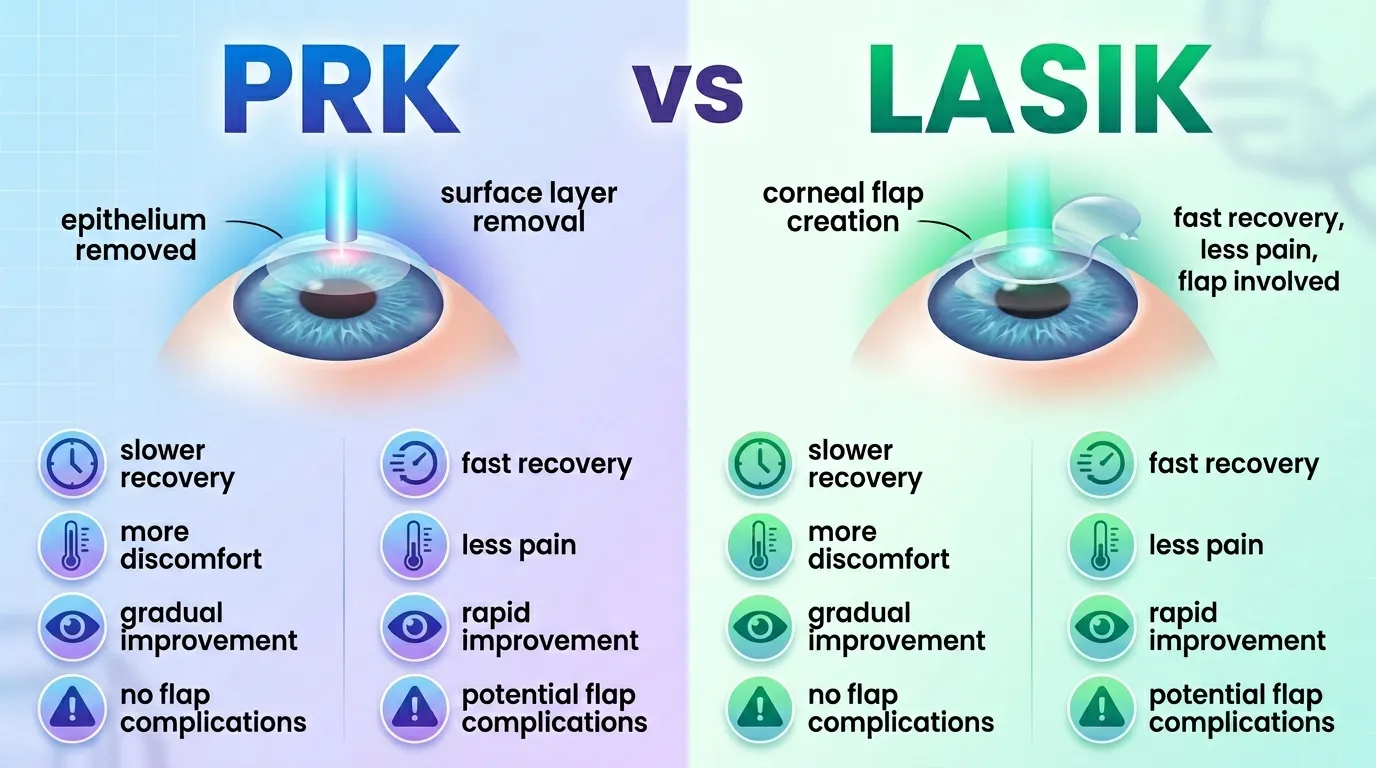
The main difference lies in how the cornea is treated:
- PRK removes the outer surface layer before reshaping
- LASIK creates a flap and reshapes underneath
This single difference impacts recovery time, pain level, and overall experience.
Detailed Definitions of Both
PRK (Photorefractive Keratectomy)
PRK is a type of laser eye surgery in which the outermost layer of the cornea (epithelium) is completely removed, allowing the laser to directly reshape the corneal surface. After the procedure, the epithelium naturally grows back over a few days.
This method is especially useful for people with thin corneas, irregular corneal surfaces, or active lifestyles where flap-related complications must be avoided.
👉 Example: An athlete or military candidate often chooses PRK because it offers long-term stability without flap risks.
LASIK (Laser-Assisted In Situ Keratomileusis)
LASIK is a modern laser eye surgery where a thin flap is created in the cornea, lifted, and then the underlying tissue is reshaped using a laser. The flap is then repositioned, acting like a natural bandage.
It is widely preferred due to its fast recovery, minimal discomfort, and immediate vision improvement.
👉 Example: A working professional may choose LASIK to resume daily activities within 24–48 hours.
Quick Comparison Table (PRK vs LASIK)
| Feature | PRK 👁️ | LASIK 👁️ |
|---|---|---|
| Procedure Type | Surface-based | Flap-based |
| Recovery Time | Slow | Fast |
| Pain Level | Moderate | Minimal |
| Vision Clarity | Gradual | Quick |
| Flap Risk | None | Present |
| Best For | Thin corneas | Most patients |
PRK vs LASIK 15 Key Differences with Real-Life Examples
1. 🧬 Procedure Technique
- PRK removes the outer layer of the cornea
- LASIK creates a thin flap in the cornea
👉 Example:
PRK is like polishing the surface, while LASIK is like opening a lid and fixing underneath.
2. ⏳ Recovery Time
- PRK: Takes 1–2 weeks
- LASIK: Takes 1–2 days
👉 Example:
A student with upcoming exams may choose LASIK to recover quickly.
3. 😣 Pain & Discomfort
- PRK: More discomfort after surgery
- LASIK: Minimal discomfort
👉 Example:
PRK patients may feel burning or irritation for a few days, while LASIK patients usually feel fine within hours.
4. 👁️ Vision Recovery Speed
- PRK: Vision improves gradually
- LASIK: Vision improves quickly
👉 Example:
A LASIK patient may see clearly the next day, while PRK takes several days.
5. ⚠️ Flap Risk
- PRK: No flap, so no flap risk
- LASIK: Flap complications are possible
👉 Example:
A boxer avoids LASIK because a hit could affect the flap.
6. 🧑⚕️ Suitability for Thin Corneas
- PRK: Suitable
- LASIK: May not be suitable
👉 Example:
Doctors often recommend PRK for patients with thin corneas.
7. 🏃 Lifestyle Compatibility
- PRK: Better for active lifestyles
- LASIK: Less suitable for contact sports
👉 Example:
An athlete chooses PRK to avoid injury-related risks.
8. 💼 Return to Work
- PRK: Slower return
- LASIK: Faster return
👉 Example:
An office worker may return to work in 2 days after LASIK.
9. 💧 Dry Eyes Risk
- PRK: Lower risk
- LASIK: Higher temporary risk
👉 Example:
LASIK patients may need eye drops for dryness.
10. 🔬 Healing Process
- PRK: Outer layer regrows naturally
- LASIK: Flap heals in place
👉 Example:
PRK healing takes longer because the surface needs to regenerate.
11. 🕶️ Aftercare
- PRK: Requires more care
- LASIK: Requires less care
👉 Example:
PRK patients need more follow-up visits.
12. 🎯 Vision Stability
- PRK: Stable but slow improvement
- LASIK: Fast and stable
👉 Example:
PRK patients may take weeks to reach final clarity.
13. 🔁 Enhancement (Redo)
- PRK: Easier to repeat
- LASIK: Depends on flap condition
👉 Example:
If vision is not fully corrected, PRK can be redone more easily.
14. 💰 Cost
- PRK: Usually cheaper
- LASIK: Usually more expensive
👉 Example:
A budget-conscious person may choose PRK.
15. ⏱️ Surgery Experience
- PRK: Slightly longer process
- LASIK: Very quick procedure
👉 Example:
LASIK is often completed within 10–15 minutes.
When to Choose Each
Choose PRK if:
- You have thin corneas
- You play contact sports
- You want zero flap risk
Choose LASIK if:
- You want fast recovery
- You prefer minimal pain
- You qualify medically
Similarities
- Both correct vision problems
- Both use laser technology
- Both offer long-term results
Real-Life Examples
- A soldier chooses PRK for safety
- An office worker chooses LASIK for quick recovery
FAQs
1. Is PRK better than LASIK?
It depends on your eye condition and lifestyle.
2. Which is more painful?
PRK is more uncomfortable during recovery.
3. Which gives faster results?
LASIK provides quicker vision improvement.
4. Are results permanent?
Both offer long-lasting results.
5. Can everyone get LASIK?
No, eligibility depends on eye health.
Conclusion
Choosing between PRK vs LASIK isn’t just about picking the “better” procedure—it’s about choosing what’s right for your eyes and lifestyle. If you value safety in high-impact situations or have thin corneas, PRK can be a reliable and stable option, even though it requires patience during recovery. On the other hand, if you want quick results, minimal discomfort, and a fast return to normal life, LASIK stands out as a convenient choice.
The important thing to understand is that both procedures are highly advanced, safe, and effective when performed by qualified professionals. Instead of following trends, focus on your individual needs, eye condition, and doctor’s advice.
Clear vision is the goal—but choosing the right path to it makes all the difference.

I am content creator and comparison blogger focused on analyzing key differences between terms, concepts, and ideas to deliver accurate, easy-to-understand information. So I decided to create a platform where these differences are explained in the simplest way possible.