Have you ever written a sentence and suddenly felt unsure about whether a word is the subject or the object? This confusion is extremely common, especially for students and beginners learning English grammar. Think about this sentence: “Ali helped Ahmed.” At first glance, it looks simple but if someone asks you which word is the subject and which is the object, you might pause for a moment.
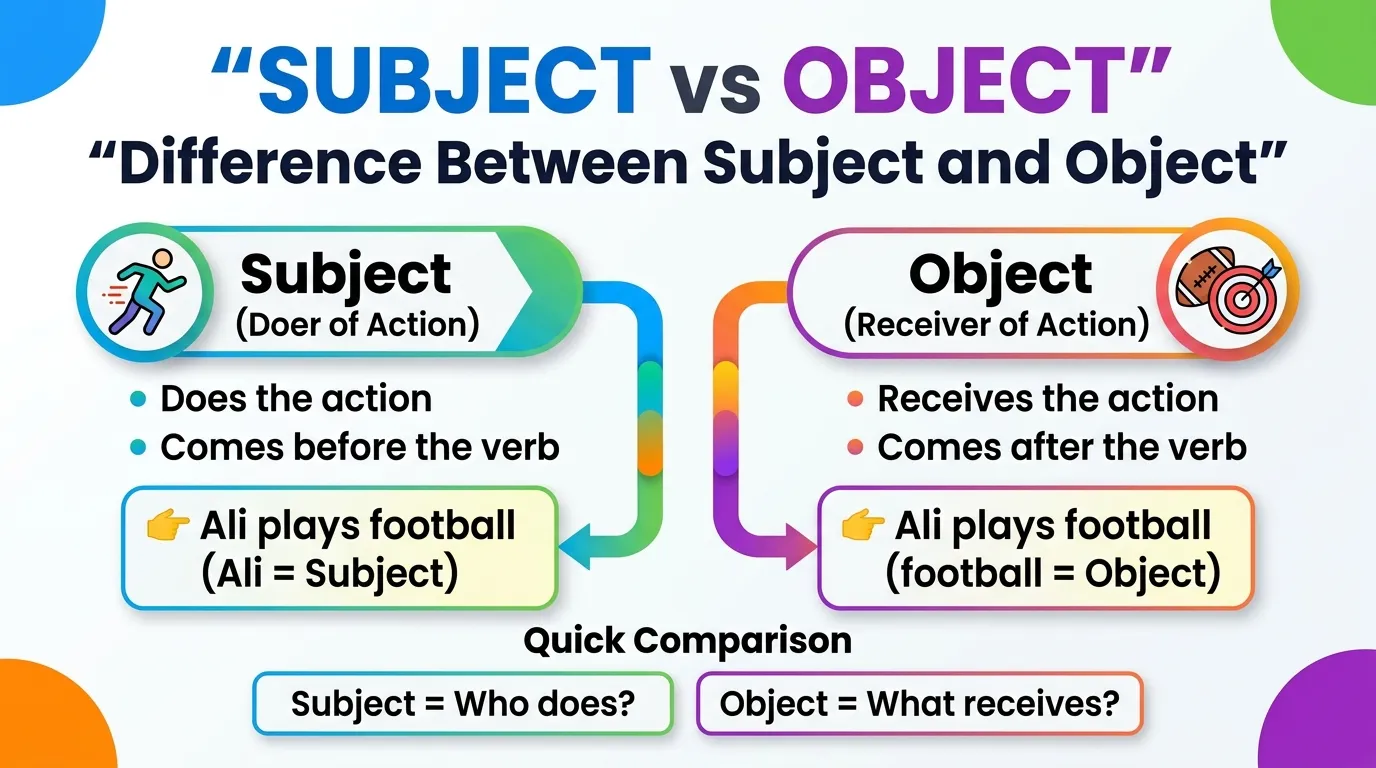
This is because both are essential parts of a sentence, yet they play completely different roles. The subject is the one performing the action, while the object is the one receiving it. Sounds easy, right? But as sentences become longer or more complex, identifying them can become tricky.
Understanding this difference is not just important for exams—it’s crucial for speaking and writing correct English in daily life. Whether you’re forming basic sentences or improving your grammar skills, mastering both will make your communication clearer and more professional.
In this guide, you’ll learn everything you need to know about the difference between subject and object, with simple explanations, real-life examples, and practical tips that you can apply instantly.
Definitions of Both
What is a Subject?
The subject is the person, place, thing, or idea that performs the action in a sentence or is being described.
Examples:
- Ahmed plays cricket
- The baby is crying
- They are happy
What is an Object?
The object is the person, place, thing, or idea that receives the action performed by the subject.
Examples:
- Ahmed plays cricket
- She bought a dress
- They invited their friends
Quick Comparison Table
| Feature | Subject | Object |
| Role | Performs the action | Receives the action |
| Position | Usually before the verb | Usually after the verb |
| Question | Who/What is doing the action? | Whom/What is affected? |
| Example | Ali kicked the ball | Ali kicked the ball |
| Importance | Main focus of sentence | Supporting element |
Key Differences Between Both with Meanings and Examples
1. Role in Sentence
- Subject performs the action
- Object receives the action
Examples:
- Ali (subject) kicked the ball (object)
- Sara reads a book
2. Position in Sentence
- Subject comes before the verb
- Object comes after the verb
Examples:
- Ahmed (subject) opened the door (object)
- She bought a dress
3. Importance
- Subject is essential
- Object may be optional
Examples:
- He (subject) runs (no object)
- They built a house
4. Action Control
- Subject controls the verb
- Object depends on the verb
Examples:
- She (subject) writes a letter (object)
- We play cricket
5. Identification Question
- Subject → Who/What is doing it?
- Object → What/Whom is affected?
Examples:
- John (subject) helped Mary (object)
- The dog chased the cat
6. Existence in Sentence
- Every sentence must have a subject
- Not every sentence has an object
Examples:
- Birds (subject) fly (no object)
- She sings songs
7. Type of Word
- Subject is usually a noun/pronoun
- Object is also a noun/pronoun
Examples:
- They (subject) watched a movie (object)
- Ali invited his friend
8. Focus of Sentence
- Subject is the main focus
- Object gives extra detail
Examples:
- The teacher (subject) explained the lesson (object)
- My brother fixed the car
9. Verb Agreement
- Subject agrees with the verb
- Object does not affect verb form
Examples:
- She (subject) eats apples (object)
- They eat apples
10. Passive Voice Change
- Subject can become object
- Object can become subject
Examples:
- Ali wrote a letter → A letter was written by Ali
- She cleaned the room → The room was cleaned by her
11. Sentence Meaning
- Subject gives core meaning
- Object completes the meaning
Examples:
- He reads books
- They watch movies
12. Pronoun Forms
- Subject: I, he, she, they
- Object: me, him, her, them
Examples:
- I called him
- She invited them
13. Placement Flexibility
- Subject position is usually fixed
- Object position can change in questions
Examples:
- You like mangoes
- What did you buy?
14. Dependency
- Subject is independent
- Object depends on the verb
Examples:
- The baby cried
- He kicked the ball
15. Sentence Examples
- Subject = doer
- Object = receiver
Examples:
- They (subject) painted the wall (object)
- She loves music
When to Use Each
Use Subject When:
- You are identifying the doer of the action
- The word comes before the verb
- You are forming the main part of a sentence
Use Object When:
- You are identifying what receives the action
- The word comes after the verb
- You want to complete the meaning of a sentence
Common Mistakes:
- ❌ Him is my friend
- ✅ He is my friend
- ❌ Me did the work
- ✅ I did the work
- ❌ She called I
- ✅ She called me
Similarities
- Both are key parts of sentence structure
- Both are usually nouns or pronouns
- Both help make sentences meaningful and complete
Real-Life Examples
- Ali wrote a letter
- She opened the door
- They watched a movie
- The teacher helped the student
- He repaired the bike
- We visited the park
FAQs
1. What is the difference between subject and object in simple words?
The subject does the action, while the object receives it.
2. Can a sentence exist without an object?
Yes, but it cannot exist without a subject.
3. How can I quickly find the subject?
Ask: Who is doing the action?
4. How do I identify the object?
Ask: What is receiving the action?
5. Are subject and object always nouns?
No, they can also be pronouns.
6. What are object pronouns?
Words like me, him, her, them used as objects.
7. Why is this difference important?
It helps you write grammatically correct sentences.
Conclusion
Understanding the difference between subject and object is one of the most important steps in mastering English grammar. While the subject tells us who is doing the action, the object tells us what is being affected by that action. This simple distinction forms the backbone of almost every sentence you speak or write. Many learners struggle with this concept at first, but once you start identifying subjects and objects in everyday sentences, it quickly becomes natural. The key is practice—read sentences, break them down, and ask the right questions: Who is doing the action? and What is receiving it? By mastering this basic rule, you not only improve your grammar but also make your communication clearer, more accurate, and more confident. So next time you write a sentence, take a moment to identify the both—you’ll be surprised how much your English improves.

I am content creator and comparison blogger focused on analyzing key differences between terms, concepts, and ideas to deliver accurate, easy-to-understand information. So I decided to create a platform where these differences are explained in the simplest way possible.