One day, a student walked into a library and asked the librarian about a book. The librarian gently corrected his wording not his question, but the word he used. He had said “inquire,” while the librarian preferred “enquire.” This small moment reflects a common confusion in English.
The difference between enquire and inquire may seem subtle, but it carries importance in tone, context, and regional usage. When we explore enquire vs inquire, we realize that both words mean “to ask” or “seek information,” yet their usage differs slightly depending on formality and geography.
Many learners struggle with enquire vs inquire, especially when writing professionally. Understanding the difference between them improve clarity, precision, and confidence in communication.
Key Difference Between Both
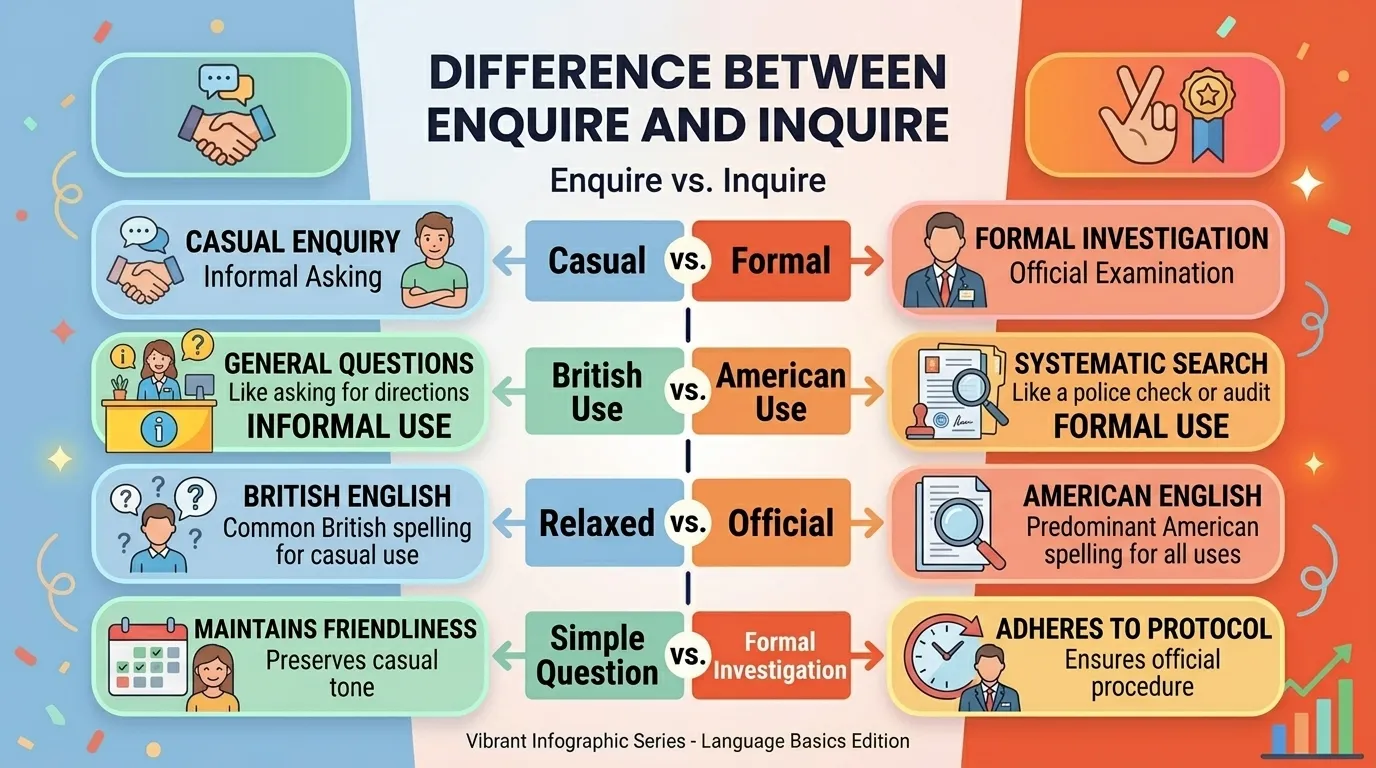
The primary difference between enquire and inquire lies in usage and context. “Enquire” is often used in British English for general questions, while “inquire” is more common in American English and formal investigations.
Why Is Their Difference Necessary to Know?
Understanding the difference between enquire and inquire is essential for both learners and professionals. In academic, legal, and business environments, using the correct word can impact clarity and credibility. For example, “inquire” is often used in official investigations, making it suitable for formal contexts. On the other hand, “enquire” feels more conversational and polite in everyday British communication.
In society, language shapes perception. A well-chosen word reflects professionalism and cultural awareness. For experts, precise usage avoids ambiguity, while learners gain confidence in both spoken and written English. Knowing enquire vs inquire also helps when dealing with international audiences, where slight differences can affect tone and interpretation.
Pronunciation of Both (US & UK)
- Enquire (UK): /ɪnˈkwaɪə/
- Inquire (US): /ɪnˈkwaɪr/
Though spelled differently, both words are pronounced very similarly. This similarity often adds to the confusion.
Linking Hook:
Now that pronunciation is clear, let’s move deeper into the real distinction between these two commonly confused words.
Difference Between Enquire and Inquire
General vs Formal Use
Enquire is used for casual questions, while inquire is used for formal investigations.
Examples:
- She enquired about the price of the dress.
- He enquired about train timings.
- The committee inquired into the matter.
- Police inquired into the incident.
British vs American Preference
Enquire is common in British English; inquire dominates American English.
Examples:
- She enquired politely (UK).
- He enquired about the event (UK).
- She inquired about the policy (US).
- He inquired about the job (US).
Tone of Communication
Enquire sounds softer and polite; inquire sounds official.
Examples:
- She enquired kindly about his health.
- He enquired with curiosity.
- The officer inquired strictly.
- The lawyer inquired formally.
Usage in Official Contexts
Inquire is preferred in legal or official matters.
Examples:
- Authorities inquired into corruption.
- The court inquired into evidence.
- She enquired about hotel services.
- He enquired about ticket prices.
Verb Forms
Both verbs behave similarly but differ in usage.
Examples:
- She is enquiring about courses.
- He enquired yesterday.
- She is inquiring about the case.
- He inquired last week.
Written vs Spoken English
Enquire is more common in casual writing; inquire in formal writing.
Examples:
- Please enquire at reception.
- She enquired via email.
- He inquired in an official letter.
- The report inquired deeply.
Intensity of Question
Enquire implies light questioning; inquire suggests deeper investigation.
Examples:
- He enquired casually.
- She enquired about lunch.
- Detectives inquired thoroughly.
- Officials inquired seriously.
Context of Use
Enquire is everyday; inquire is specialized.
Examples:
- She enquired about directions.
- He enquired about fees.
- The panel inquired about misconduct.
- Police inquired into fraud.
Regional Adaptation
Usage depends on audience location.
Examples:
- British teacher enquired.
- UK notice says “enquire here.”
- US form says “inquire within.”
- American company inquired officially.
Perception and Impression
Enquire feels friendly; inquire feels authoritative.
Examples:
- She enquired gently.
- He enquired politely.
- The judge inquired firmly.
- The manager inquired seriously.
Nature and Behaviour of Both
“Enquire” behaves as a soft, polite, and conversational verb, often used in everyday situations. It reflects curiosity without seriousness.
“Inquire,” on the other hand, behaves as a formal, investigative verb. It carries a sense of authority and depth, often associated with official or legal matters.
Why People Are Confused About Their Use?
| Aspect | Enquire | Inquire | Similarity |
| Meaning | Ask casually | Ask formally | Both mean “to ask” |
| Region | British English | American English | Used globally |
| Tone | Polite | Formal | Both polite in context |
| Usage | Daily conversation | Official context | Interchangeable sometimes |
| Pronunciation | Same | Same | Causes confusion |
Which Is Better in What Situation?
“Enquire” is better suited for everyday communication, especially in British English contexts. If you are asking about directions, prices, or general information, “enquire” sounds more natural and polite. It creates a friendly tone and works well in casual conversations or informal writing.
“Inquire” is more appropriate in formal, academic, or legal situations. When dealing with investigations, official reports, or professional communication, “inquire” conveys seriousness and authority. In American English, it is commonly used in both formal and informal contexts, making it more versatile globally.
Use in Metaphors and Similes
- He enquired like a curious child exploring the world.
- She enquired as gently as a breeze.
- The detective inquired like a hawk watching its prey.
- He inquired as deeply as an ocean searching for truth.
Connotative Meaning of Both
Enquire (Positive/Neutral):
- Suggests curiosity and politeness
Examples: - She enquired kindly about my health.
- He enquired with genuine interest.
Inquire (Neutral/Serious):
- Suggests investigation or authority
Examples: - The officer inquired about the case.
- The panel inquired into the issue.
Idioms or Proverbs Related to the Words
- “Ask and you shall receive”
Example: If you enquire politely, you will find help. - “Curiosity killed the cat”
Example: He inquired too deeply into the matter. - “Seek and you shall find”
Example: She enquired about opportunities and found success.
Works in Literature
- An Inquiry into the Nature and Causes of the Wealth of Nations — Genre: Economics, Writer: Adam Smith, Year: 1776
- Inquiry (Essay collections and philosophical texts often use the term)
Movie Names
- The Inquiry — Released: 2006, Country: Italy
- An Inquiry into Love — Released: 2012, Country: USA
Frequently Asked Questions
What is the main difference between enquire and inquire?
Enquire is used for general questions, while inquire is used for formal investigations.
Can both words be used interchangeably?
Yes, but context and region determine the better choice.
Which is more common in American English?
“Inquire” is more commonly used in the US.
Is enquire outdated?
No, it is still widely used in British English.
Why do people confuse enquire vs inquire?
Because they have similar meanings and identical pronunciation.
How Both Are Useful for Surroundings
Both words play a vital role in communication. “Enquire” helps build polite and friendly interactions in daily life, while “inquire” supports formal communication, investigations, and professional clarity. Together, they enhance effective communication in society.
Final Words for Both
“Enquire” and “inquire” are not rivals but companions in language. Each serves a purpose depending on tone, context, and region. Mastering their use helps you sound more natural and precise.
Conclusion
The difference between enquire and inquire may appear minor, but it holds significant value in communication. From casual conversations to formal investigations, choosing the right word ensures clarity and professionalism. While “enquire” suits everyday British usage, “inquire” dominates formal and American contexts. Understanding enquire vs inquire allows speakers and writers to adapt their language effectively across different situations. By learning their nuances, you not only improve your vocabulary but also enhance your confidence in English communication.

I am content creator and comparison blogger focused on analyzing key differences between terms, concepts, and ideas to deliver accurate, easy-to-understand information. So I decided to create a platform where these differences are explained in the simplest way possible.