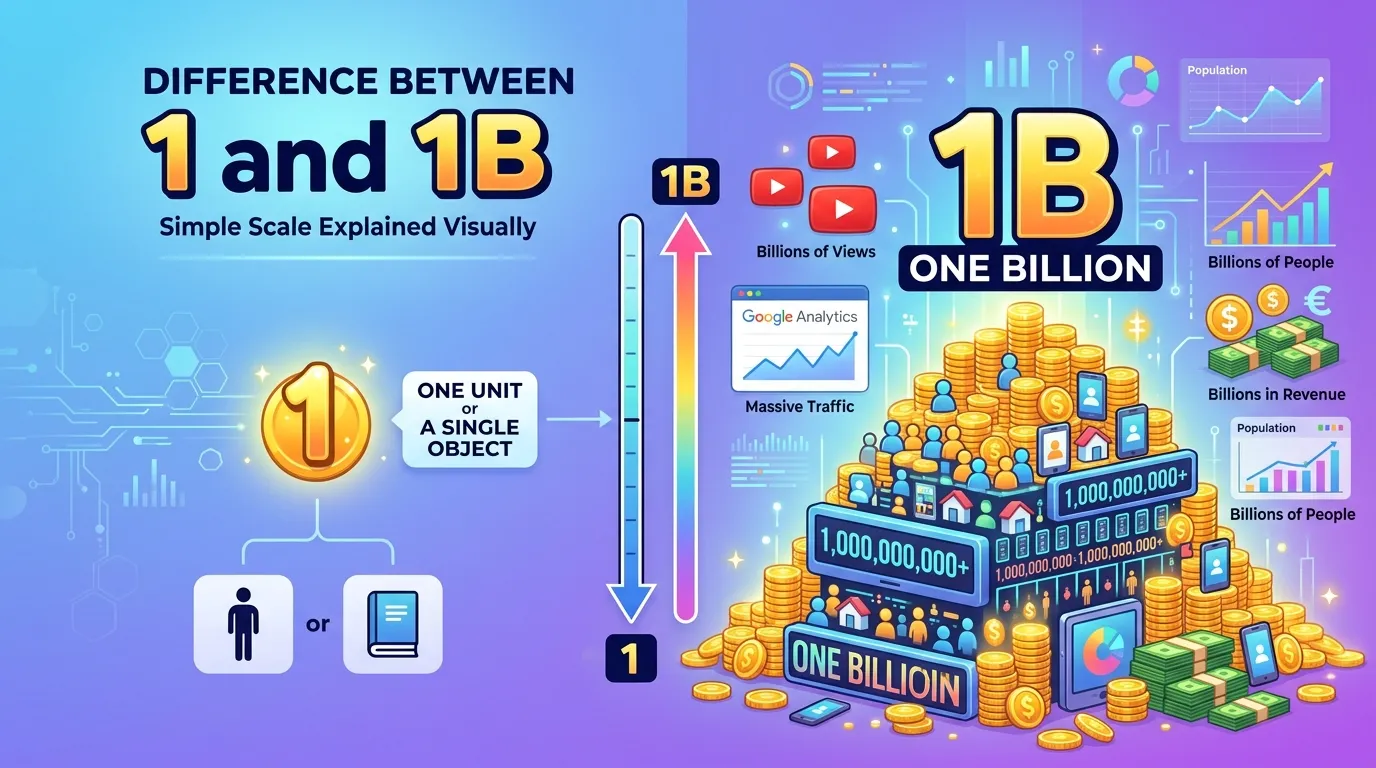
The difference between 1 and 1B is a basic but very important concept that many people misunderstand when they see numbers in real life, especially in finance, social media, and data reports.
In simple terms, “1” means a single unit or quantity of something, while “1B (1 billion)” means 1,000,000,000 units, representing an extremely large scale used in global systems like YouTube views, company revenues, or population data. This topic often creates confusion when users search the difference between both, because both look similar but represent completely different levels of magnitude.
In this article, you will clearly understand what these terms mean, how they are used in real-world scenarios, and why the difference between both matters in everyday digital and financial understanding.
Quick Answer: Difference Between 1 and 1B
The difference between 1 and 1B (1 billion) is scale.
1 means a single unit, while 1B means 1,000,000,000 (one billion units).
Example:
1 dollar is a single unit, but 1B dollars equals one billion dollars, which is a massive financial amount used in global economies like Google, Meta, or YouTube revenue reports.
Definition of Both
- 1 (One): A single unit, number, or quantity representing something individual.
- 1B (One Billion): A numerical value equal to 1,000,000,000 in the short scale system used in most countries including the US, UK, and Pakistan.
Both terms are used in mathematics, finance, data analytics, and digital platforms like YouTube, Instagram, and Google Analytics.
Pronunciation (US & UK)
To better understand the difference between both, let’s also look at how they are spoken:
- 1
- US: /wʌn/
- UK: /wʌn/
- 1B (One Billion)
- US: /wʌn ˈbɪl.jən/
- UK: /wʌn ˈbɪl.jən/
This helps in real-world communication, especially in business meetings, financial reporting, and media discussions.
1 vs 1B (Comparison Table)
| Feature | 1 | 1B (One Billion) | Similarity |
| Value | Single unit | 1,000,000,000 units | Both represent numbers |
| Scale | Very small | Extremely large | Used in counting systems |
| Usage | Everyday counting | Finance, population, analytics | Used globally |
| Context | Personal use | Business/global use | Mathematical representation |
| Example | 1 apple | 1B dollars/views | Both measurable quantities |
| Digital Use | Basic counters | YouTube views, Google data | Used in tech systems |
| Symbol | 1 | 1B or 1,000,000,000 | Numeric representation |
Key Differences Explained Between Both
1. Scale Difference
1 is a single unit, while 1B represents a billion units.
Example: 1 user vs 1B users on platforms like YouTube.
2. Financial Impact
1 dollar is minimal, but 1B dollars can represent company valuations like Meta or Google.
3. Digital Analytics
On Instagram or YouTube, 1 view is nothing, but 1B views show viral content reach.
4. Real-World Meaning
1 represents personal scale, 1B represents global scale usage.
5. Data Representation
In Google Analytics, 1 is raw data, while 1B indicates massive traffic or engagement.
6. Educational Context
Students learn 1 in early math, but 1B in advanced numerical systems.
7. Business Context
Startups aim for 1M users, while tech giants aim for billions like Meta platforms.
Why Does the Difference Between 1 and 1B Exist?
The difference exists because humans needed a system to measure extremely large quantities efficiently. Imagine counting every person, dollar, or click manually—impossible without scaling systems.
So, numerical scales like million (M), billion (B), and trillion (T) were introduced to simplify global communication in economics, science, and technology.
How Both Are Used in Real Life
- Finance: Bank reports, GDP, company valuation
- Social Media: YouTube views, Instagram reach
- Science: Population studies, astronomy data
- Business: Revenue reports, user base metrics
- Technology: Google search data, server requests
Entities like Google, YouTube, and Meta rely heavily on these large-scale numbers to measure success and performance.
Difference Between Both Explained in Simple Words
In simple terms, 1 is something you can easily count, while 1B is something so large it represents massive systems like global users or billions of dollars.
Think of it like this:
- 1 drop of water
- 1B drops = an ocean
Common Mistakes with Both
- Confusing 1B with 1 million
- Misreading financial reports
- Ignoring number formatting in analytics tools
- Mixing short scale and long scale systems
Fix: Always remember 1B = 1,000,000,000 in modern international usage.
Real-Life Examples of both
- A person has 1 phone, but Apple sells 1B+ devices globally over time
- A YouTube video can have 1 view or 1B views
- A startup may have 1 user, while Facebook (Meta) has billions
- A small transaction is 1 dollar, global GDP involves billions
When to Use 1 vs 1B
- Use 1 when talking about individual or small quantities
- Use 1B when discussing large-scale systems, global data, or financial reports
Decision-making becomes easier when you understand scale clearly.
Why People Get Confused Between Them
Many users confuse these because:
- Social media shows “1B views” casually
- Educational systems don’t always explain scale deeply
- Regional differences in number naming
- Lack of real-world comparison understanding
So the gap between simple math and real-world usage creates confusion.
Expert Insight
From an analytical perspective, understanding the difference between 1 and 1B is essential in data-driven industries. In real-world experience, beginners often underestimate how billion-scale metrics influence business decisions. For example, a marketing analyst at a digital agency must interpret whether 1M or 1B impressions significantly change campaign performance.
FAQs
Q1: What is 1B equal to?
1B equals 1,000,000,000 (one billion).
Q2: Is 1B bigger than 1 million?
Yes, 1B is 1000 times larger than 1 million.
Q3: What does 1B mean in YouTube views?
It means one billion total views.
Q4: Why is 1B used instead of full numbers?
To simplify large numbers in reporting and communication.
Q5: Is 1B the same in all countries?
Yes, in the short scale system used globally.
Q6: Where is 1B commonly used?
Finance, social media, population stats, and business analytics.
Conclusion
The difference between 1 and 1b is fundamentally about scale and real-world application. While 1 represents a single unit, 1B represents one billion units, which is used in global systems like finance, technology, and social media platforms.
Understanding the difference between both helps you interpret data more accurately in everyday life, whether you’re reading YouTube analytics, financial reports, or population statistics. In simple terms, 1 is personal and small-scale, while 1B represents massive global-scale impact.

I am content creator and comparison blogger focused on analyzing key differences between terms, concepts, and ideas to deliver accurate, easy-to-understand information. So I decided to create a platform where these differences are explained in the simplest way possible.