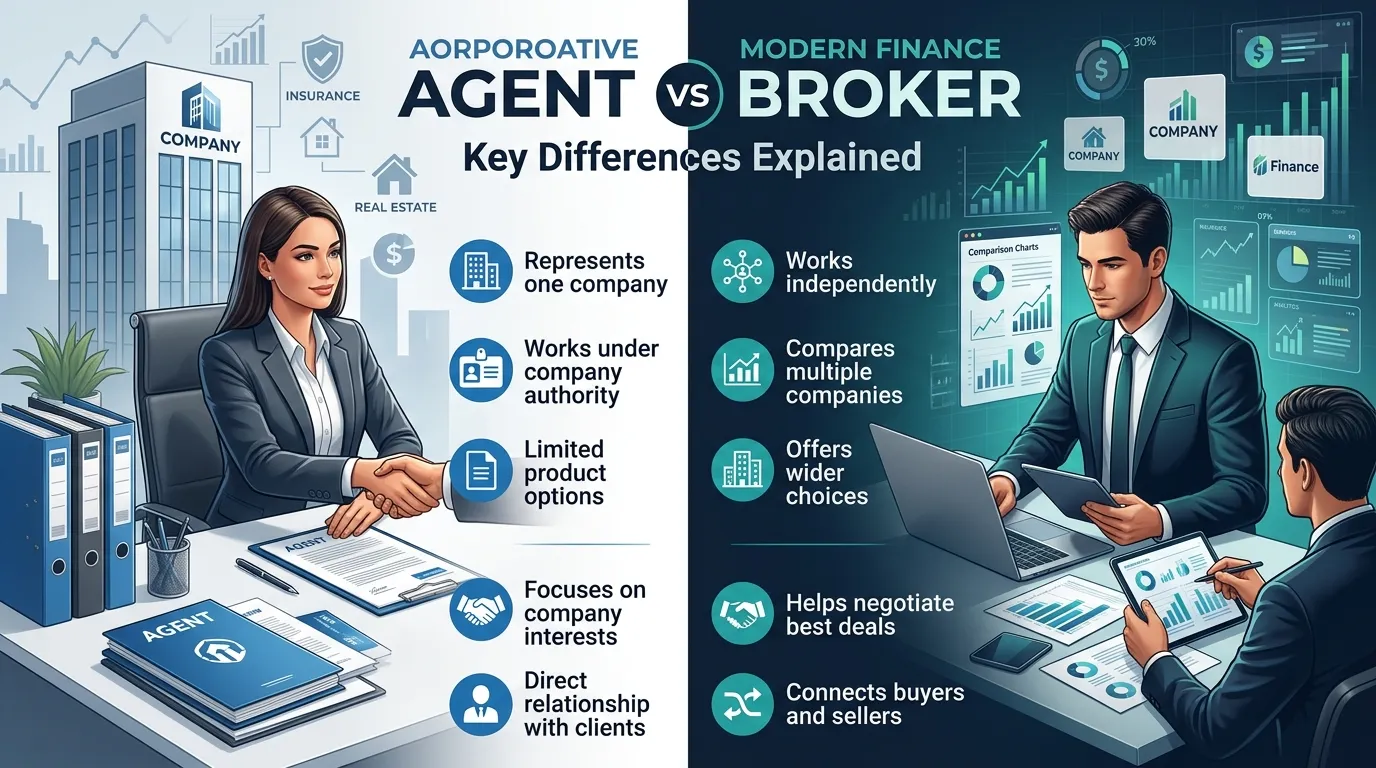
Many users get confused about the difference between agent and broker because both terms are often used in insurance, real estate, finance, and business transactions. In simple words, an agent usually represents one company or party, while a broker works independently and connects buyers with multiple sellers or providers.
Understanding the difference between agent and broker matters because it affects pricing, legal responsibility, commissions, and the level of choice you get as a customer. Whether you are buying insurance, investing in stocks, purchasing property, or working with a service provider, knowing who represents whom can save time and money.
In this guide, you will learn:
- what an agent is
- what a broker does
- how agents and brokers differ
- when to use each one
- real-world examples
- common mistakes people make
Let’s understand this clearly so you never confuse these two professional roles again.
Quick Answer: Difference Between Agent and Broker
An agent represents a company, seller, or client and acts on their behalf. A broker is an independent middleman who connects buyers and sellers and often offers multiple options.
Real Example:
- An insurance agent may sell policies from only one insurance company.
- An insurance broker compares plans from several companies to find the best option for a client.
Definition of Agent and Broker
- Agent: A professional authorized to act for another person, company, or organization in business deals or transactions.
- Broker: An independent intermediary who connects buyers and sellers while helping negotiate deals or compare options.
Simple Example:
A real estate agent may work for one property agency, while a mortgage broker helps clients compare loans from many lenders.
Pronunciation of Both Terms
| Term | US Pronunciation | UK Pronunciation |
| Agent | /ˈeɪ.dʒənt/ | /ˈeɪ.dʒənt/ |
| Broker | /ˈbroʊ.kɚ/ | /ˈbrəʊ.kər/ |
Now that the meanings are clear, let’s explore the deeper comparison between these two roles and why people often misunderstand them.
Difference Between Agent and Broker (Comparison Table)
| Feature | Agent | Broker |
| Main Role | Represents a company or client | Connects buyers and sellers |
| Independence | Often tied to one company | Usually independent |
| Product Options | Limited options | Multiple options |
| Responsibility | Works for principal/company | Works for transaction success |
| Licensing | Specific industry license | Often requires higher-level license |
| Client Relationship | Represents one side | May work between both sides |
| Commission Source | Paid by company/principal | Earns from transaction fees |
| Decision Authority | Can act officially for principal | Usually negotiates only |
| Common Industries | Insurance, real estate, travel | Finance, insurance, stock market |
| Main Goal | Promote company/client interest | Help complete the best deal |
KEY DIFFERENCES EXPLAINED BETWEEN AGENT AND BROKER
1. Representation Structure
An agent directly represents someone else. A broker mainly acts as a connector.
Real-Life Example
A travel agent books packages from a specific company, while a travel broker compares offers from many providers.
2. Independence Level
Most brokers operate independently. Agents often work under contracts with a company.
User Intent Insight
People searching “broker vs agent” usually want to know who offers more flexibility.
3. Product Variety
Brokers typically provide more choices because they work with multiple companies.
Example
An insurance broker may compare policies from several insurers, while an insurance agent may only offer one brand.
4. Licensing Requirements
In industries like real estate and finance, brokers usually need more advanced certifications.
Practical Insight
In many regions, a broker can supervise agents, but agents cannot supervise brokers.
5. Client Responsibility
Agents protect the interests of their employer or principal. Brokers focus more on matching both sides effectively.
6. Income Structure
Agents often earn salaries plus commissions. Brokers usually depend heavily on commissions from successful transactions.
7. Legal Authority
An agent may legally sign or act on behalf of another party. A broker usually cannot make decisions for clients.
Why Does the Agent and Broker System Exist?
The system exists because markets are complex. Buyers often need guidance, while companies need representatives.
Why Agents Exist
Companies use agents to:
- increase sales
- manage customers
- provide direct representation
- build brand loyalty
Why Brokers Exist
Brokers exist because consumers want:
- better comparisons
- unbiased recommendations
- multiple pricing options
- negotiation support
In practical use, brokers became more important as industries like finance and insurance became more competitive.
How Does an Agent Work?
An agent acts under authority given by another party.
Typical Agent Workflow
- Represents a company or client
- Promotes products or services
- Handles communication
- Earns commission after sale
Real Scenario
A real estate agent lists homes, arranges property tours, and negotiates prices on behalf of the seller.
How Does a Broker Work?
A broker works as an intermediary between parties.
Typical Broker Workflow
- Understands client needs
- Compares available options
- Negotiates deals
- Helps complete transactions
Example
A stock broker helps investors buy and sell shares in markets like the New York Stock Exchange.
Today, online platforms from companies like Google and financial apps influenced by companies like Meta use recommendation systems that also changed how brokers connect with users digitally.
Industries Where Agents and Brokers Are Common
Insurance Industry
- Insurance agents represent insurers
- Insurance brokers compare policies for customers
Real Estate
- Agents represent buyers or sellers
- Brokers may manage agencies and supervise agents
Financial Markets
- Stock brokers execute trades
- Investment agents may represent firms
Travel Industry
- Travel agents sell packages
- Brokers arrange corporate travel solutions
Common Mistakes With Agent and Broker
1. Thinking They Are the Same
Many beginners assume both words mean “salesperson.”
Correction
Agents represent. Brokers connect.
2. Assuming Brokers Always Cost More
Some users think brokers increase prices.
Reality
Brokers sometimes save money by comparing multiple providers.
3. Ignoring Licensing Differences
Not all agents can legally perform broker-level tasks.
4. Believing Agents Are Always Biased
Good agents can still provide excellent service despite representing one company.
5. Choosing Without Understanding Roles
People often hire professionals before understanding whether they need representation or comparison support.
Real-Life Examples With Agent and Broker
Example 1: Buying Insurance
A customer contacts:
- an insurance agent for one company’s policy
- a broker to compare many policies
Example 2: Buying a House
A real estate broker may oversee multiple agents handling different property deals.
Example 3: Stock Trading
An online brokerage platform lets investors trade securities through licensed brokers.
Example 4: Business Partnerships
A commercial broker connects companies with suppliers and negotiates contracts.
Example 5: Travel Booking
A travel agent promotes holiday packages, while a broker may customize business travel solutions.
When Should You Use an Agent?
Use an agent when:
- you already trust a company
- you want direct representation
- you need specialized support
- loyalty matters more than comparison
Best Example
Using a dedicated insurance agent for long-term policy management.
When Should You Use a Broker?
Use a broker when:
- you want multiple options
- you need price comparisons
- you are entering a complex market
- negotiation support matters
Best Example
Using a mortgage broker to compare loan rates from many banks.
Why People Get Confused Between Agent and Broker
Similar Daily Usage
Movies, media, and casual conversations often use the terms interchangeably.
Industry Differences
In some countries, legal definitions vary across industries.
Digital Platforms Changed Meanings
Modern apps blur the line between agents and brokers using automation and AI recommendations.
Platforms like YouTube and social media discussions sometimes spread simplified explanations that create further confusion.
Expert Insight: Industry Perspective
In real scenarios, the best choice depends on the complexity of the transaction.
Most beginners benefit from brokers when they need comparison and flexibility. However, experienced customers sometimes prefer agents because they already trust a specific brand or company.
Professionals in insurance and finance often explain it this way:
- Agents deepen relationships.
- Brokers widen choices.
That small distinction changes the entire customer experience.
Frequently Asked Questions (FAQ)
What is the main difference between agent and broker?
An agent represents a company or client, while a broker independently connects buyers and sellers.
Is a broker higher than an agent?
In industries like real estate, brokers often have higher licensing authority and can supervise agents.
Who earns more, agent or broker?
It depends on the industry, experience, and transaction volume. Brokers may earn more due to independent commissions.
Can a broker also be an agent?
Yes. In some industries, professionals can perform both roles depending on licensing and agreements.
Which is better: broker or agent?
Neither is universally better. Brokers offer more options, while agents provide focused representation.
Are brokers independent?
Most brokers operate independently and work with multiple providers or clients.
Why do companies use agents?
Agents help companies maintain direct customer relationships and consistent brand representation.
Do brokers charge clients directly?
Some brokers earn from commissions, while others may charge consulting or transaction fees.
What is the difference between insurance broker and insurance agent?
An insurance agent usually sells policies from one insurer. A broker compares policies from several insurers.
Conclusion
Understanding the difference between agent and broker becomes much easier once you focus on one key idea: representation versus connection.
An agent represents a person or company directly, while a broker acts more independently to connect buyers and sellers and compare available options. Both roles are important in industries like insurance, real estate, finance, travel, and business services.
In practical use, choosing between an agent and a broker depends on your goals. If you value brand loyalty and direct representation, an agent may be the right choice. If you want flexibility, comparison shopping, and negotiation support, a broker is often better.

I am content creator and comparison blogger focused on analyzing key differences between terms, concepts, and ideas to deliver accurate, easy-to-understand information. So I decided to create a platform where these differences are explained in the simplest way possible.