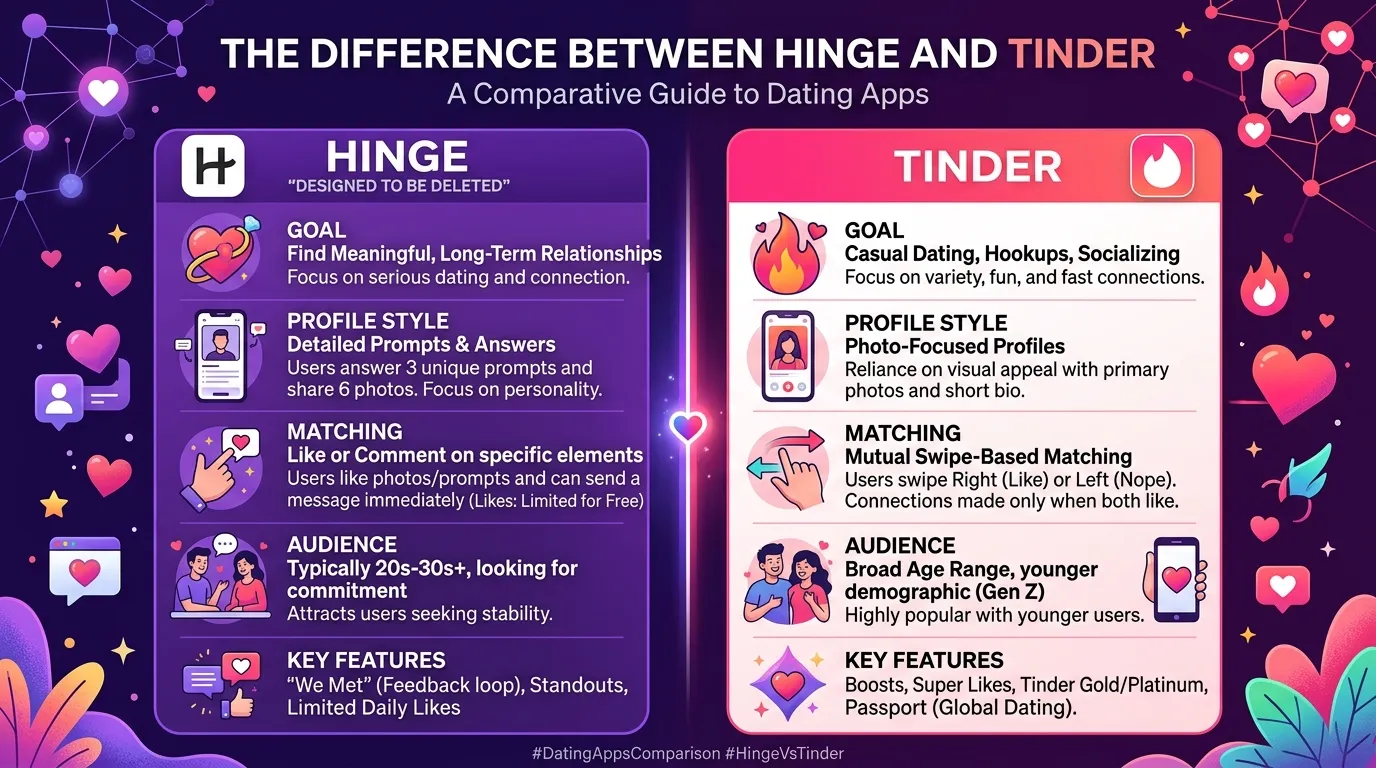
Many people search for the difference between Hinge and Tinder because both apps look similar at first, but their purpose, matching style, and user experience are actually very different. Some users want serious relationships, while others only want casual dating or quick conversations. That confusion is why this topic has become one of the most searched online dating comparisons in 2026.
In simple words, the main difference between Hinge and Tinder is the type of relationships they encourage. Hinge is more focused on meaningful connections and long-term compatibility, while Tinder is known for fast swiping, casual matches, and quick interactions. Both apps are owned by Match Group, but they target different user behaviors and dating goals.
This guide explains everything clearly, including features, algorithms, real-world usage, similarities, differences, user intent, and expert insights so you do not need another article after reading this one.
Quick Answer: Difference Between Hinge and Tinder
The biggest difference between Hinge and Tinder is the dating intention behind each app.
- Hinge focuses more on serious relationships and meaningful conversations.
- Tinder focuses more on fast matching, casual dating, and social discovery.
For example, someone searching for long-term compatibility may prefer Hinge, while a traveler looking for casual meetups may choose Tinder.
Definition of Hinge and Tinder
- Hinge: A relationship-focused dating app that encourages detailed profiles, personality prompts, and deeper conversations.
- Tinder: A swipe-based dating app designed for quick matches, casual interaction, and fast browsing.
Example:
A person wanting emotional compatibility may use Hinge, while someone interested in meeting new people quickly may choose Tinder.
Pronunciation of Both Apps
Hinge
- US Pronunciation: /hɪndʒ/
- UK Pronunciation: /hɪndʒ/
Tinder
- US Pronunciation: /ˈtɪndər/
- UK Pronunciation: /ˈtɪndə/
Now let’s understand the real difference between Hinge and Tinder in a deeper and more practical way.
Key Differences Between Hinge and Tinder
1. Relationship Goals
Hinge is designed for users looking for serious relationships. The app even uses the slogan “designed to be deleted,” which means it wants users to eventually leave the platform after finding a partner.
Tinder is more flexible. Some people use it for serious dating, but many also use it for casual relationships, travel meetups, and social networking.
In real scenarios, many users move from Tinder to Hinge after getting tired of endless casual swiping.
2. Matching System
Hinge allows users to like a specific photo or prompt on someone’s profile. This creates natural conversation starters and more personalized interaction.
Tinder mainly uses a swipe-left and swipe-right system. The process is quick and simple, but it can feel less personal.
Most beginners find Tinder easier at first because the app is extremely fast and straightforward.
3. Profile Structure
Hinge profiles are more detailed and include:
- Personal prompts
- Interests
- Lifestyle habits
- Voice notes
- Relationship intentions
Tinder profiles are shorter and rely heavily on photos.
This difference changes how users judge compatibility and personality.
4. Conversation Style
Hinge naturally supports better conversations because users respond directly to prompts or profile details.
Tinder conversations often start with:
- “Hey”
- “What’s up?”
- Emojis
That is why many users say Hinge feels more mature and relationship-oriented.
5. User Experience
Hinge limits excessive swiping and encourages thoughtful decisions.
Tinder promotes rapid browsing and constant engagement.
This difference impacts user psychology. Some users enjoy Tinder’s speed, while others prefer Hinge’s slower and more meaningful approach.
6. Match Quality
Many users believe Hinge provides higher-quality matches because profiles contain more information.
Tinder offers a larger dating pool, but compatibility can sometimes feel weaker because decisions are often based on photos first.
7. Audience and Age Groups
Hinge is especially popular among professionals in their late 20s and 30s who want serious relationships.
Tinder attracts a wider audience including:
- College students
- Travelers
- Casual daters
- Younger users
However, both apps continue growing globally in 2026.
Why Do People Prefer Hinge for Serious Dating?
Better Personality Matching
Hinge focuses heavily on personality and compatibility. Users answer prompts that reveal humor, interests, and opinions.
This helps people connect beyond physical appearance.
More Meaningful Conversations
The prompt system reduces awkward introductions.
Instead of sending generic messages, users can reply directly to profile answers or interests.
Reduced Swipe Fatigue
Many people become mentally exhausted from endless swiping on dating apps.
Hinge slows the process down, making matches feel more intentional and valuable.
Why Is Tinder Still So Popular?
Huge Global User Base
Tinder remains one of the largest dating apps in the world.
A larger audience means more potential matches in almost every city.
Extremely Fast Matching
The swipe system is simple and addictive.
New users can start matching within minutes without building a detailed profile.
Great for Travel and Social Discovery
Many travelers use Tinder to meet locals while visiting new places.
This flexibility keeps Tinder highly relevant in modern dating culture.
Similarities Between Hinge and Tinder
Even though these apps are different, they still share many similarities.
| Similarity | Explanation |
| Mobile Dating Apps | Both are designed mainly for smartphones |
| Matching System | Both require mutual interest before chatting |
| Premium Features | Both offer paid subscriptions |
| Algorithm-Based | Both use AI-style recommendation systems |
| Messaging Features | Both allow users to communicate after matching |
| Photo Profiles | Photos remain important on both platforms |
Hinge vs Tinder Comparison Table
| Feature | Hinge | Tinder | Similarity |
| Purpose | Serious relationships | Casual or mixed dating | Both connect people online |
| Profile Style | Detailed and personality-focused | Simple and image-focused | Both require user profiles |
| Matching Method | Prompt interaction | Swipe matching | Both depend on mutual likes |
| User Experience | Slow and intentional | Fast and engaging | Both use mobile interfaces |
| Audience | Long-term relationship seekers | Casual and social users | Both attract Gen Z and millennials |
| Algorithm Logic | Compatibility focused | Engagement focused | Both use recommendation systems |
| Communication | Deeper conversations | Faster messaging | Both support chatting |
| Ownership | Match Group | Match Group | Same parent company |
This table clearly shows the difference and similarity between difference between Hinge and Tinder for quick understanding.
How Hinge and Tinder Algorithms Work
Like Google, Instagram, and Meta, dating apps rely heavily on engagement algorithms.
These apps track:
- Swipe behavior
- User activity
- Match frequency
- Conversation quality
- Profile engagement
Hinge Algorithm
Hinge rewards:
- Detailed profiles
- Meaningful conversations
- Intentional interactions
The app tries to show users who are likely to create real engagement.
Tinder Algorithm
Tinder focuses more on:
- Swipe activity
- Popularity signals
- Active usage
- Fast engagement patterns
This explains why highly active users often receive more profile visibility.
Common Mistakes With Hinge and Tinder
Thinking Tinder Is Only for Hookups
Many people build serious relationships through Tinder too.
The platform depends largely on user intent and communication style.
Fix:
Clearly mention your dating goals in your bio.
Expecting Instant Commitment on Hinge
Hinge improves compatibility, but relationships still take time.
Fix:
Focus on patience and consistency.
Ignoring Profile Quality
Low-quality photos and empty bios reduce match success on both apps.
Fix:
Use authentic photos and complete your profile properly.
Using the Same Strategy on Both Apps
Hinge requires thoughtful interaction, while Tinder rewards speed and activity.
Fix:
Adjust your communication style depending on the platform.
Real-Life Examples of Hinge and Tinder Usage
Example 1: Serious Relationship Search
A 30-year-old professional uses Hinge because they want long-term compatibility and meaningful conversations.
Example 2: Casual Travel Dating
A traveler visiting another country uses Tinder to meet locals and explore social events.
Example 3: Personality-Based Matching
An introverted user prefers Hinge because prompts make conversations easier to start naturally.
Example 4: Fast Social Interaction
A university student prefers Tinder because it provides quick matches and a larger dating pool.
When Should You Use Hinge or Tinder?
Use Hinge If:
- You want a serious relationship
- You value emotional compatibility
- You enjoy meaningful conversations
- You prefer quality over quantity
Use Tinder If:
- You want quick matches
- You enjoy casual dating
- You travel frequently
- You like fast browsing experiences
The best app depends more on your personal goals than the app itself.
Why People Get Confused Between Hinge and Tinder
Several reasons cause confusion between these apps.
Same Parent Company
Both apps are owned by Match Group, so many features overlap.
Similar Online Dating Industry
Both belong to the same modern dating app ecosystem.
Social Media Influence
Platforms like TikTok and Instagram often create viral content that mixes the image of both apps together.
Changing Dating Culture
Modern dating habits continue evolving, especially among Gen Z users in 2026.
Many users now combine casual and serious dating goals on the same app.
Expert Insight
From a digital relationship perspective, Hinge and Tinder are built around different emotional experiences.
Hinge reduces endless swiping and pushes users toward intentional communication. Tinder focuses more on speed, accessibility, and instant interaction.
In practical use, many beginners start with Tinder because it feels easier and faster. Over time, users looking for deeper emotional compatibility often transition toward Hinge.
Dating experts frequently mention that success on either app depends more on:
- Communication quality
- Authenticity
- Emotional maturity
- Profile clarity
The platform matters, but user behavior matters even more.
Frequently Asked Questions
Is Hinge better than Tinder for relationships?
Yes, Hinge is generally considered better for serious relationships because it encourages meaningful interaction and compatibility.
Can people find real love on Tinder?
Yes. Many users have built long-term relationships and marriages through Tinder.
Why does Hinge feel more serious?
Hinge uses detailed prompts and intentional matching systems that encourage deeper conversations.
Which app has more users?
Tinder has a much larger global audience than Hinge.
Is Tinder easier for beginners?
Yes. Tinder’s swipe system is simpler and faster for new users.
Which app is better for introverts?
Many introverts prefer Hinge because prompts reduce awkward conversation starters.
Do both apps use algorithms?
Yes. Both apps use recommendation systems based on user behavior and engagement.
Can I use both Hinge and Tinder together?
Yes. Many users combine both apps because they serve different dating purposes.
Conclusion
Understanding the difference between Hinge and Tinder helps users choose the right dating experience based on their goals. Hinge focuses more on meaningful relationships, personality matching, and intentional conversations. Tinder focuses more on quick matching, casual interaction, and social discovery.
In real-world dating culture, many users actually switch between both apps depending on life stage and relationship goals. That is why understanding how these apps work is more important than following internet stereotypes.
The biggest success factor on either app is authenticity. A clear profile, honest communication, and realistic expectations usually matter more than the platform itself.

I am content creator and comparison blogger focused on analyzing key differences between terms, concepts, and ideas to deliver accurate, easy-to-understand information. So I decided to create a platform where these differences are explained in the simplest way possible.