Many people get confused about the difference between misdemeanor and infraction, especially after getting a traffic ticket or hearing legal terms in movies, news reports, or on platforms like Google and YouTube. In simple words, both are lower-level legal violations, but they are not the same thing.
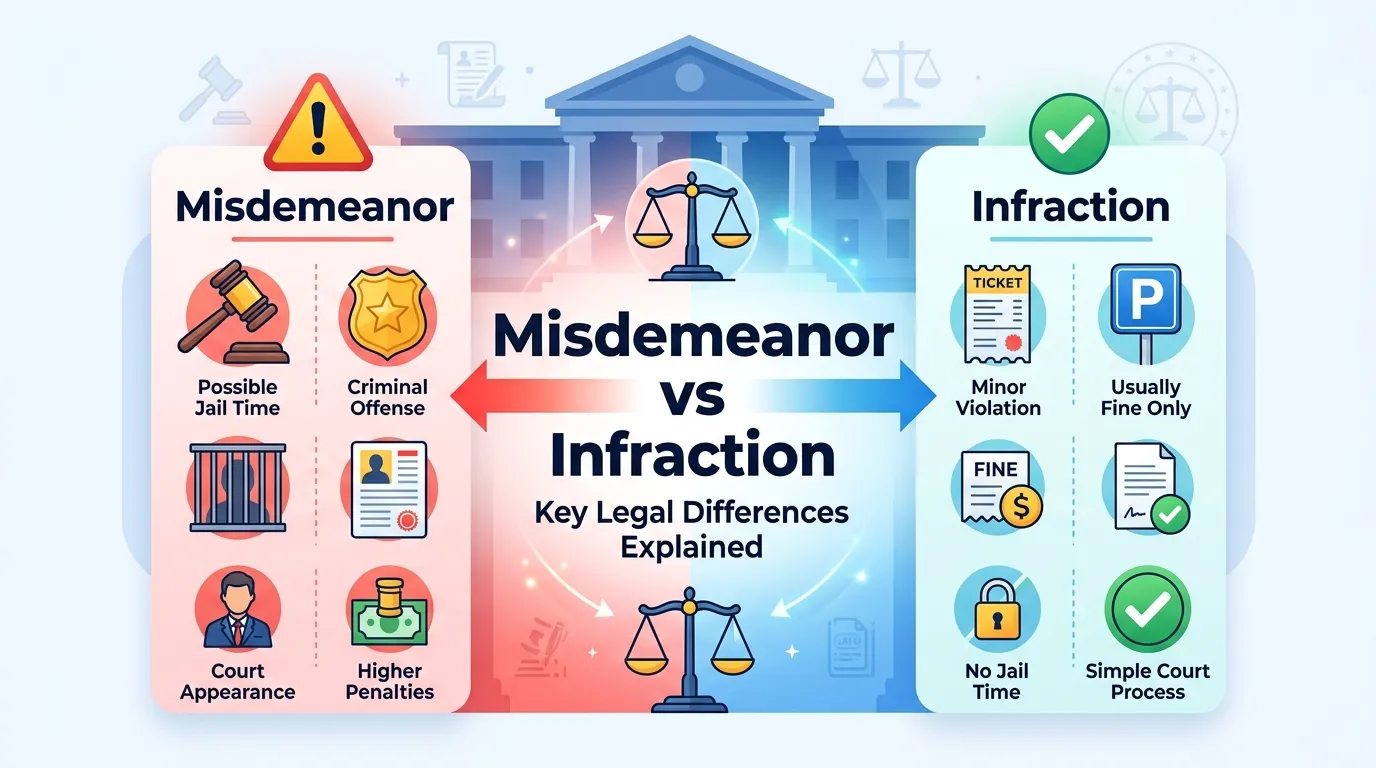
The difference between misdemeanor and infraction mainly comes down to seriousness, punishment, criminal record impact, and court procedures. A misdemeanor is a criminal offense that can lead to jail time, while an infraction is usually a minor violation that only results in a fine.
People search for the difference between misdemeanor and infraction because they want to know:
- Will this go on my criminal record?
- Can I go to jail?
- Do I need a lawyer?
- How serious is my offense?
This guide explains everything clearly, with real-life examples, comparison tables, legal insights, and beginner-friendly explanations so you do not need another article afterward.
Quick Answer: Difference Between Misdemeanor and Infraction
A misdemeanor is a minor criminal offense that may lead to jail time, probation, community service, or fines.
An infraction is a non-criminal violation that usually only results in a fine and does not lead to jail.
Example:
- Speeding slightly over the limit → usually an infraction
- Shoplifting a low-cost item → often a misdemeanor
Definition of Misdemeanor and Infraction
- Misdemeanor: A less serious criminal offense punishable by fines, probation, or up to one year in local jail.
- Infraction: A minor legal violation that normally results in a fine and does not carry jail time.
Simple Example:
Running a stop sign may be an infraction, while driving under the influence may become a misdemeanor.
Pronunciation of Both Terms
| Term | US Pronunciation | UK Pronunciation |
|---|---|---|
| Misdemeanor | mis-duh-MEE-ner | mis-di-MEE-nuh |
| Infraction | in-FRAK-shun | in-FRAK-shun |
Now that the meanings are clear, let’s understand how these legal categories actually work in real life.
KEY DIFFERENCES EXPLAINED BETWEEN MISDEMEANOR AND INFRACTION
1. Criminal vs Non-Criminal Status
The biggest difference is legal classification.
A misdemeanor is considered a criminal offense. An infraction is generally not criminal.
Real-Life Example
If someone steals inexpensive merchandise from a retail store, that may become a misdemeanor. But parking in a restricted zone is normally only an infraction.
2. Jail Punishment
Misdemeanors may lead to jail time.
Infractions do not carry jail sentences.
Why This Matters
Many beginners wrongly assume every legal violation can send someone to jail. That is not true.
3. Effect on Criminal Record
A misdemeanor can stay on your criminal record and affect employment checks on platforms used by companies like Meta or professional hiring systems.
Infractions usually do not create a criminal record.
4. Court Procedures
Misdemeanor cases are handled more formally.
Infractions are often resolved by simply paying a fine online.
Example
Traffic camera violations are commonly handled digitally without appearing before a judge.
5. Legal Defense Rights
People charged with misdemeanors may have rights such as:
- legal representation
- jury trial
- plea bargaining
Infractions normally have fewer legal protections because they are considered minor.
6. Social and Professional Consequences
A misdemeanor can affect:
- job applications
- professional licenses
- immigration status
- housing approvals
An infraction usually has limited long-term effects.
7. Financial Impact
Misdemeanor penalties are often more expensive because they may include:
- court costs
- probation fees
- legal expenses
Infractions generally involve a simple fine.
Difference and Similarity Between Misdemeanor and Infraction
| Feature | Misdemeanor | Infraction | Similarity |
|---|---|---|---|
| Meaning | Minor criminal offense | Minor legal violation | Both break laws |
| Punishment | Jail or fines | Mostly fines | Both may require payment |
| Court Process | Formal criminal court | Simpler process | Both involve legal systems |
| Severity | More serious | Less serious | Both are below felonies |
| Record Impact | Criminal record possible | Usually no criminal record | Both may appear in some databases |
| Examples | DUI, petty theft | Parking ticket | Both involve rule violations |
| Lawyer Need | Often helpful | Rarely needed | Legal advice can help in both |
| Public Perception | Seen as criminal | Seen as minor offense | Both may affect reputation |
This table clearly shows the difference and similarity between misdemeanor and infraction for quick understanding.
Why Does the Legal System Separate Misdemeanors and Infractions?
The legal system creates categories to manage seriousness and fairness.
If every small mistake became a criminal offense, courts would become overloaded. That is why governments separate:
- severe crimes
- moderate crimes
- minor violations
Infractions exist to handle low-level rule breaking efficiently.
Practical Insight
In real scenarios, courts want to avoid criminally punishing someone for every small traffic mistake. That helps reduce legal system pressure and saves resources.
What Is Considered a Misdemeanor?
Common misdemeanor offenses include:
- petty theft
- disorderly conduct
- vandalism
- simple assault
- first-time DUI
- trespassing
Some states in the United States classify offenses differently, so the exact rules vary.
What Is Considered an Infraction?
Common infractions include:
- parking violations
- speeding tickets
- littering
- seat belt violations
- noise ordinance violations
Most infractions are handled quickly with fines.
Can an Infraction Become a Misdemeanor?
Yes, sometimes.
This is one area many users misunderstand.
Example
Ignoring multiple traffic tickets could eventually lead to:
- license suspension
- court violations
- misdemeanor charges
The original issue may start small but become more serious later.
How Courts Handle Misdemeanors vs Infractions
Misdemeanor Court Process
Usually includes:
- Arrest or citation
- Court appearance
- Plea
- Possible trial
- Sentencing
Infraction Process
Usually includes:
- Ticket issued
- Fine payment
- Optional dispute process
The procedures are much simpler for infractions.
Why People Get Confused Between Misdemeanor and Infraction
1. Movies and Media Simplify Legal Terms
Television shows often use “crime” for everything.
That creates misunderstanding.
2. Traffic Violations Cause Confusion
Many people assume all traffic offenses are criminal.
In reality, most traffic tickets are infractions.
3. State Laws Differ
Different states and countries classify offenses differently.
An act considered an infraction in one area may become a misdemeanor elsewhere.
4. Online Legal Advice Is Sometimes Misleading
Search results, short videos, and social media clips on Instagram or TikTok often oversimplify legal topics.
That is why understanding the actual legal definitions matters.
Common Mistakes with Difference Between Misdemeanor and Infraction
| Mistake | Reality | Fix |
|---|---|---|
| Thinking all tickets are criminal | Most are infractions | Read the citation carefully |
| Ignoring infractions | Some can escalate | Pay or contest on time |
| Assuming misdemeanors are “not serious” | They can affect life opportunities | Seek legal advice |
| Believing fines are the only penalty | Misdemeanors may include probation | Understand sentencing rules |
| Not checking state laws | Rules vary by region | Review local regulations |
Real Life Examples with Difference Between Misdemeanor and Infraction
Example 1: Traffic Ticket
A driver goes slightly above the speed limit.
Result: Usually an infraction.
Example 2: Shoplifting
Someone steals a low-cost item from a store.
Result: Often charged as a misdemeanor.
Example 3: Noise Complaint
A loud late-night party violates local city rules.
Result: Often an infraction.
Example 4: Public Fight
Two people engage in a minor physical altercation.
Result: Possible misdemeanor assault charge.
Example 5: Business Compliance Issue
A company ignores minor permit requirements.
Result: Regulatory infraction or administrative penalty.
When to Use Each Legal Category
Infractions Are Used When:
- the violation is minor
- public safety risk is low
- punishment should remain simple
Misdemeanors Are Used When:
- behavior harms others
- repeat offenses occur
- society considers the conduct criminal
This system creates proportional punishment.
Expert Insight
In practical legal situations, the difference between misdemeanor and infraction matters more than many people realize.
A misdemeanor can follow someone for years during:
- employment background checks
- housing applications
- professional licensing reviews
An infraction, while less serious, should still not be ignored because unpaid violations can escalate.
Most beginners focus only on fines, but experienced legal professionals understand the long-term consequences matter far more than the immediate penalty.
One important insight: courts generally use infractions for correction, while misdemeanors are used for punishment and accountability.
That distinction explains why the legal system treats them differently.
FAQ Section
Is a misdemeanor worse than an infraction?
Yes. A misdemeanor is more serious because it is a criminal offense and may involve jail time.
Does an infraction go on your criminal record?
Usually no. Most infractions are non-criminal violations.
Can you go to jail for an infraction?
No. Infractions normally only result in fines.
What is an example of a misdemeanor?
Petty theft, disorderly conduct, and simple assault are common examples.
Is speeding a misdemeanor or infraction?
Most speeding tickets are infractions, but reckless driving may become a misdemeanor.
Can a misdemeanor be removed from your record?
In some jurisdictions, expungement may be possible after meeting legal requirements.
Why are infractions considered less serious?
Because they usually involve minor rule violations with limited harm to society.
Do I need a lawyer for an infraction?
Usually not, although legal advice may help in disputed cases.
Can unpaid infractions become criminal?
Sometimes yes. Ignoring fines or court orders can escalate legal consequences.
Conclusion
Understanding the difference between misdemeanor and infraction is important because the legal consequences are very different. A misdemeanor is a criminal offense that may involve jail time, probation, and long-term record damage. An infraction is usually a minor non-criminal violation punished mainly through fines.
In simple words, infractions are designed for small rule violations, while misdemeanors address more serious misconduct that society considers criminal. That distinction affects court procedures, legal rights, background checks, and future opportunities.
The most important takeaway is this: even minor legal issues should never be ignored. An infraction may seem small today, but repeated violations or failure to respond can create bigger legal problems later.

I am content creator and comparison blogger focused on analyzing key differences between terms, concepts, and ideas to deliver accurate, easy-to-understand information. So I decided to create a platform where these differences are explained in the simplest way possible.