Many people search for the difference between company and business because both words sound similar and are often used in the same way. In real life, however, they are not exactly the same. A business refers to any activity that earns money, while a company is a legally registered organization created to run that business.
This confusion is very common among students, freelancers, startup founders, ecommerce sellers, and even small shop owners. For example, someone selling products on Instagram may call it a business, but after legal registration, it can officially become a company.
In this complete guide, you will learn:
- what a business means
- what a company means
- key differences between both
- similarities and practical uses
- real-world examples
- legal and financial importance
- why people often confuse these terms
By the end, you will have complete clarity without needing another article.
Quick Answer: Difference Between Company and Business
A business is an activity done to earn profit through products or services.
A company is a legally registered entity formed to operate a business.
Simple Example
A person selling homemade cakes online is running a business.
If that same person registers “Sweet Bakes Pvt Ltd” under company law, it becomes a company.
Definition of Company and Business
Business
A business is any activity where goods or services are sold to make money.
Company
A company is a legally incorporated organization formed by one or more people to conduct business activities.
Quick Understanding
- Every company usually operates a business.
- Not every business becomes a company.
Pronunciation of Both Terms
| Word | US Pronunciation | UK Pronunciation |
| Company | kuhm-puh-nee | kuhm-puh-nee |
| Business | biz-nuhs | biz-nis |
Now let’s understand the difference between company and business in a much deeper and practical way.
Key Differences Explained Between Company and Business
1. Legal Structure
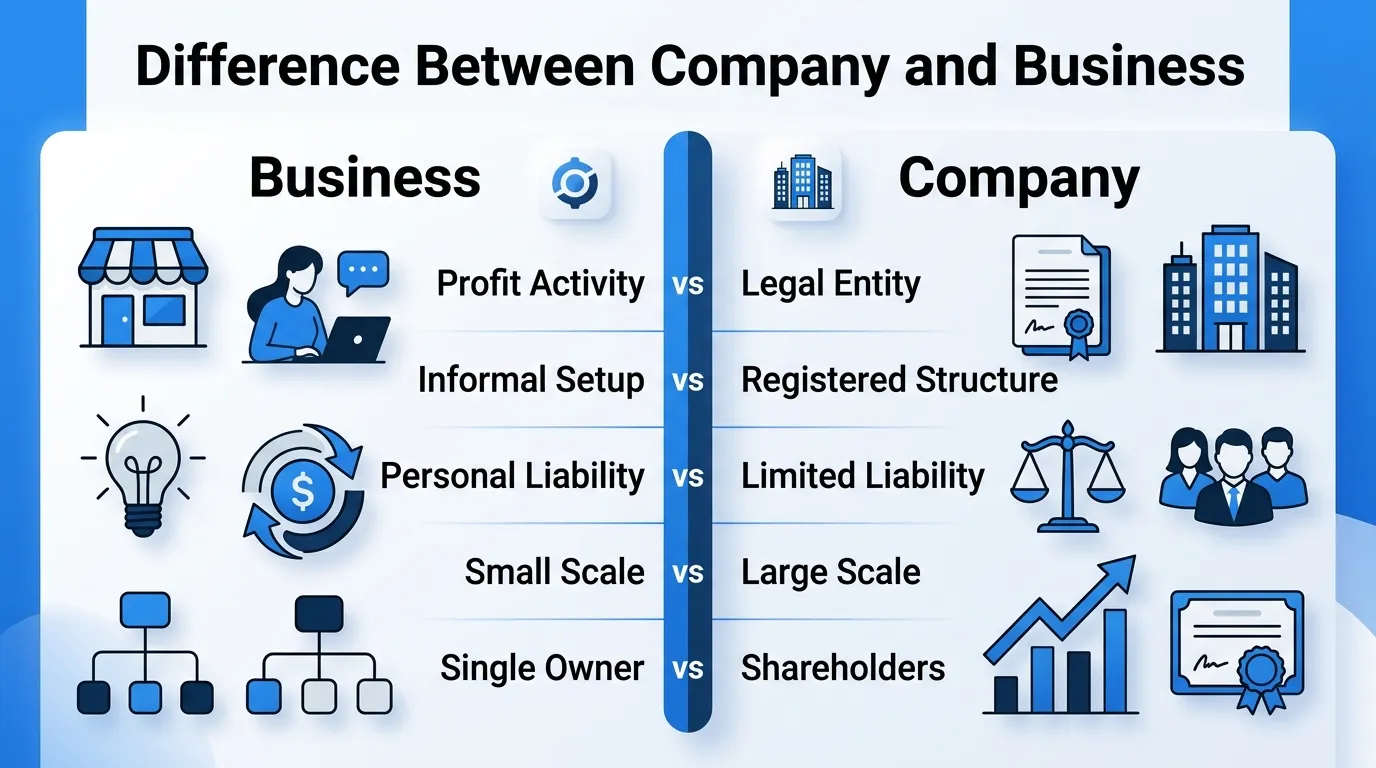
The biggest difference between company and business is legal identity.
A business can operate informally, but a company must follow legal registration procedures.
Example
A freelance designer may run a business from home.
A registered digital agency operates as a company.
2. Liability Protection
Many beginners ignore this important point.
In small businesses, owners are often personally responsible for debts. In companies, legal separation provides better protection.
Real Scenario
If a sole business owner faces losses, personal assets may be affected.
In many companies, liability is limited to business assets.
3. Ownership System
A business may have one owner only.
A company can have:
- directors
- shareholders
- investors
- board members
This structure supports long-term growth.
4. Funding and Investment
Investors usually trust companies more than informal businesses.
That is why startups often register as companies before raising funds.
Example
Large brands like Google and Amazon operate under formal company structures because investors need legal protection and transparency.
5. Continuity and Stability
A business may stop if the owner quits or passes away.
A company can continue operating even if management changes.
This creates long-term stability and trust.
6. Tax and Compliance
Companies usually face stricter:
- tax filing
- auditing
- compliance
- reporting requirements
Businesses may have simpler tax systems depending on local laws.
7. Brand Value and Expansion
Companies often build stronger public trust because they appear more professional.
That is why many ecommerce brands later convert into companies.
Difference and Similarity Between Company vs Business
| Feature | Business | Company | Similarity |
| Main Purpose | Earn profit | Earn profit | Both generate income |
| Operations | Commercial activity | Organized business operations | Both serve customers |
| Legal Status | May be informal | Fully legal entity | Both can operate legally |
| Ownership | Single owner common | Multiple owners possible | Both need management |
| Risk | Personal liability possible | Limited liability common | Both face market risks |
| Branding | Can use trade name | Registered corporate identity | Both build reputation |
| Growth | Smaller scale common | Easier global expansion | Both can grow |
| Revenue Model | Product/service sales | Product/service sales | Both depend on customers |
This table clearly shows the difference and similarity between company and business for quick understanding.
What Is a Business and Why Does It Exist?
A business exists to solve customer problems while earning profit.
Businesses can be:
- online
- offline
- small
- large
- local
- global
Common Business Examples
- restaurants
- fitness coaching
- freelancing
- ecommerce stores
- digital marketing
- software services
Even creators on YouTube often start with simple business models before forming companies.
Why Businesses Matter
Businesses:
- create jobs
- improve economies
- solve customer problems
- provide innovation
Without businesses, markets cannot function properly.
What Is a Company and Why Is It Important?
A company is more than just an income activity. It is a legal structure designed for organized operations.
Why Companies Exist
Companies help businesses:
- scale faster
- attract investors
- reduce personal risk
- create legal protection
- survive long term
Real Example
Meta is a company managing multiple businesses including:
- social media
- advertising
- AI systems
- virtual reality products
This is why company structures are important for large-scale growth.
Why People Get Confused Between Company and Business
Many users get confused because both terms overlap in daily language.
Main Reasons
1. Social Media Influence
People casually call every startup a company.
2. Movies and Media
Business and company are often used interchangeably.
3. Startup Culture
Many startups begin as simple businesses but later become companies.
4. Regional Language Differences
Some countries legally separate the terms more clearly than others.
When Should You Use “Business” or “Company”?
Use “Business” When:
- discussing commercial activities
- talking about earning money
- referring to small operations
Example
“She started an online clothing business.”
Use “Company” When:
- discussing legal registration
- talking about corporate operations
- mentioning shareholders or directors
Example
“He owns a software company.”
Real Life Examples of Company and Business
Example 1: Freelancer
A graphic designer working independently operates a business.
Example 2: Ecommerce Brand
Selling products through social media is a business.
Registering legally creates a company.
Example 3: Tech Startup
Most startups begin as businesses.
After attracting investors, they register as companies.
Example 4: Local Restaurant
A small family restaurant may remain only a business for years without becoming a company.
Example 5: Large Global Brand
Google operates as a company managing multiple businesses like:
- search engine services
- advertising
- cloud computing
- AI tools
Common Mistakes About Difference Between Company and Business
| Mistake | Reality |
| Thinking both words mean exactly the same | They are related but legally different |
| Assuming every business is registered | Many businesses operate informally |
| Believing all companies are large | Small companies also exist |
| Ignoring liability differences | Legal protection matters greatly |
| Confusing brand with company | A brand is not the same as a company |
Expert Insight: Which One Is Better?
In practical business environments, most entrepreneurs start with a simple business structure because it is cheaper and easier.
However, as growth increases, many transition into companies for:
- legal protection
- investor trust
- scalability
- taxation benefits
- professional branding
Experienced business consultants often recommend forming a company when:
- hiring employees
- handling large contracts
- seeking investors
- expanding internationally
This transition happens in almost every industry today.
Why Company Structures Dominate the Modern Economy
Global platforms like Amazon, Google, and Meta became global leaders because company structures support:
- large investments
- international expansion
- legal continuity
- shareholder systems
- scalable management
A business creates income.
A company creates long-term structure and expansion power.
That is the deeper strategic difference many beginners miss.
Frequently Asked Questions (FAQ)
Is every company a business?
Usually yes, because companies conduct commercial activities.
Can a business exist without a company?
Yes. Many freelancers and local shops operate without incorporation.
What is the biggest difference between company and business?
The main difference is legal identity and registration.
Which comes first: business or company?
Usually the business idea comes first. The company structure follows later.
Can one company own multiple businesses?
Yes. Many large corporations manage several business divisions.
Why do startups become companies later?
Because investors and legal systems prefer structured organizations.
Is a sole proprietorship a company?
No. It is a business owned personally by one individual.
Are all companies large corporations?
No. Small companies also exist in many industries.
Conclusion
Understanding the difference between company and business is extremely important for entrepreneurs, freelancers, students, startups, and business owners. Although both terms are connected, they are not identical. A business refers to any activity done to earn profit, while a company is a legally registered entity formed to manage that business professionally.
In simple words, a business focuses on commercial activity, whereas a company focuses on legal structure, protection, ownership, and long-term scalability. Many successful brands begin as small businesses and later evolve into companies when they need investment, legal protection, or expansion opportunities.

I am content creator and comparison blogger focused on analyzing key differences between terms, concepts, and ideas to deliver accurate, easy-to-understand information. So I decided to create a platform where these differences are explained in the simplest way possible.