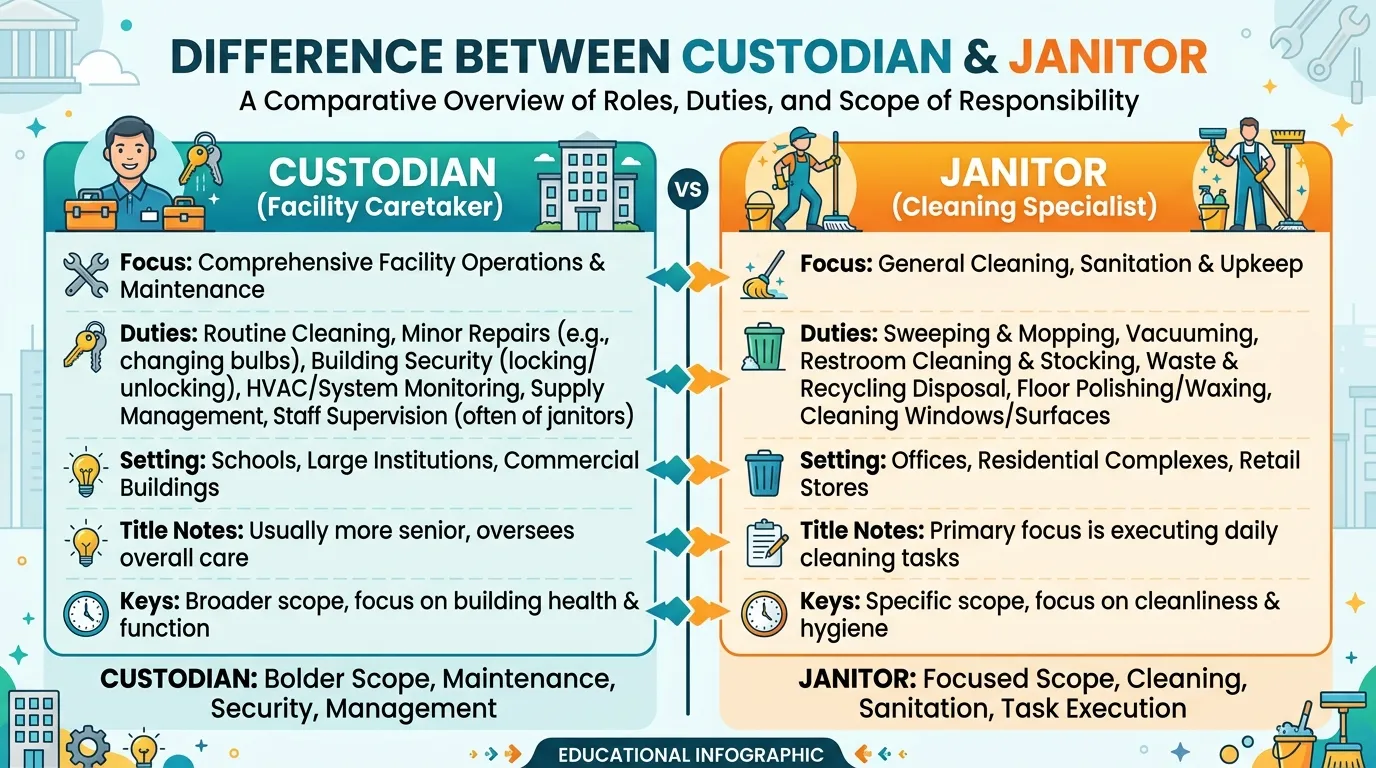
Many people use the terms “custodian” and “janitor” as if they mean the same thing. In schools, offices, hospitals, and commercial buildings, you may hear both titles used for cleaning and maintenance staff. That is why the difference between custodian and janitor is a common search query today.
In simple words, both roles help keep buildings clean, safe, and organized, but their responsibilities, authority level, and work scope can be different. A janitor usually focuses mainly on cleaning tasks, while a custodian often handles broader building care and maintenance duties. The difference between custodian and janitor also depends on industry, company structure, and workplace expectations.
People search for the difference between custodian and janitor because job titles matter in hiring, salary comparisons, career growth, and workplace respect. In this guide, you will learn definitions, pronunciation, key differences, similarities, real-life examples, common mistakes, and how companies like Google and Meta organize facility management roles in modern workplaces.
Quick Answer: Difference Between Custodian and Janitor
A janitor mainly performs cleaning duties such as mopping floors, emptying trash, and cleaning bathrooms. A custodian usually has broader responsibilities, including maintenance, security checks, and overall building care.
Example:
In a school, a janitor may clean classrooms after students leave, while a custodian may manage cleaning schedules, check building safety, and handle minor repairs.
What Is a Custodian?
A custodian is responsible for the complete care of a building or property. This role goes beyond basic cleaning.
Typical custodian duties include:
- Monitoring building safety
- Handling minor maintenance
- Managing supplies
- Inspecting equipment
- Coordinating cleaning schedules
- Responding to emergencies
In schools, custodians are especially important because they help maintain a healthy learning environment.
In real scenarios, custodians often become the “go-to” people for building-related problems.
What Is a Janitor?
A janitor mainly handles cleaning and sanitation tasks.
Common janitor responsibilities include:
- Sweeping floors
- Vacuuming carpets
- Cleaning restrooms
- Emptying trash bins
- Sanitizing surfaces
- Washing windows
Most beginners think janitors only mop floors, but modern janitorial work also includes hygiene management and safe chemical handling.
Since 2026 workplace hygiene standards are stricter, janitors now use advanced cleaning systems and eco-friendly sanitation tools in many companies.
Pronunciation of Both Terms
- Custodian
- US: /kuh-STOH-dee-uhn/
- UK: /kuh-STOH-dee-uhn/
- Janitor
- US: /JAN-ih-ter/
- UK: /JAN-ih-tuh/
Now that the meanings are clear, let’s understand the deeper difference between custodian and janitor with real-world examples and professional insights.
Comparison Table: Difference Between Custodian and Janitor
| Feature | Custodian | Janitor | Similarity |
| Main Role | Oversees building care | Focuses on cleaning | Both maintain cleanliness |
| Work Scope | Broad responsibilities | Mostly cleaning duties | Both support facility operations |
| Maintenance Tasks | Often handles small repairs | Usually limited repairs | Both may report issues |
| Authority Level | May supervise cleaning staff | Usually follows assigned tasks | Both work under facility management |
| Workplace | Schools, hospitals, offices | Offices, malls, buildings | Both work in commercial spaces |
| Skill Requirement | Cleaning + maintenance knowledge | Cleaning expertise | Both need practical skills |
| Job Perception | More professional management role | Traditional cleaning role | Both are essential jobs |
| Daily Duties | Building inspection and upkeep | Sweeping, mopping, trash removal | Both ensure safe environments |
This table clearly shows the difference and similarity between custodian and janitor for quick understanding.
Key Differences Explained Between Custodian and Janitor
1. Scope of Responsibility
A custodian often manages the overall condition of a property. A janitor mainly cleans assigned areas.
Real-life example:
In a university, the custodian may monitor classroom conditions and coordinate repairs, while janitors clean hallways and restrooms.
2. Maintenance Duties
Custodians frequently perform light maintenance work such as replacing bulbs or checking heating systems.
Janitors usually focus on sanitation tasks.
Many users get confused because some companies combine both roles into one job description.
3. Workplace Authority
Custodians sometimes supervise janitorial staff or cleaning schedules.
In practical use, a janitor usually reports to a supervisor or facility manager.
4. Professional Perception
The word “custodian” sounds broader and more professional in modern workplaces.
That is why companies like Google and YouTube often use modern facility-management titles instead of traditional cleaning titles.
5. Industry Usage
Schools and government buildings often prefer the term “custodian.”
Hotels and shopping centers commonly use “janitor” or “cleaning staff.”
6. Training Requirements
Custodians may need knowledge of safety systems, maintenance tools, and facility operations.
Janitors mainly need cleaning and sanitation training.
7. Career Growth Opportunities
Custodian roles can lead to facility management careers.
A janitor may later become a supervisor or custodian with experience.
Why Does the Difference Between Custodian and Janitor Exist?
The difference exists because workplaces need different levels of building care.
A small office may only hire janitors because cleaning is the main need. A large school or hospital may require custodians because the property needs broader management.
In simple words:
- Janitor = cleaning-focused
- Custodian = building-care focused
This distinction helps organizations organize staff responsibilities efficiently.
Difference Between Custodian and Janitor in Schools
Schools are one of the biggest reasons people search this topic.
In many educational institutions:
Custodian Duties in Schools
- Opening and locking buildings
- Managing classroom setup
- Inspecting safety conditions
- Reporting repairs
- Supervising cleaning routines
Janitor Duties in Schools
- Cleaning classrooms
- Removing trash
- Sanitizing restrooms
- Cleaning cafeterias
Many school districts now use “custodian” because it sounds more respectful and accurately reflects broader responsibilities.
Difference Between Custodian and Janitor Salary and Career Path
Salary differences vary by country, experience, and organization.
Generally:
- Custodians may earn more because of additional responsibilities.
- Janitors may have more entry-level positions available.
Career progression often looks like this:
Janitor → Senior Cleaner → Custodian → Facility Supervisor
Companies increasingly value workers who understand building systems, workplace safety, and environmental cleaning standards.
Difference Between Custodian and Janitor in Modern Workplaces
Modern workplaces have changed these roles significantly.
Companies like Instagram and Meta focus heavily on employee wellness and workplace hygiene. That means custodians and janitors now work with:
- Smart cleaning systems
- Eco-friendly products
- Workplace safety software
- Sanitization protocols
- Automated maintenance alerts
In tech companies, custodial teams may coordinate with facility management software to maintain large office campuses.
This shows how the roles are evolving beyond traditional cleaning work.
Common Mistakes With Difference Between Custodian and Janitor
1. Thinking Both Jobs Are Exactly the Same
They overlap, but custodians often have broader duties.
Fix:
Understand the workplace structure before using the titles interchangeably.
2. Assuming Janitors Only Clean Floors
Modern janitors handle sanitation systems and safety cleaning too.
Fix:
Recognize professional cleaning as a skilled service.
3. Ignoring Industry Differences
A hospital custodian may do more technical work than a mall janitor.
Fix:
Always consider the workplace context.
4. Believing “Custodian” Is Only a Fancy Word
In many organizations, custodians truly have expanded responsibilities.
Fix:
Read actual job descriptions carefully.
5. Confusing Maintenance Staff With Custodians
Maintenance technicians handle technical repairs that custodians may only report.
Fix:
Separate cleaning, custodial, and technical maintenance roles.
Real Life Examples With Difference Between Custodian and Janitor
Example 1: School Environment
A custodian opens the school building at 6 AM and checks heating systems. A janitor cleans classrooms after school ends.
Example 2: Hospital Facility
Custodians inspect sanitation compliance and safety equipment. Janitors disinfect patient rooms daily.
Example 3: Corporate Office
In a large office used by companies like Google, custodians may coordinate cleaning schedules and monitor building conditions.
Example 4: Shopping Mall
Janitors clean food courts and public washrooms throughout the day. Custodians manage supply inventories and maintenance reports.
Example 5: Apartment Complex
A custodian handles tenant facility concerns, while janitors clean shared spaces like hallways and elevators.
When To Use Each
Use “Custodian” When:
- Talking about building care management
- Discussing schools or institutions
- Referring to broader maintenance roles
- Mentioning supervisory responsibilities
Use “Janitor” When:
- Talking mainly about cleaning duties
- Referring to sanitation work
- Describing traditional cleaning staff roles
Understanding the correct term improves professional communication.
Why People Get Confused in Difference Between Custodian and Janitor
There are several reasons behind the confusion.
Language Evolution
Modern workplaces prefer respectful job titles, so “custodian” became more common.
Regional Differences
Some countries and organizations use both words interchangeably.
Media and Industry Influence
Movies, TV shows, and social media often blur the distinction.
Company Branding
Businesses sometimes rename janitor roles as custodial staff for professionalism and employee respect.
FAQs
Is a custodian higher than a janitor?
In many workplaces, yes. Custodians often have broader responsibilities and may supervise cleaning operations.
What is the main difference between custodian and janitor?
The main difference is that custodians usually manage overall building care, while janitors mainly focus on cleaning tasks.
Can a janitor become a custodian?
Yes. Many custodians start as janitors and gain experience in maintenance and facility operations.
Do schools use custodians or janitors?
Most schools prefer the term “custodian” because the role includes building management duties beyond cleaning.
Is custodian a more respectful term?
Many organizations consider it more professional because it reflects wider responsibilities.
Are custodians responsible for repairs?
They may handle small maintenance tasks, but major repairs are usually done by maintenance technicians.
Why do companies use different titles?
Companies choose titles based on branding, workplace culture, and job responsibilities.
Is janitorial work still important in 2026?
Absolutely. Modern sanitation, workplace health, and hygiene standards make janitorial work more important than ever.
Conclusion
Understanding the difference between custodian and janitor is important because these terms are closely related but not always identical. A janitor mainly focuses on cleaning and sanitation, while a custodian usually takes care of broader building maintenance, safety, and operational responsibilities.
In real-world workplaces, the distinction depends on the organization, industry, and job structure. Schools, hospitals, and government facilities often use “custodian” because the role involves more building oversight.
The final answer is simple:
- Janitor = mainly cleaning
- Custodian = broader building care and maintenance
Both roles are essential, valuable, and highly important in keeping environments healthy, organized, and functional.

My name is Ryan Mitchell, and I am a comparison content writer based in the United States. I specialize in creating clear and easy-to-understand articles that explain the differences between similar concepts, products, and ideas. My work focuses on helping readers quickly understand what makes two things different so they can make better decisions.