In today’s competitive and innovation-driven world, protecting your brand identity and original ideas is not optional—it’s essential. Two of the most powerful tools in intellectual property law are trademark and patent. While many people use these terms interchangeably, they actually serve very different purposes.
A trademark protects the identity of your business, such as your brand name, logo, or slogan. A patent, on the other hand, protects your inventions and innovations, ensuring that no one else can copy or use them without permission.
Understanding the difference between trademark and patent is crucial for entrepreneurs, startups, content creators, and businesses because it helps them secure legal ownership, avoid disputes, and build long-term value.
In this detailed guide, we will not only explain the core differences but also explore types of trademarks, types of patents, the importance of both, and how copyright fits into the picture.
What is a Trademark?
A trademark is a legal protection given to unique brand elements that distinguish one business from another.
Examples:
- Brand names (e.g., Nike)
- Logos (e.g., Apple logo of Apple Inc.)
- Slogans (e.g., “Just Do It”)
Purpose:
- Protect brand identity
- Prevent market confusion
- Build customer trust
Simple idea: Trademark = Your brand’s identity protection
Types of Trademark
There are several types of trademarks, each serving a different branding purpose:
1. Word Mark
Protects brand names or words.
Example: “Nike”
2. Logo Mark (Design Mark)
Protects symbols or graphical designs.
Example: Apple logo
3. Service Mark
Used for services instead of products.
Example: Banking or consulting brands
4. Collective Mark
Used by a group or organization.
Example: Associations or unions
5. Certification Mark
Shows quality or standards certification.
Example: ISO certification marks
6. Trade Dress
Protects the overall look and feel of a product or packaging.
Example: Unique product packaging style
What is a Patent?
A patent is a legal right granted to inventors for new and useful inventions or processes.
Examples:
- Machines
- Software innovations
- Industrial processes
Purpose:
- Protect innovation
- Prevent copying
- Encourage technological growth
Simple idea: Patent = Your invention protection
Types of Patents
Patents are divided into different categories based on the type of invention:
1. Utility Patent
Protects functional inventions and processes.
Example: A new machine or software system
2. Design Patent
Protects the appearance or design of a product.
Example: Shape of a smartphone
3. Plant Patent
Protects new plant varieties.
Example: Genetically developed plants
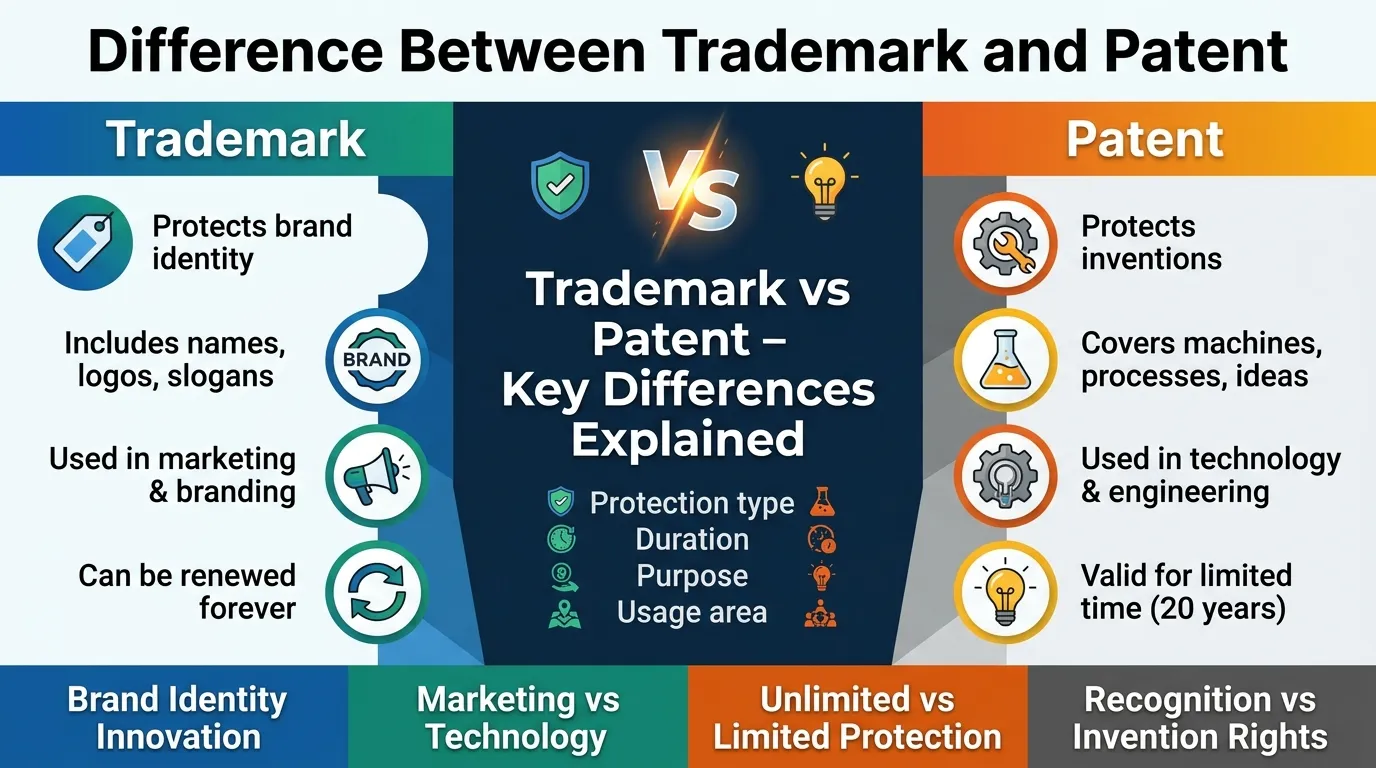
Quick Comparison Table
| Feature | Trademark | Patent |
| Protects | Brand identity | Inventions |
| Purpose | Branding | Innovation |
| Duration | Unlimited (renewable) | ~20 years |
| Complexity | Simple | Complex |
| Cost | Lower | Higher |
15 Key Differences Between Trademark and Patent with Examples
1. Meaning and Scope
A trademark protects identifiers like names, logos, and slogans that represent a brand.
A patent protects inventions, processes, or technical solutions.
Example:
A clothing brand name is trademarked, while a new fabric-making machine is patented.
2. Purpose and Function
The main purpose of a trademark is to create brand recognition and prevent confusion.
A patent aims to protect innovation and give exclusive rights to inventors.
Example:
A logo helps customers identify a brand, while a patent prevents others from copying a product.
3. Nature of Protection
Trademark protection is symbolic and identity-based, focusing on branding.
Patent protection is functional and technical, focusing on how something works.
Example:
Brand symbol = trademark
Engine design = patent
4. Field of Application
Trademarks are used in marketing, branding, and advertising.
Patents are used in engineering, science, and technology sectors.
Example:
A company slogan vs a new software algorithm
5. Duration of Protection
Trademarks can last forever if renewed regularly.
Patents typically last 20 years from the filing date and cannot be renewed.
Example:
Brands like Nike exist for decades; patents expire after a fixed period.
6. Registration Process
Trademark registration is simpler and faster.
Patent registration is complex, lengthy, and requires technical documentation.
Example:
Registering a logo vs filing detailed invention specifications
7. Level of Complexity
Trademarks involve basic legal checks for uniqueness.
Patents require deep technical analysis, novelty checks, and examination.
Example:
Unique brand name vs innovative engineering design
8. Cost and Investment
Trademarks are cost-effective and affordable.
Patents require significant financial investment due to legal and technical work.
Example:
Low-cost brand registration vs expensive patent filing
9. Legal Rights Provided
A trademark gives rights to stop others from using similar branding.
A patent gives rights to stop others from making, using, or selling the invention.
Example:
Prevent logo copying vs prevent product replication
10. Renewal and Expiry
Trademarks can be renewed indefinitely as long as they are in use.
Patents expire permanently after 20 years.
Example:
A brand can exist forever; a patent cannot.
11. Geographic Protection
Both trademarks and patents are territorial rights, meaning they must be registered in each country separately.
Example:
A trademark in one country may not protect your brand globally.
12. Type of Asset Protected
Trademarks protect intangible branding elements.
Patents protect tangible inventions or technical processes.
Example:
Logo vs machine
13. Innovation Requirement
Trademarks do not require innovation—only uniqueness.
Patents require newness, usefulness, and originality.
Example:
Unique brand name vs new technology invention
14. Risk of Infringement
Trademark infringement occurs when brands look or sound similar.
Patent infringement occurs when someone copies an invention without permission.
Example:
Similar logo vs copied product design
15. Relationship Between Them
Trademarks and patents protect different aspects of a business, but together they create strong legal protection.
Example:
A company can trademark its brand and patent its product technology.
Simple Way to Remember
- Trademark = Brand identity (name, logo, slogan)
- Patent = Invention (product, process, technology)
Importance of Trademark and Patent
Why Trademarks Matter:
- Build strong brand identity
- Increase customer trust
- Protect business reputation
Why Patents Matter:
- Protect innovative ideas
- Prevent competitors from copying
- Provide competitive advantage
Together, they help businesses grow securely and sustainably.
What is Copyright?
Copyright is another form of intellectual property that protects creative works such as:
- Books
- Music
- Videos
- Software code
Simple idea: Copyright = Protection for creative content
Key Difference:
- Trademark → Brand identity
- Patent → Invention
- Copyright → Creative work
Simple Way to Remember
- Trademark = Brand (Name, Logo)
- Patent = Invention (Product, Technology)
- Copyright = Creativity (Content, Art)
Conclusion
The difference between trademark and patent becomes clear when you understand what each protects. A trademark secures your brand identity, while a patent protects your inventions. Both play a vital role in modern business by ensuring that your efforts, ideas, and identity remain safe from misuse.
When combined with copyright protection, businesses and creators can build a complete legal shield around their intellectual property.
Final takeaway:
- Trademark = Identity protection
- Patent = Innovation protection
- Copyright = Creative protection
FAQs
1. Can I have trademark, patent, and copyright together?
Yes, many businesses use all three for complete protection.
2. Which is most important?
It depends—brands need trademarks, inventors need patents, creators need copyright.
3. Which is hardest to get?
Patents are the most complex and difficult.
4. Do trademarks expire?
They can be renewed indefinitely.
5. What is the main difference?
Trademark protects branding, patent protects inventions.

I am content creator and comparison blogger focused on analyzing key differences between terms, concepts, and ideas to deliver accurate, easy-to-understand information. So I decided to create a platform where these differences are explained in the simplest way possible.