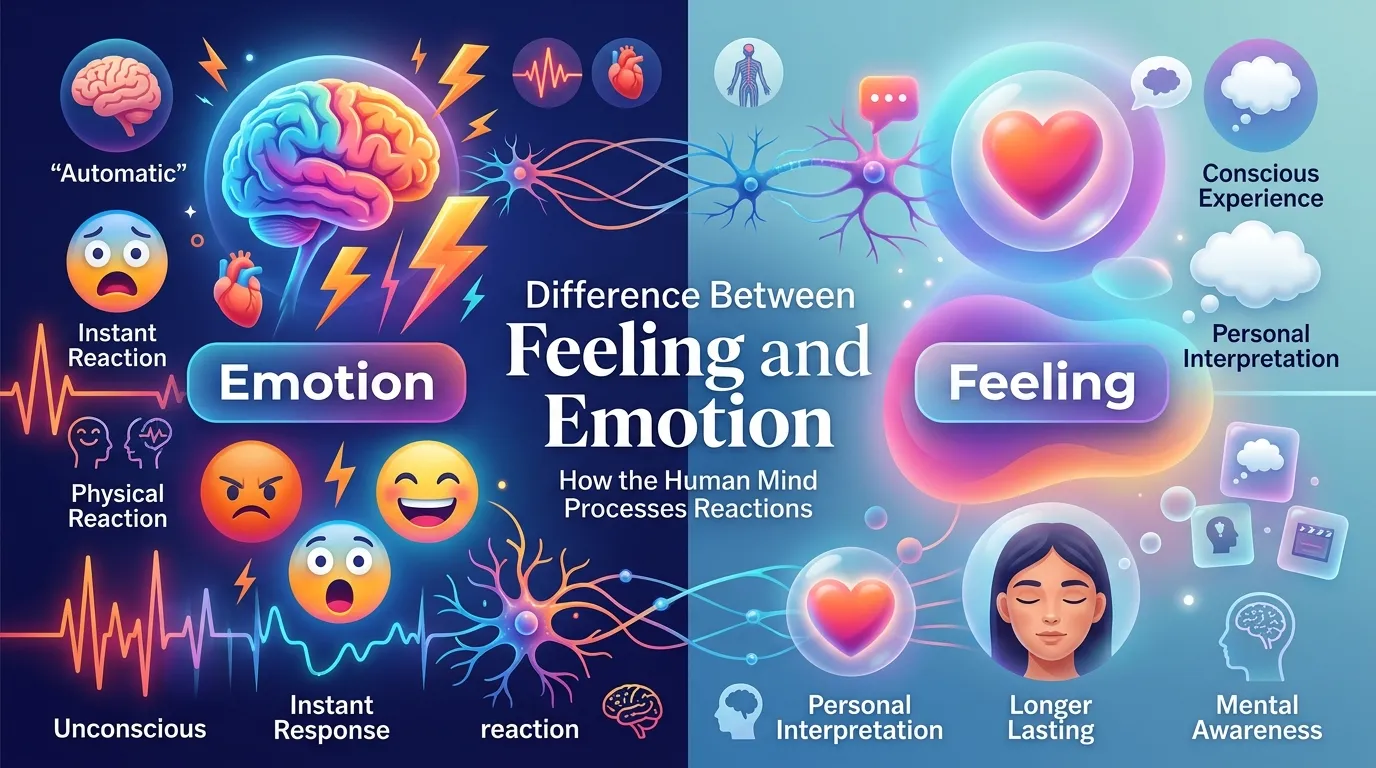
Many people use the terms feeling and emotion as if they mean the same thing. In everyday conversations, that confusion is completely normal. But when you look deeper into psychology, neuroscience, communication, and even modern wellness apps, there is a real difference between feelings and emotions.
In simple words, emotions happen first inside the brain and body, while feelings are your personal interpretation of those emotions. Understanding the difference between feeling and emotion can improve emotional intelligence, relationships, mental health, decision-making, and self-awareness.
Today, platforms like Google,Instagram, and YouTube constantly discuss emotional wellness, mindfulness, and human behavior. That is why more users are searching for the difference between feeling and emotion in 2026 than ever before.
In this guide, you will learn:
- what emotions and feelings really mean
- how they work in the brain
- why people confuse them
- real-life examples
- similarities and differences
- expert insights from psychology and neuroscience
Quick Answer: Difference Between Feeling and Emotion
An emotion is an automatic biological reaction triggered by a situation, memory, or event. A feeling is the conscious experience you create after interpreting that emotion.
Example:
- You suddenly hear bad news → your body reacts with fear or sadness (emotion).
- Later, you think, “I feel hurt and disappointed” (feeling).
So, emotions are automatic. Feelings are personal and conscious.
Definition of Feeling and Emotion
- Emotion: A natural physical and psychological reaction created by the brain in response to an event, thought, or experience.
- Feeling: The conscious mental experience or interpretation of an emotion after the brain processes it.
Simple Example
Seeing a snake may trigger fear instantly (emotion), while later saying “I feel unsafe” becomes the feeling.
Pronunciation of Both Terms
| Word | US Pronunciation | UK Pronunciation |
| Emotion | ih-MOH-shən | ih-MOH-shən |
| Feeling | FEE-ling | FEE-ling |
Now that the definitions are clear, let’s understand the deeper psychological and real-world difference between feeling and emotion.
Difference Between Feeling and Emotion Table
| Feature | Emotion | Feeling | Similarity |
| Meaning | Automatic body response | Conscious mental experience | Both relate to human psychology |
| Origin | Comes from the brain and nervous system | Comes from personal interpretation | Both influence behavior |
| Speed | Happens instantly | Develops after thinking | Both can happen together |
| Control | Mostly unconscious | More conscious and manageable | Both affect decisions |
| Duration | Usually short-term | Can last longer | Both impact mood |
| Physical Signs | Heartbeat, sweating, facial changes | Internal thoughts and awareness | Both involve mind-body connection |
| Universality | Similar across humans | Different from person to person | Both are human experiences |
| Example | Fear after hearing a loud noise | Feeling anxious afterward | Both relate to the same event |
This table clearly shows the difference and similarity between feeling and emotion for quick understanding.
Key Differences Between Feeling and Emotion
1. Emotions Are Automatic, Feelings Are Interpreted
Emotions happen before conscious thought. Your brain reacts instantly to danger, joy, stress, or excitement.
Feelings appear after your mind interprets that emotional response.
Real-Life Example
A student sees exam results:
- Immediate panic = emotion
- “I feel like a failure” = feeling
Many users searching “what comes first feeling or emotion” often misunderstand this sequence.
2. Emotions Are Physical
Emotions affect the body directly:
- sweating
- heartbeat changes
- tense muscles
- tears
Feelings mainly happen in the conscious mind.
Example
During public speaking:
- shaking hands = emotional reaction
- “I feel nervous” = feeling
3. Feelings Are Shaped by Experience
Two people can experience the same emotion but develop different feelings.
Example
A job rejection:
- one person feels motivated
- another feels hopeless
This is why emotional experiences differ across cultures, personalities, and life history.
4. Emotions Are Universal
Psychologists believe basic emotions like fear, anger, happiness, sadness, surprise, and disgust are universal human responses.
Feelings are more personal and subjective.
5. Feelings Last Longer
Most emotions are temporary and intense. Feelings can stay for hours, days, or even years because they involve thinking and memory.
Example
A breakup creates emotional pain immediately, but feelings of loneliness may continue long afterward.
6. Emotions Help Survival
Emotions evolved to protect humans.
Fear helps avoid danger.
Anger helps defend boundaries.
Joy encourages social bonding.
Feelings help humans understand meaning and identity.
What Is an Emotion in Psychology?
In psychology, emotions are fast biological reactions created by the limbic system, especially the amygdala.
Common emotions include:
- happiness
- fear
- anger
- sadness
- surprise
- disgust
Psychologists such as Paul Ekman studied universal facial expressions connected to emotions.
Why Emotions Exist
Emotions exist mainly for survival and adaptation.
For example:
- fear protects from danger
- guilt supports social behavior
- love strengthens human connection
Modern apps from companies like Meta and mindfulness platforms track emotional engagement because emotions strongly affect human behavior online.
What Is a Feeling and How Does It Develop?
Feelings develop after the brain interprets emotions using:
- memories
- beliefs
- culture
- personality
- experiences
In simple words:
Emotion is the reaction.
Feeling is the story you create about the reaction.
Example
Emotion: stress before an interview
Feeling:
- “I feel excited”
or - “I feel terrified”
The body reaction may be similar, but interpretation changes the feeling.
Why People Get Confused Between Feelings and Emotions
1. Everyday Language Mixes Them Together
Most people casually say:
- “I’m emotional”
- “I feel angry”
This creates overlap in normal conversation.
2. Social Media Simplifies Psychology
Platforms like TikTok, Instagram, and YouTube often use emotional terms loosely for engagement and relatability.
That makes psychological concepts appear interchangeable.
3. Schools Rarely Teach Emotional Intelligence
Most beginners never formally learn:
- emotional processing
- self-awareness
- emotional regulation
As a result, many users search:
- “are feelings and emotions the same?”
- “emotion vs feeling psychology”
- “difference between emotions and feelings in simple words”
How the Brain Processes Emotion and Feeling
The brain handles emotions and feelings in different stages.
Step 1: Emotional Trigger
Something happens:
- loud noise
- criticism
- praise
- danger
The amygdala reacts instantly.
Step 2: Physical Response
Your body changes:
- heartbeat increases
- hormones release
- muscles tighten
This is emotion.
Step 3: Conscious Interpretation
The brain analyzes the situation.
You create meaning:
- “I feel embarrassed”
- “I feel respected”
- “I feel unsafe”
This becomes the feeling.
Difference Between Feeling and Emotion in Real Life
Personal Relationships
A partner forgets an anniversary.
Emotion:
Immediate anger or sadness.
Feeling:
“I feel ignored.”
Understanding this difference improves communication dramatically.
Workplace Scenario
An employee receives criticism.
Emotion:
Stress response.
Feeling:
“I feel undervalued.”
Companies now train emotional intelligence because unmanaged feelings affect productivity and teamwork.
Sports and Fitness
Athletes experience emotions during competition:
- adrenaline
- fear
- excitement
But feelings determine confidence and mindset afterward.
Fitness apps and wellness platforms track mood patterns because feelings influence motivation and consistency.
Parenting
Children often experience emotions before they can describe feelings.
That is why emotional education matters in child development.
When to Use Each: Emotion vs Feeling
| Situation | Better Term |
| Instant reaction | Emotion |
| Conscious self-description | Feeling |
| Biological response | Emotion |
| Personal interpretation | Feeling |
| Psychology research | Emotion |
| Self-awareness conversations | Feeling |
Quick Tip
If the reaction happens automatically, it is usually an emotion.
If you are describing your inner experience consciously, it is usually a feeling.
Expert Insight: Why This Difference Matters in Real Life
Mental health professionals, communication coaches, and emotional intelligence trainers often emphasize this distinction because understanding emotions improves self-control and relationships.
In practical use:
- emotions signal what is happening
- feelings explain what it means to you
Most beginners react emotionally without identifying their feelings clearly. That creates misunderstandings, stress, and poor communication.
Professionals in psychology, leadership training, education, and therapy teach emotional labeling because naming feelings reduces emotional overwhelm and improves decision-making.
This is one reason mindfulness and emotional-awareness tools continue growing across apps, therapy platforms, and workplace wellness systems in 2026.
Frequently Asked Questions (FAQ)
Are feelings and emotions the same thing?
No. Emotions are automatic biological responses, while feelings are conscious interpretations of those emotions.
Which comes first: feeling or emotion?
Emotion comes first. Feelings develop after the brain processes the emotional reaction.
Can you have emotions without feelings?
Yes. Some emotional reactions happen automatically before conscious awareness develops.
Why is understanding emotions important?
It improves emotional intelligence, communication, stress management, and relationships.
Are emotions physical or mental?
Emotions are both physical and mental because they involve brain activity and body reactions.
What are the basic human emotions?
Psychologists commonly identify:
- happiness
- sadness
- fear
- anger
- surprise
- disgust
Why do people confuse feelings and emotions?
Because daily language, social media, and casual communication often use the terms interchangeably.
Can feelings change emotions?
Yes. Conscious interpretation and mindset can influence future emotional responses.
Is anxiety a feeling or emotion?
It can involve both. The immediate stress response is emotional, while ongoing worry becomes a feeling.
How does emotional intelligence help?
It helps people identify emotions, understand feelings, and respond more effectively in personal and professional situations.
Conclusion
Understanding the difference between feeling and emotion gives you a clearer view of how the human mind works. Emotions are fast, automatic reactions created by the brain and body. Feelings are the conscious meanings we attach to those emotional experiences.
In simple terms:
- emotions happen to you
- feelings are how you interpret them
This difference matters in relationships, parenting, leadership, mental health, communication, and emotional intelligence. Many users confuse the two because everyday language treats them similarly, but psychology clearly separates them.
The better you understand emotions and feelings, the better you understand yourself.

I am content creator and comparison blogger focused on analyzing key differences between terms, concepts, and ideas to deliver accurate, easy-to-understand information. So I decided to create a platform where these differences are explained in the simplest way possible.