Many users get confused when comparing the difference between digital and analog systems because both are used in everyday technology. From smartphones and computers to clocks and audio devices, digital and analog technologies exist all around us.
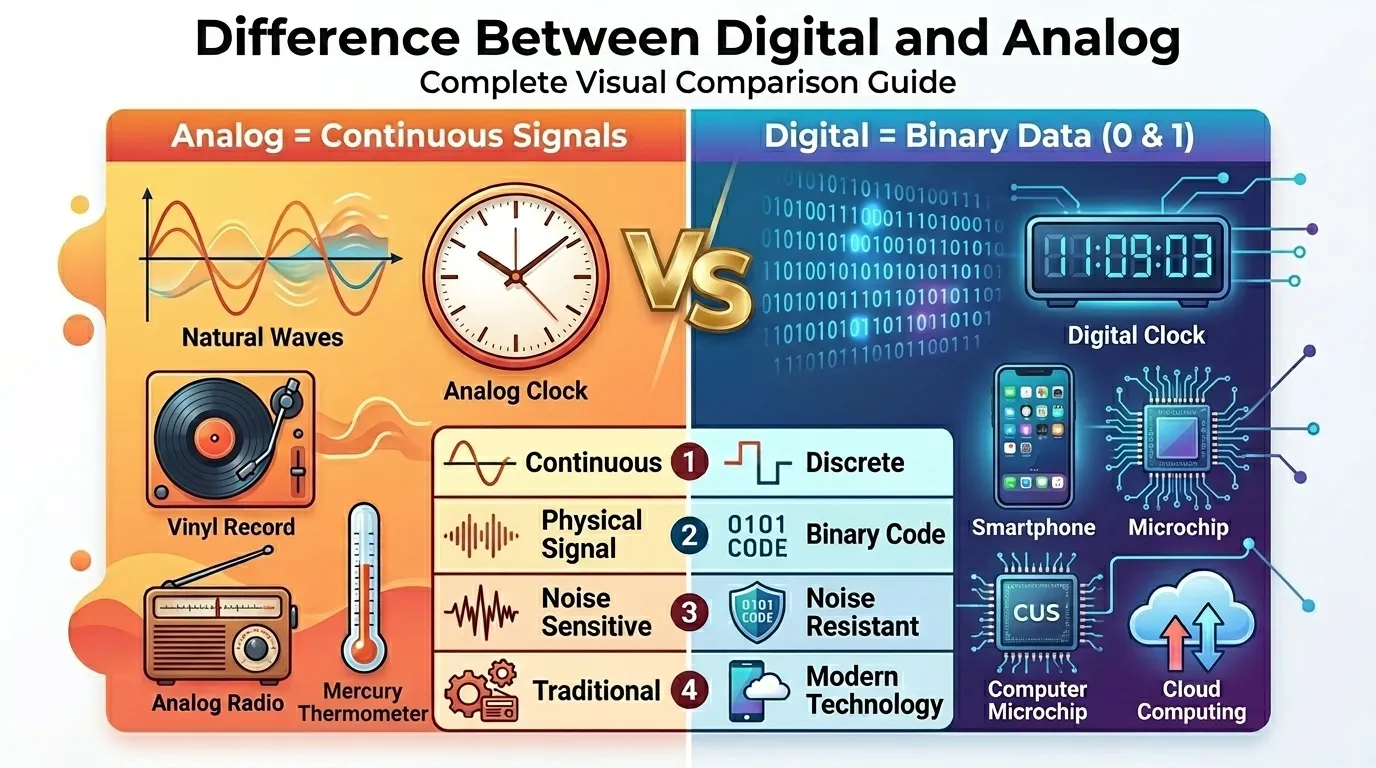
In simple words, the difference between digital and analog is that analog systems use continuous signals, while digital systems use discrete values, usually represented as 0s and 1s. Understanding the difference between digital and analog helps you choose the right technology for communication, recording, computing, and data processing.
If you’ve ever wondered what digital means, how analog works, why digital devices dominate modern technology, or where analog systems are still useful, this guide covers everything in one place.
Quick Answer: Difference Between Digital and Analog
The main difference between digital and analog is how information is represented.
- Analog uses continuously changing signals.
- Digital uses fixed values or binary numbers (0 and 1).
Example
An analog clock shows time using moving hands, while a digital clock displays exact numbers on a screen.
Definition of Difference Between Digital and Analog
Analog:
A system that represents information using continuously varying physical quantities such as voltage, sound waves, or movement.
Digital:
A system that represents information using discrete values, usually binary digits (0 and 1).
Simple Example:
A vinyl record stores analog sound waves, while an MP3 file stores digital audio data.
Pronunciation of Both Terms
| Term | US Pronunciation | UK Pronunciation |
|---|---|---|
| Analog | AN-uh-log | AN-uh-log |
| Digital | DIJ-i-tl | DIJ-i-tl |
Now that you know what these terms mean and how they are pronounced, let’s understand the key differences in greater detail.
Difference Between Digital and Analog: Comparison Table
| Feature | Analog | Digital |
|---|---|---|
| Signal Type | Continuous | Discrete |
| Data Representation | Infinite values | Binary values |
| Accuracy | Can degrade over time | Highly accurate |
| Noise Resistance | More affected by noise | Less affected by noise |
| Storage | Physical media | Electronic storage |
| Processing Speed | Generally slower | Faster |
| Editing Capability | Difficult | Easy |
| Transmission Quality | Signal loss possible | Quality remains consistent |
| Examples | Vinyl records, analog clocks | Smartphones, computers |
| Modern Usage | Specialized applications | Dominates modern technology |
Key Differences Explained Between Digital and Analog
1. Signal Representation
Analog signals change continuously.
Digital signals use fixed numerical values.
Real-life example: Human speech is naturally analog, while a voice message on a smartphone becomes digital data.
2. Accuracy
Digital systems can reproduce information more accurately.
Analog systems may lose quality over time.
Example: A copied digital photo remains identical, while repeated analog photocopies degrade.
3. Noise Handling
Analog signals are vulnerable to interference.
Digital systems can detect and correct errors.
Example: Old radio broadcasts often contain static noise, while digital streaming remains clear.
4. Storage Efficiency
Digital information can be compressed and stored efficiently.
Analog storage usually requires physical space.
5. Processing Power
Digital devices process information using microprocessors and software.
Analog systems rely on physical signal behavior.
6. Scalability
Digital systems are easier to duplicate and distribute.
Analog systems require direct physical reproduction.
7. Integration with Modern Technology
Most platforms such as Google Search, YouTube, Instagram, and Meta platforms operate entirely on digital data.
Why Does the Difference Between Them Exist?
The distinction exists because humans originally measured and transmitted information through naturally occurring signals.
Sound, light, and temperature exist as analog phenomena.
As computing advanced, engineers developed digital systems because they offered:
- Better reliability
- Easier storage
- Faster processing
- Improved scalability
This shift accelerated with the rise of personal computers and the internet.
How Do Analog Systems Work?
Analog systems represent real-world information directly.
For example:
- A thermometer’s mercury level rises continuously.
- A microphone converts sound waves into continuously changing electrical signals.
- Analog radio broadcasts use varying frequencies.
The key characteristic is that analog values can take an infinite number of possible states.
Advantages of Analog Systems
- Natural signal representation
- Smooth transitions
- Useful in certain scientific instruments
Limitations
- Susceptible to interference
- Harder to duplicate accurately
- Difficult long-term storage
How Do Digital Systems Work?
Digital systems convert information into binary code.
Computers process data using:
- 0s
- 1s
- Logic gates
- Microprocessors
Everything from a text message to a YouTube video eventually becomes digital data.
Advantages of Digital Systems
- High accuracy
- Easy storage
- Fast transmission
- Error correction
Limitations
- Requires conversion from analog sources
- Can lose detail if sampling rates are too low
Why Is Digital Technology Dominating Modern Devices?
The modern world runs on digital systems because they offer efficiency and scalability.
Consider:
- Google processes billions of digital search queries daily.
- YouTube stores and streams digital video content.
- Instagram manages digital photos and videos.
- Meta relies on digital networks to connect billions of users.
Digital technology supports cloud computing, artificial intelligence, machine learning, and real-time communication.
Without digital systems, today’s internet ecosystem would be impossible.
Difference Between Digital and Analog in Communication
Communication systems provide one of the clearest examples.
Analog Communication
Examples include:
- Traditional landline phones
- AM radio
- FM radio
Digital Communication
Examples include:
- Video calls
- Messaging apps
- Email systems
- Internet communication
Digital communication offers:
- Better security
- Error correction
- Faster delivery
- Global scalability
Difference Between Both Audio
Audio is where many beginners first encounter this comparison.
Analog Audio
Examples:
- Vinyl records
- Cassette tapes
Characteristics:
- Continuous waveforms
- Warm sound quality
- Physical storage
Digital Audio
Examples:
- MP3 files
- Streaming music
- Digital recordings
Characteristics:
- Binary storage
- Easy editing
- Consistent playback quality
Many audiophiles still prefer analog audio because of its unique listening experience, even though digital audio is technically more precise.
Difference Between Both in Computers
Analog Computers
Designed to solve mathematical and engineering problems using physical variables.
Common in earlier scientific applications.
Digital Computers
Modern laptops, smartphones, and servers.
Used for:
- Artificial intelligence
- Data analysis
- Gaming
- Cloud computing
Digital computers dominate because they can handle enormous amounts of data accurately.
Difference and Similarity Table Between Both
| Feature | Analog | Digital | Similarity |
|---|---|---|---|
| Meaning | Continuous representation | Discrete representation | Both transmit information |
| Signal | Smooth waveform | Binary values | Both carry data |
| Storage | Physical formats | Electronic formats | Both store information |
| Accuracy | Can degrade | Highly consistent | Both aim to preserve data |
| Communication | Traditional systems | Modern networks | Both enable communication |
| Processing | Physical signal behavior | Computer processing | Both process information |
| Applications | Instruments, audio | Computers, internet | Both solve real-world problems |
| User Purpose | Natural representation | Efficient management | Both serve users’ needs |
This table clearly shows the difference and similarity between both for quick understanding.
Common Mistakes with Difference Between Them
Mistake 1: Thinking Digital Is Always Better
Correction:
Some applications benefit from analog precision and natural signal representation.
Mistake 2: Assuming Analog Means Old
Correction:
Many modern sensors still use analog principles.
Mistake 3: Believing Digital Has No Errors
Correction:
Digital systems can experience data corruption but often include error correction.
Mistake 4: Confusing Analog with Manual
Correction:
Not all analog systems are manual.
Mistake 5: Ignoring Conversion Processes
Correction:
Most modern devices convert analog input into digital data.
Real Life Examples with Difference Between Both
Personal Use
Analog wall clock vs digital smartwatch.
Home Entertainment
Vinyl records vs music streaming services.
Business Environment
Paper-based record systems vs cloud databases.
Healthcare Industry
Analog blood pressure gauges vs digital monitoring systems.
Manufacturing
Analog sensors integrated with digital automation systems.
Artificial Intelligence Applications
AI systems rely entirely on digital data processing.
When to Use Each
Use Analog When:
- Natural signal measurement is required
- Scientific instruments need continuous readings
- Audio enthusiasts prefer traditional sound characteristics
Use Digital When:
- Data must be stored efficiently
- Information requires fast processing
- Internet communication is involved
- Scalability is important
For most modern users, digital technology is the practical choice.
Why People Get Confused in Difference Between Both
Several reasons create confusion:
- Both often work together
- Modern devices convert analog inputs into digital outputs
- Marketing terminology can be misleading
- Educational resources often oversimplify explanations
Most beginners assume both are competitors, but in reality they frequently complement each other.
Expert Insight
From a technology perspective, digital systems became dominant because businesses needed reliable storage, transmission, and scalability.
In real scenarios, organizations rarely choose purely analog or purely digital systems. Instead, they combine both approaches.
For example, microphones capture analog sound waves, then convert them into digital signals for editing, storage, and streaming.
This hybrid approach delivers the strengths of both technologies.
FAQ Section
What is the main difference between digital and analog?
Analog uses continuous signals, while digital uses discrete binary values.
Which is more accurate, digital or analog?
Digital is generally more accurate because it resists signal degradation.
Is human voice analog or digital?
Human voice is naturally analog.
Why are computers digital?
Digital systems process information reliably using binary code.
Are analog devices still used today?
Yes. Sensors, instruments, and audio equipment often use analog technology.
Is a smartphone digital or analog?
A smartphone is primarily digital but receives analog inputs like sound and touch.
Why does digital dominate modern technology?
Because it allows efficient storage, processing, transmission, and scalability.
Can analog and digital work together?
Yes. Most modern devices convert analog signals into digital information.
Which is better for audio quality?
It depends on user preference. Digital offers precision, while analog offers a unique listening experience.
What are examples of analog systems?
Analog clocks, vinyl records, thermometers, and radio broadcasts.
Conclusion
Understanding the difference between digital and analog is essential because these two technologies form the foundation of modern communication, computing, media, and electronics. Analog systems represent information through continuous signals and closely mirror natural phenomena such as sound waves and temperature changes. Digital systems, on the other hand, convert information into binary data, making storage, processing, and transmission far more reliable.
The final answer is simple: the difference between both lies in how information is represented—continuous versus discrete. Once you understand that core concept, every comparison becomes much easier to understand.

My name is Ryan Mitchell, and I am a comparison content writer based in the United States. I specialize in creating clear and easy-to-understand articles that explain the differences between similar concepts, products, and ideas. My work focuses on helping readers quickly understand what makes two things different so they can make better decisions.