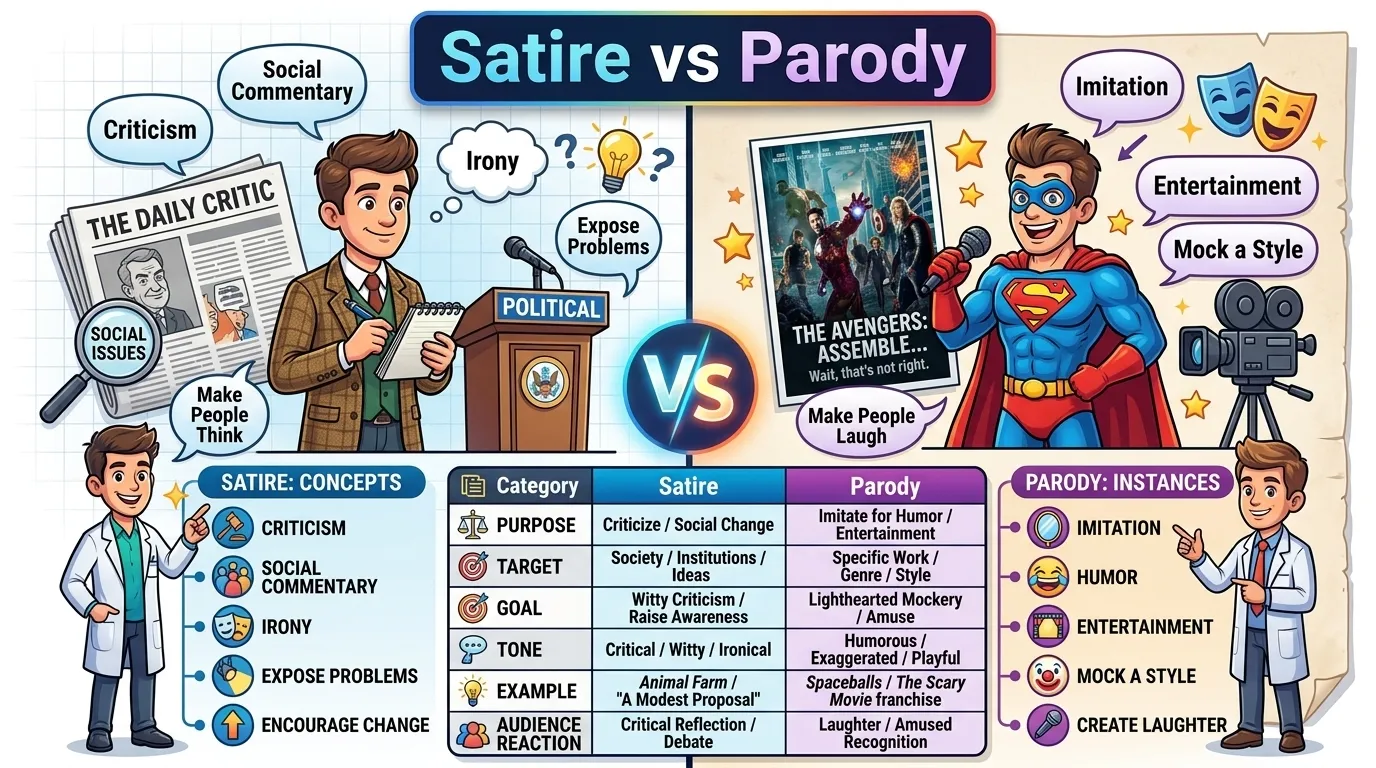
Many people get confused about the difference between satire and parody because both use humor, imitation, and exaggeration. At first glance, they can seem almost identical. However, the difference between satire and parody becomes clear when you understand their purpose and message.
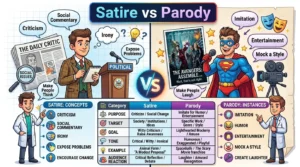
The difference between satire and parody is that satire aims to criticize or expose flaws in society, politics, culture, or human behavior, while parody mainly imitates a specific work, person, or style for humorous effect. Although they often overlap, their goals are not always the same.
If you’ve ever wondered what satire is, how parody works, why writers use them, and how to tell them apart in movies, books, social media, and entertainment, this guide covers everything you need to know.
Quick Answer: Difference Between Satire and Parody
Satire uses humor, irony, sarcasm, or exaggeration to criticize and expose problems in society, politics, or human behavior.
Parody imitates a person, work, genre, or style to create humor and entertainment.
Example
- A comedy show mocking government corruption to encourage social awareness = Satire
- A funny imitation of a famous superhero movie = Parody
In simple words, satire targets an issue, while parody targets a style or work.
Definition of Satire and Parody
- Satire: A literary and artistic technique that uses humor, irony, ridicule, or exaggeration to criticize flaws, mistakes, or social issues.
- Parody: A humorous imitation of a specific work, character, author, celebrity, genre, or style for entertainment or commentary.
Simple Example
A fake news article exposing political hypocrisy is satire.
A humorous copy of a news broadcast style is parody.
Pronunciation of Both Terms
| Term | US Pronunciation | UK Pronunciation |
| Satire | /ˈsætaɪr/ | /ˈsæt.aɪə/ |
| Parody | /ˈpærədi/ | /ˈpærədi/ |
Now that you know how these words are pronounced, let’s understand the deeper differences that separate them in literature, media, comedy, and modern digital content.
Satire vs Parody: Comparison Table
| Feature | Satire | Parody |
| Primary Purpose | Criticize flaws or issues | Create humor through imitation |
| Main Target | Society, politics, culture, behavior | Specific work, person, or style |
| Tone | Critical, ironic, thoughtful | Playful, humorous, entertaining |
| Goal | Encourage reflection or change | Entertain through imitation |
| Message | Usually carries social commentary | May or may not carry commentary |
| Focus | Ideas and problems | Form and style |
| Audience Reaction | Think and laugh | Mostly laugh |
| Common Mediums | Editorials, comedy shows, literature | Movies, sketches, social media videos |
| Use of Humor | Tool for criticism | Main objective |
| Real-World Impact | Often sparks discussion | Usually creates amusement |
Key Differences Explained Between Satire and Parody
1. Purpose Is Different
The biggest distinction is purpose.
Satire wants audiences to think critically about a problem.
Parody mainly wants audiences to recognize and laugh at an imitation.
Example
A cartoon criticizing climate policies is satire.
A cartoon copying a famous movie scene for laughs is parody.
2. Satire Attacks Issues
Satire focuses on real problems.
It may challenge political leaders, social trends, media behavior, or cultural beliefs.
Example
Television programs that expose misinformation often use satire.
3. Parody Copies a Style
Parody works by imitation.
It recreates the appearance, tone, structure, or mannerisms of something recognizable.
Example
A comedy video imitating influencer content on Instagram is parody.
4. Satire Usually Has a Message
Most satire contains a deeper meaning.
Writers use it to encourage discussion and reflection.
Example
A satirical article about excessive smartphone use highlights modern dependency on technology.
5. Parody Can Exist Without Criticism
Parody does not always criticize.
Sometimes it simply entertains audiences through clever imitation.
Example
A funny version of a popular song may not contain any criticism at all.
6. Emotional Impact Differs
Satire often creates both laughter and thought.
Parody primarily creates laughter.
This difference helps audiences identify the creator’s true intention.
7. Audience Expectations Are Different
When people watch satire, they often expect social commentary.
When people watch parody, they expect recognizable imitation and humor.
What Is Satire and Why Does It Exist?
Satire has existed for centuries because societies need ways to discuss sensitive issues without direct confrontation.
Writers, comedians, journalists, and filmmakers use satire to expose:
- Political corruption
- Social hypocrisy
- Cultural trends
- Media manipulation
- Human weaknesses
In practical use, satire allows criticism to become more engaging and memorable than straightforward arguments.
Famous satirical works often remain relevant because the underlying issues continue to exist.
What Is Parody and How Does It Work?
Parody works by borrowing recognizable elements from an original source.
These elements may include:
- Writing style
- Visual appearance
- Character behavior
- Story structure
- Dialogue patterns
The audience laughs because they recognize the original reference and notice how it has been exaggerated or transformed.
Modern platforms like YouTube, TikTok, and Instagram have made parody more popular than ever because creators can quickly imitate trending content.
Can Satire and Parody Be Used Together?
Yes. This is where many beginners become confused.
A work can be both satire and parody simultaneously.
Example
A television sketch may imitate a politician’s speech style (parody) while criticizing political dishonesty (satire).
In this case:
- The imitation is parody.
- The criticism is satire.
Many successful comedy shows combine both techniques.
Difference Between Satire and Parody in Literature
In literature, satire is often more message-driven.
Writers use it to reveal social and political problems through stories and characters.
Parody in literature typically copies the style of another author, genre, or literary movement.
Literary Satire Example
A novel exposing class inequality through humor.
Literary Parody Example
A book that imitates the writing style of a famous fantasy author for comedic effect.
Difference Between Satire and Parody in Movies and Television
Modern entertainment provides some of the easiest examples.
Satire in Film
Movies may criticize:
- Consumer culture
- Political systems
- Social expectations
- Corporate power
Parody in Film
Movies may imitate:
- Horror films
- Superhero films
- Action movies
- Romantic comedies
The audience laughs because familiar conventions are exaggerated.
How Social Media Uses Satire and Parody
Platforms such as Instagram, YouTube, and Meta have changed how satire and parody spread.
Satire on Social Media
Creators often discuss:
- Politics
- News events
- Consumer trends
- Public behavior
through humorous commentary.
Parody on Social Media
Creators frequently imitate:
- Influencers
- Celebrities
- Viral trends
- Advertising styles
for entertainment.
The short-form format makes parody especially effective because audiences instantly recognize familiar patterns.
Why the Difference Between Satire and Parody Matters
Understanding the distinction improves:
- Media literacy
- Critical thinking
- Literary analysis
- Content creation
- Academic writing
Many users search Google for the difference because misunderstanding a creator’s intent can lead to incorrect interpretations.
For example, someone may mistake a parody video for serious criticism or assume a satirical article is factual reporting.
Recognizing the difference helps audiences consume content more accurately.
Difference and Similarity Between Satire and Parody
| Feature | Satire | Parody | Similarity |
| Meaning | Criticism through humor | Imitation through humor | Both use comedy |
| Purpose | Expose flaws | Entertain through imitation | Both engage audiences |
| Focus | Social issues and ideas | Style, work, or person | Both rely on recognition |
| Tone | Critical and reflective | Playful and amusing | Both can be exaggerated |
| Audience Response | Think and laugh | Mostly laugh | Both create engagement |
| Use of Irony | Common | Sometimes used | Humor often depends on irony |
| Media Usage | News, literature, comedy | Movies, videos, sketches | Both appear across media |
| Cultural Impact | Encourages discussion | Builds entertainment value | Both influence popular culture |
This table clearly shows the difference and similarity between satire and parody for quick understanding.
Common Mistakes With Satire and Parody
Mistake 1: Thinking They Are Identical
Correction: Satire criticizes; parody imitates.
Mistake 2: Assuming Every Parody Is Satirical
Correction: Many parodies exist purely for entertainment.
Mistake 3: Ignoring the Creator’s Intent
Correction: Ask what the creator wants the audience to learn or feel.
Mistake 4: Confusing Exaggeration With Satire
Correction: Exaggeration alone does not create satire. A critical message is usually necessary.
Mistake 5: Treating Satire as Factual Reporting
Correction: Satirical content often uses fictional or exaggerated scenarios to make a point.
Real-Life Examples With Satire and Parody
Personal Use
A friend jokingly imitates another friend’s speaking style.
Result: Parody.
Business Use
A marketing campaign humorously copies a popular advertisement style.
Result: Parody.
Media Industry Use
A comedy program criticizes political decisions through humor.
Result: Satire.
Entertainment Industry
A movie mimics famous superhero films while making fun of genre clichés.
Result: Parody.
Journalism and Commentary
An article uses irony to expose social hypocrisy.
Result: Satire.
When to Use Each
Use Satire When
- You want to highlight a problem.
- You want audiences to think critically.
- You want social commentary.
- You are discussing politics, culture, or behavior.
Use Parody When
- You want to imitate something recognizable.
- You want entertainment and humor.
- You want to mock a style or format.
- You want audiences to recognize familiar patterns.
Why People Get Confused in Satire and Parody
Several factors create confusion:
Shared Use of Humor
Both make audiences laugh.
Shared Use of Exaggeration
Both often exaggerate reality.
Media Overlap
Movies, television shows, and social platforms frequently blend the two.
Similar Creative Techniques
Both may use irony, imitation, sarcasm, and absurdity.
Because of this overlap, many works contain elements of both categories.
Expert Insight
From a literary and communication perspective, the easiest way to identify the difference is to ask one question:
“What is being targeted?”
If the target is a social issue, political behavior, cultural norm, or human weakness, you are likely looking at satire.
If the target is a specific work, genre, creator, celebrity, or recognizable style, you are likely looking at parody.
In real scenarios, many modern comedians intentionally combine both techniques because parody grabs attention while satire delivers a deeper message. Understanding this distinction helps readers, students, writers, marketers, and content creators analyze media more accurately.
Frequently Asked Questions
Is satire the same as parody?
No. Satire criticizes issues or behavior, while parody imitates a specific work or style.
Can a parody be satirical?
Yes. A parody can include social criticism and become satirical.
Which is older, satire or parody?
Both have ancient roots, but satire has been a major literary form since classical times.
Why do writers use satire?
To expose flaws, encourage reflection, and discuss serious topics through humor.
Why do creators use parody?
To entertain audiences by imitating recognizable works, styles, or personalities.
Is every comedy a parody?
No. Comedy includes many forms beyond parody.
Can satire be serious?
Yes. Although humorous, satire often addresses serious issues.
How can I quickly identify satire?
Look for criticism of society, politics, culture, or human behavior.
How can I quickly identify parody?
Look for imitation of a specific work, genre, celebrity, or style.
Which is more common on social media today?
Parody is extremely common because short-form content makes imitation easy, though satire remains popular for commentary and current events.
Conclusion
Understanding the difference between satire and parody becomes much easier once you focus on purpose. Satire uses humor to criticize, expose, or challenge social issues, political systems, cultural habits, and human behavior. Parody, on the other hand, uses imitation to entertain audiences by copying a recognizable style, person, genre, or creative work.
If you remember one rule, remember this: satire targets problems, while parody targets presentation. That simple distinction can help you identify, analyze, and appreciate both forms of humor more effectively. Whether you’re a student, writer, content creator, or curious reader, understanding the difference between satire and parody improves media literacy and critical thinking in today’s content-rich world.

My name is Ryan Mitchell, and I am a comparison content writer based in the United States. I specialize in creating clear and easy-to-understand articles that explain the differences between similar concepts, products, and ideas. My work focuses on helping readers quickly understand what makes two things different so they can make better decisions.