Many people confuse smallpox and chickenpox because both diseases cause fever and a skin rash. However, several important factors clearly distinguish them. Health authorities eradicated smallpox worldwide, while chickenpox still affects people today, particularly children and unvaccinated individuals.
If you have ever wondered what is the difference between smallpox and chickenpox, how do their symptoms differ, or why are they often confused, this guide provides a complete answer. Understanding the difference between smallpox and chickenpox is important for students, healthcare learners, and anyone interested in infectious diseases.
In this article, you will learn definitions, pronunciation, symptoms, causes, transmission methods, treatment options, prevention strategies, similarities, differences, expert insights, and real-world examples in a simple and easy-to-understand format.
Quick Answer: Difference Between Smallpox and Chickenpox
Smallpox and chickenpox are different viral diseases.
- Smallpox was a severe and often deadly disease caused by the Variola virus and was officially eradicated in 1980.
- Chickenpox is caused by the Varicella-Zoster virus and still occurs today, although vaccines have greatly reduced cases.
Example: A child developing itchy blisters after exposure at school likely has chickenpox, while naturally occurring smallpox cases no longer exist anywhere in the world.
Definition of Smallpox and Chickenpox
- Smallpox: A serious infectious disease caused by the Variola virus that produced high fever and deep skin lesions. It has been eradicated globally.
- Chickenpox: A contagious viral infection caused by the Varicella-Zoster virus that produces itchy blisters and mild-to-moderate fever.
Example: Smallpox caused major epidemics in history, while chickenpox remains a common childhood illness in some regions.
Pronunciation of Both Terms
| Term | US Pronunciation | UK Pronunciation |
|---|---|---|
| Smallpox | /ˈsmɔːl.pɑːks/ | /ˈsmɔːl.pɒks/ |
| Chickenpox | /ˈtʃɪk.ɪn.pɑːks/ | /ˈtʃɪk.ɪn.pɒks/ |
Now that we know what these diseases are and how to pronounce them, let’s explore the major differences in detail.
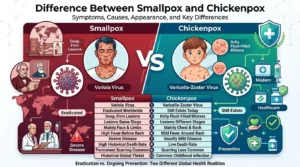
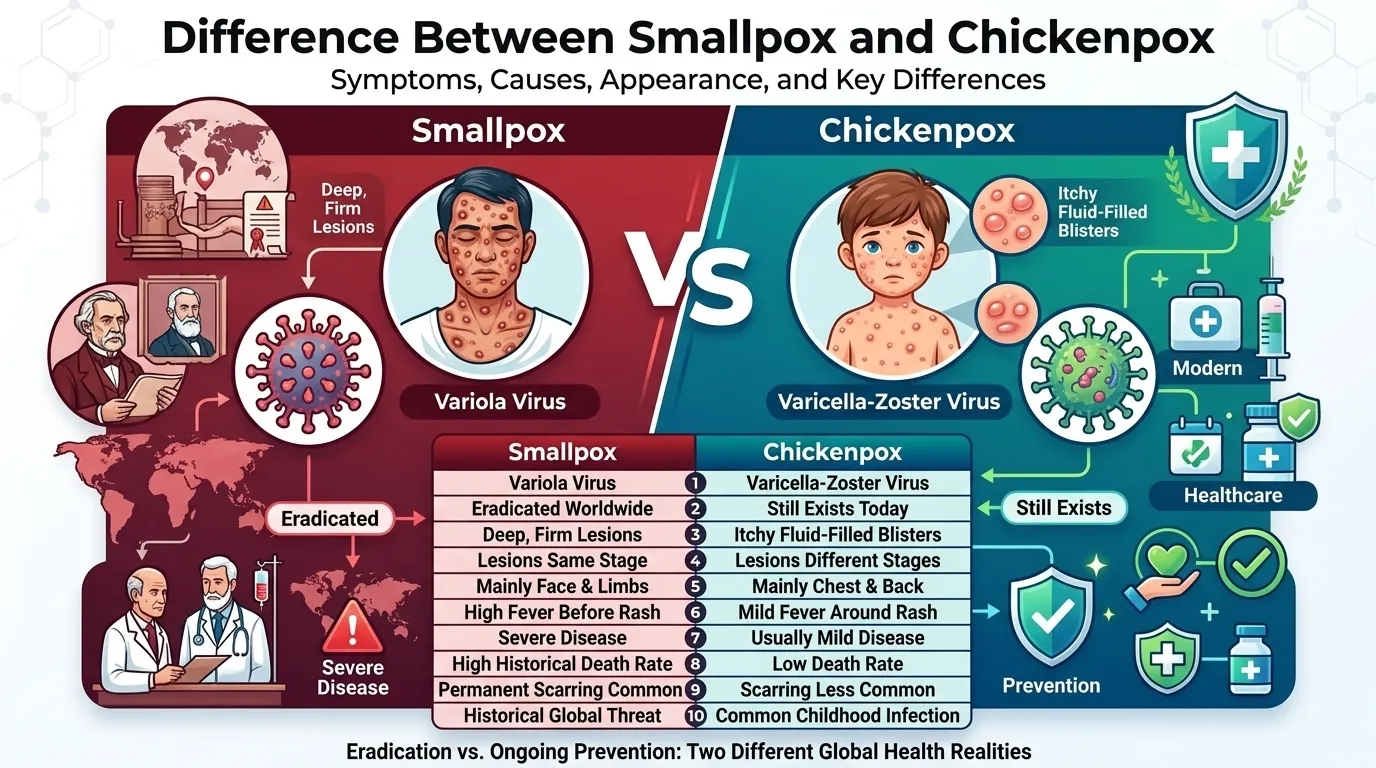
Smallpox vs Chickenpox: Comparison Table
| Feature | Smallpox | Chickenpox |
|---|---|---|
| Cause | Variola virus | Varicella-Zoster virus |
| Current Status | Eradicated worldwide | Still exists globally |
| Rash Appearance | Deep, firm lesions | Superficial itchy blisters |
| Rash Distribution | Concentrated on face and limbs | More common on torso |
| Severity | Often severe and life-threatening | Usually mild |
| Fever Timing | High fever before rash | Mild fever around rash onset |
| Scarring | Common permanent scars | Usually little or no scarring |
| Mortality Rate | Historically high | Very low in healthy individuals |
| Vaccination Purpose | Prevented eradicated disease | Prevents current infections |
| Public Health Impact | Historical global threat | Ongoing but manageable disease |
KEY DIFFERENCES EXPLAINED BETWEEN SMALLPOX AND CHICKENPOX
1. Different Viruses Cause Them
Smallpox comes from the Variola virus, while chickenpox is caused by the Varicella-Zoster virus.
Real-life insight: Many beginners assume they are different stages of the same illness, but they are entirely separate infections.
2. Smallpox Is Eradicated
One of the biggest differences is that naturally occurring smallpox no longer exists.
Example: A doctor today may diagnose chickenpox but would not expect to encounter a naturally occurring smallpox patient.
3. Rash Characteristics Differ
Smallpox lesions are deeper and firmer.
Chickenpox blisters are softer, itchier, and appear in different stages simultaneously.
Example: A chickenpox patient may have new blisters and healing lesions at the same time.
4. Severity Levels Are Different
Smallpox historically caused serious complications and death.
Chickenpox is generally mild, especially in healthy children.
5. Fever Pattern Is Different
Smallpox often begins with a high fever before the rash appears.
Chickenpox usually develops a mild fever around the time the rash starts.
6. Body Distribution Varies
Smallpox commonly affected the face, hands, and feet.
Chickenpox typically appears most heavily on the chest, back, and abdomen.
7. Scarring Risk Is Higher in Smallpox
Many survivors of smallpox carried lifelong facial scars.
Chickenpox usually heals without significant marks unless blisters are scratched excessively.
8. Historical Impact Is Vastly Different
Smallpox changed world history through devastating outbreaks.
Chickenpox remains important medically but has never caused the same level of global devastation.
What Causes Smallpox and Chickenpox?
Smallpox Cause
Smallpox was caused by the Variola virus, a member of the Orthopoxvirus family.
The virus spread through:
- Respiratory droplets
- Close personal contact
- Contaminated materials
Chickenpox Cause
Chickenpox is caused by the Varicella-Zoster virus.
It spreads through:
- Coughing
- Sneezing
- Direct contact with blisters
- Airborne transmission
Understanding the viral cause helps explain why treatment and prevention strategies differ.
How Does the Rash Look Different?
Smallpox Rash
Characteristics include:
- Deep and hard lesions
- Uniform appearance
- Lesions develop at the same stage
- More common on face and extremities
Chickenpox Rash
Characteristics include:
- Itchy fluid-filled blisters
- Different stages present simultaneously
- More concentrated on the trunk
- Usually less severe
Mini Summary
If all skin lesions look similar in age, smallpox would be suspected historically. If lesions appear in multiple stages, chickenpox is more likely.
Why Was Smallpox More Dangerous?
Smallpox became one of the deadliest infectious diseases in human history because:
- It spread easily among susceptible populations.
- It caused severe complications.
- Mortality rates were high.
The successful global vaccination campaign led by the World Health Organization (WHO) remains one of humanity’s greatest public health achievements.
How Is Chickenpox Treated Today?
Most chickenpox cases require supportive care:
- Rest
- Hydration
- Fever management
- Anti-itch medications
In higher-risk patients, doctors may prescribe antiviral medicines.
Because chickenpox still exists today, vaccination remains an important prevention strategy.
Difference Between Smallpox and Chickenpox Vaccines
Smallpox Vaccine
The smallpox vaccine played a critical role in eradication.
Today, it is generally reserved for specific preparedness programs and certain laboratory personnel.
Chickenpox Vaccine
The chickenpox vaccine is routinely used in many countries and significantly reduces infection rates and complications.
Why Vaccines Matter
Vaccines train the immune system to recognize viruses before serious illness develops.
Difference Between Smallpox and Chickenpox: Similarities and Differences Table
| Feature | Smallpox | Chickenpox | Similarity |
|---|---|---|---|
| Disease Type | Viral infection | Viral infection | Both are viral diseases |
| Main Cause | Variola virus | Varicella-Zoster virus | Both caused by viruses |
| Rash | Deep lesions | Itchy blisters | Both produce skin rashes |
| Fever | Usually high | Usually mild | Both may cause fever |
| Contagious Nature | Highly contagious | Highly contagious | Both spread between people |
| Vaccines | Smallpox vaccine | Chickenpox vaccine | Both can be prevented through vaccination |
| Current Status | Eradicated | Still active worldwide | Both are important in medical history |
| Public Health Impact | Historic pandemics | Common childhood illness | Both influenced healthcare systems |
This table clearly shows the difference and similarity between difference between smallpox and chickenpox for quick understanding.
Common Mistakes with Difference Between Smallpox and Chickenpox
Mistake 1: Thinking They Are the Same Disease
Correction: They are caused by completely different viruses.
Mistake 2: Assuming Smallpox Still Circulates Naturally
Correction: Smallpox was eradicated globally in 1980.
Mistake 3: Confusing Rash Patterns
Correction: Chickenpox lesions appear in different stages, while smallpox lesions develop together.
Mistake 4: Believing Chickenpox Is Always Harmless
Correction: Complications can occur in adults, newborns, and immunocompromised individuals.
Mistake 5: Assuming All Pox Diseases Are Related
Correction: Similar names do not necessarily mean similar viruses.
Real Life Examples with Difference Between Smallpox and Chickenpox
Scenario 1: School Exposure
A child develops itchy blisters after exposure to classmates. This is far more likely to be chickenpox.
Scenario 2: Historical Epidemic
Historical records describing widespread deaths and facial scarring often refer to smallpox outbreaks.
Scenario 3: Medical Education
Healthcare students frequently compare smallpox and chickenpox to learn disease recognition.
Scenario 4: Public Health Planning
Governments maintain emergency preparedness plans partly because of smallpox’s historical significance.
Scenario 5: Vaccine Awareness
Parents researching childhood immunization schedules often encounter information about chickenpox vaccines.
When to Use Each Term
Use “Smallpox” When:
- Discussing medical history
- Studying eradicated diseases
- Learning about vaccination campaigns
- Exploring historical pandemics
Use “Chickenpox” When:
- Discussing current infections
- Talking about childhood illnesses
- Reviewing vaccination schedules
- Understanding Varicella-Zoster virus infections
Why People Get Confused in Difference Between Smallpox and Chickenpox
Several factors create confusion:
Similar Names
Both include the word “pox.”
Similar Visible Symptoms
Both produce fever and skin eruptions.
Historical References
Older books sometimes discuss both diseases together.
Media and Internet Searches
Many users search symptoms online and see images of both diseases, leading to confusion.
In simple words, the names sound similar, but medically they are very different conditions.
Expert Insight
From a public health perspective, the most important distinction is not merely the rash appearance but the disease status.
Most beginners focus only on skin symptoms, but experts first consider the virus involved, disease prevalence, vaccination history, and epidemiological context.
This broader perspective provides a more accurate understanding than simply comparing blisters or fever patterns.
Frequently Asked Questions (FAQs)
Is chickenpox the same as smallpox?
No. They are caused by different viruses and have different severity levels.
Which is more dangerous, smallpox or chickenpox?
Smallpox was significantly more dangerous and had a much higher mortality rate.
Why are smallpox and chickenpox often confused?
Both diseases cause fever and skin rashes, and their names sound similar.
Can adults get chickenpox?
Yes. Adults can develop chickenpox, and symptoms may be more severe than in children.
What virus causes smallpox?
The Variola virus causes smallpox.
What virus causes chickenpox?
The Varicella-Zoster virus causes chickenpox.
Does chickenpox leave scars?
Usually not, although excessive scratching can increase scarring risk.
Is there a vaccine for chickenpox?
Yes. Vaccination is widely used and highly effective.
What was the biggest achievement against smallpox?
The global eradication campaign led by international public health organizations.
Conclusion
Understanding the difference between smallpox and chickenpox is easier once you focus on their causes, symptoms, severity, and current status. The Variola virus caused smallpox, a deadly disease that healthcare organizations successfully eradicated through one of history’s greatest vaccination campaigns. In contrast, the Varicella-Zoster virus causes chickenpox, which still occurs today, although widespread vaccination has significantly reduced its spread and impact.
For students, healthcare learners, parents, and anyone researching infectious diseases, knowing the difference between smallpox and chickenpox helps prevent misconceptions and improves medical understanding. By remembering the virus, rash pattern, severity, and eradication status, you can quickly distinguish between these two well-known diseases and confidently answer common comparison questions.

I am content creator and comparison blogger focused on analyzing key differences between terms, concepts, and ideas to deliver accurate, easy-to-understand information. So I decided to create a platform where these differences are explained in the simplest way possible.