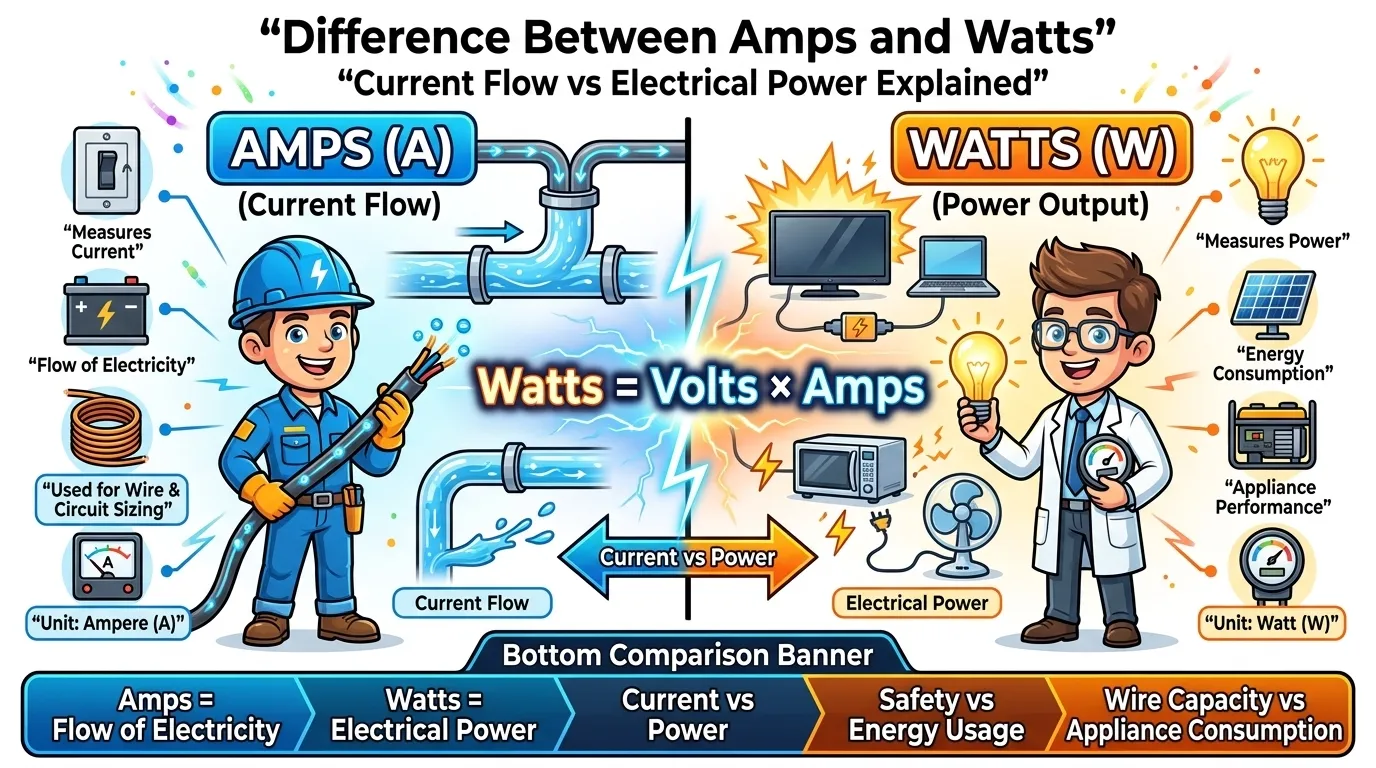
Many people searching for the difference between amps and watts are trying to understand electricity, power consumption, batteries, generators, solar systems, or home appliances. The confusion is understandable because amps and watts are closely connected, yet they measure completely different things.
The difference between both is that amps measure the flow of electrical current, while watts measure the total electrical power being used or produced. Understanding the difference between both helps you choose the right electrical devices, calculate energy needs, and avoid costly mistakes.
In this guide, you’ll learn what amps and watts mean, how they work together, why they matter, and how to calculate one from the other using real-world examples. Whether you’re a beginner, electrician, DIY enthusiast, or solar energy user, this article will provide complete clarity.
Quick Answer: Difference Between Both
Amps (A) measure the amount of electrical current flowing through a circuit, while watts (W) measure the total power consumed or produced.
Example:
A device running at 120 volts and drawing 5 amps uses:
Watts = Volts × Amps
120 × 5 = 600 watts
In simple words, amps tell you how much electricity is flowing, while watts tell you how much work that electricity is doing.
Definition of Amps and Watts
- Amps (Amperes): A unit that measures the flow of electric current through a circuit.
- Watts: A unit that measures electrical power or the rate at which energy is used.
Simple Example:
A water pipe analogy works well:
- Amps = Amount of water flowing
- Watts = Total power created by that water flow
Pronunciation of Both Terms
| Term | US Pronunciation | UK Pronunciation |
| Amps | /æmps/ | /æmps/ |
| Watts | /wɑːts/ | /wɒts/ |
Now that you know what each term means, let’s understand how they differ in practical electrical systems.
Amps vs Watts Comparison Table
| Feature | Amps | Watts |
| Meaning | Measures electrical current | Measures electrical power |
| Unit Symbol | A | W |
| Represents | Flow of electrons | Energy usage rate |
| Formula Role | Part of power calculation | Final power value |
| Depends On Voltage | Yes | Yes |
| Used For | Circuit current measurement | Appliance power rating |
| Seen On | Breakers, wires, batteries | Appliances, generators |
| Indicates | How much current flows | How much work electricity performs |
| Electrical Focus | Current | Power |
| Common Measurement | 10A, 20A, 30A | 100W, 500W, 2000W |
Key Differences Explained Between Both
1. What They Measure
Amps measure current flow.
Watts measure power output or consumption.
For example, a wire may carry 10 amps, but the total watts depend on voltage.
2. Their Purpose
Amps help determine wire size, breaker capacity, and electrical safety.
Watts help determine energy usage and appliance performance.
3. Appliance Labels
Most appliances display watts because consumers care about power consumption.
Electricians often focus on amps when designing circuits.
4. Impact on Electricity Bills
Electric utility companies charge based on energy consumption related to watts and kilowatt-hours.
Amps alone do not determine your electricity bill.
5. Circuit Design
Circuit breakers are rated in amps.
Power ratings are generally shown in watts.
6. Battery Systems
Battery banks often specify amp-hours.
Power tools and appliances are usually rated in watts.
7. Solar Energy Applications
Solar panels are marketed in watts.
Charge controllers and wiring systems are often selected using amp ratings.
What Is an Amp and How Does It Work?
An ampere measures the amount of electrical current flowing through a conductor.
Think of electrons moving through a wire like water flowing through a pipe.
The more electrons passing through each second, the higher the amp rating.
Common Examples
- Smartphone charger: 1–3 amps
- Home circuit: 15–20 amps
- EV charger: 30–80 amps
In practical use, higher amps mean more current flow.
What Is a Watt and How Does It Work?
A watt measures power.
Power represents how much electrical work is performed every second.
When electricity powers a light bulb, television, refrigerator, or computer, the amount of work being done is measured in watts.
Common Examples
- LED bulb: 10 watts
- Laptop charger: 65 watts
- Microwave: 1200 watts
- Air conditioner: 2000+ watts
Higher wattage generally means greater energy consumption.
How Are Amps and Watts Related?
The relationship between amps and watts is straightforward.
W=V\times A
Where:
- W = Watts
- V = Volts
- A = Amps
Example 1
120 volts × 10 amps = 1200 watts
Example 2
240 volts × 15 amps = 3600 watts
This formula explains why the same current can produce different wattage depending on voltage.
Why Understanding the Difference Between Both Matters
Many beginners think amps and watts mean the same thing.
They don’t.
Understanding the difference helps with:
- Choosing generators
- Installing solar systems
- Selecting extension cords
- Sizing circuit breakers
- Managing power consumption
- Reducing electrical overload risks
In real scenarios, knowing the difference can prevent expensive equipment damage.
Difference Between Them in Home Appliances
Every household appliance uses both amps and watts.
Refrigerator
- Approx. 700 watts
- May draw 6–8 amps
Microwave
- Approx. 1200 watts
- Higher amp demand
Air Conditioner
- High wattage and high current
Manufacturers usually advertise watts because consumers compare power usage.
Electricians often calculate amps to ensure safe wiring.
Difference Between Them in Solar Systems
Solar energy users frequently encounter both terms.
Watts in Solar Panels
Solar panels are sold using watt ratings:
- 200W panel
- 400W panel
- 600W panel
Amps in Solar Systems
Current ratings help determine:
- Cable sizes
- Charge controllers
- Battery charging rates
A complete solar installation requires understanding both measurements.
Difference Between Both in Batteries
Battery systems commonly use amp-hours (Ah).
Power requirements are often measured in watts.
Example
A battery may provide:
- 12 volts
- 100 amp-hours
The available energy can be estimated as:
12 × 100 = 1200 watt-hours
This is why battery and solar professionals frequently convert between amps and watts.
Difference and Similarity Between Both
| Feature | Amps | Watts | Similarity |
| Definition | Measures current flow | Measures electrical power | Both describe electricity |
| Unit | Ampere (A) | Watt (W) | International SI units |
| Electrical Role | Current measurement | Power measurement | Used together |
| Formula Position | Input value | Output value | Connected through voltage |
| Appliance Usage | Current demand | Power consumption | Found in device specifications |
| Safety Importance | Prevents overloads | Estimates power needs | Important for electrical planning |
| Solar Applications | Charge current | Panel output | Essential for solar systems |
| Battery Systems | Charging/discharging current | Energy delivery | Used in battery calculations |
This table clearly shows the difference and similarity between both for quick understanding.
Common Mistakes with Both
Mistake 1: Assuming They Mean the Same Thing
Correction:
Amps measure current; watts measure power.
Mistake 2: Ignoring Voltage
Correction:
Voltage affects watt calculations significantly.
Mistake 3: Buying the Wrong Generator
Correction:
Always calculate watt requirements first.
Mistake 4: Choosing Incorrect Wire Sizes
Correction:
Wire sizing depends primarily on amps.
Real-Life Examples with Difference Between Them
Personal Use
A phone charger may use 2 amps but only 20 watts.
Home Use
A microwave may consume 1200 watts while drawing around 10 amps.
Business Use
Offices calculate watts to estimate electricity costs.
Industrial Use
Factories monitor amps to protect motors and equipment.
Solar Energy Systems
Installers calculate both amps and watts to ensure efficiency and safety.
When to Use Each
Use Amps When:
- Selecting wires
- Choosing circuit breakers
- Measuring current flow
- Designing electrical circuits
Use Watts When:
- Comparing appliances
- Estimating energy usage
- Buying generators
- Planning solar panel output
Why People Get Confused About Both
Several factors contribute to confusion.
Similar Electrical Terminology
People often see volts, amps, watts, and kilowatts together.
Product Marketing
Manufacturers emphasize wattage more than current ratings.
Lack of Technical Knowledge
Many users never learn the relationship between current and power.
Online Information Overload
Different websites explain the concepts using varying approaches.
Expert Insight
From an electrical engineering perspective, neither amps nor watts are more important than the other.
Professionals evaluate both simultaneously.
In practical use, amps determine whether wiring and components can safely carry current. Watts determine how much power equipment consumes or delivers.
Most beginners focus only on wattage because that’s what they see on product labels. However, electricians often pay closer attention to amp ratings because safety, overheating risks, and circuit capacity depend heavily on current flow.
Understanding both measurements provides a complete picture of how electrical systems operate.
Frequently Asked Questions (FAQs)
Is 10 amps the same as 1000 watts?
Not necessarily. Wattage depends on voltage. At 120 volts, 10 amps equals 1200 watts.
Which is more important, amps or watts?
Both are important because they measure different aspects of electricity.
Can I convert amps directly to watts?
Yes, if voltage is known.
Watts = Volts × Amps.
Why do appliances show watts instead of amps?
Consumers typically compare energy usage, making wattage more useful for product labeling.
Do electricity bills use amps or watts?
Electricity companies bill based on energy consumption measured in kilowatt-hours, which relates to watts.
What comes first, amps or watts?
Neither. They are related measurements connected through voltage.
Are amps dangerous?
High current can be dangerous and may cause overheating or electrical shock.
How many watts are in 20 amps?
It depends on voltage.
At 120V: 2400 watts.
At 240V: 4800 watts.
Why are solar panels rated in watts?
Watts indicate total power production, making performance comparisons easier.
Do batteries use amps or watts?
Both. Batteries are often rated in amp-hours, while devices powered by batteries are usually rated in watts.
Conclusion
Understanding the difference between amps and watts is essential for anyone working with electricity, whether you’re powering a smartphone, installing a solar system, selecting a generator, or managing household appliances. Amps measure the flow of electrical current, while watts measure the amount of power being consumed or produced. Although they are closely related through voltage, they serve different purposes and provide different information.
The simplest way to remember the difference between both is this: amps tell you how much electricity is flowing, and watts tell you how much work that electricity is doing. Once you understand that relationship, reading electrical specifications becomes much easier. Whether for home use, business applications, batteries, generators, or solar systems, knowing the difference between both helps you make smarter and safer decisions.

I am content creator and comparison blogger focused on analyzing key differences between terms, concepts, and ideas to deliver accurate, easy-to-understand information. So I decided to create a platform where these differences are explained in the simplest way possible.