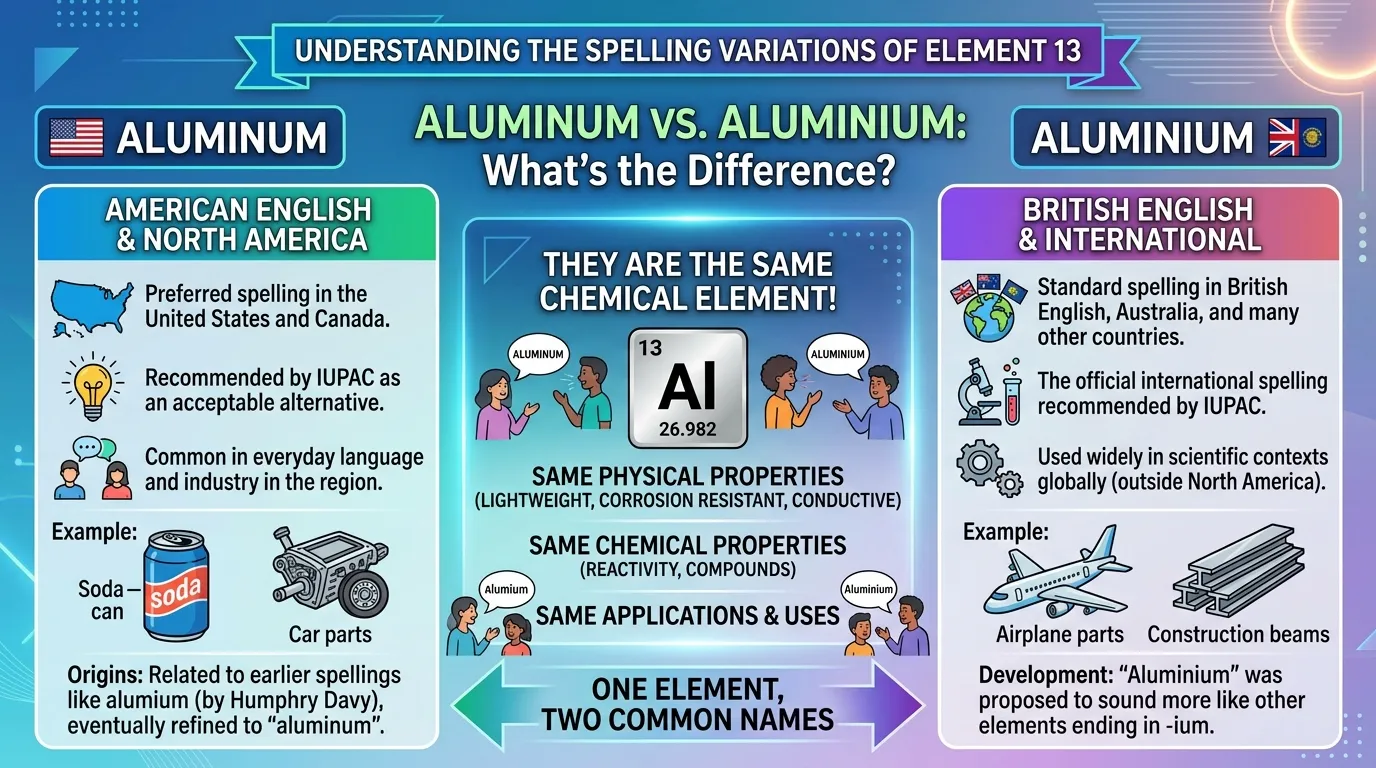
The terms aluminum and aluminium often confuse students, professionals, and even engineers. At first glance, they look like two different substances—but in reality, they refer to the same chemical element (Al, atomic number 13). The difference is not scientific but linguistic, historical, and regional.
Aluminum vs Aluminium distinction matters more than it seems. In technical documents, academic writing, international trade, and engineering standards, using the correct term can improve clarity, professionalism, and compliance with regional standards.
In simple terms:
- Aluminum is used mainly in American English
- Aluminium is used in British English and globally
This detailed guide, we will explore the difference between aluminum and aluminium, their origins, usage, and 15 key differences with real examples to make everything crystal clear.
Spelling and Pronunciation Differences
The most noticeable difference lies in spelling and pronunciation.
- Aluminum (American English)
- Aluminium (British/International English)
Pronunciation:
- Aluminum → uh-LOO-muh-num
- Aluminium → al-yoo-MIN-ee-um
Example:
- In the US, you’ll hear: “Aluminum foil”
- In the UK, it’s: “Aluminium foil”
Historical Origin of the Two Spellings
The naming history goes back to Humphry Davy, who first identified the element.
- Initially named “alumium”
- Then changed to “aluminum”
- Later adjusted to “aluminium” to match other elements like sodium and magnesium
Example:
- Scientific journals outside the US adopted “aluminium”
- American publications continued using “aluminum”
Physical and Chemical Properties of Aluminum
Regardless of spelling, the element remains identical in every scientific aspect.
Properties:
- Lightweight and strong
- Corrosion-resistant
- Excellent conductor of heat and electricity
- Highly recyclable
Example:
- Aircraft bodies use aluminum/aluminium due to its strength-to-weight ratio
Industrial Applications of Aluminum
This metal is essential in modern industries.
Uses:
- Aerospace (airplanes)
- Construction (windows, roofing)
- Packaging (cans, foil)
- Electronics (devices, wiring)
Example:
- A soda can in the US says aluminum can
- The same in Europe says aluminium can
Standardization and Certification Terminology
Different standards organizations prefer different terms:
- US standards → Aluminum
- International standards → Aluminium
Example:
- ASTM (US) uses aluminum
- ISO (global) uses aluminium
Quick Comparison Table (Aluminum vs Aluminium)
| Feature | Aluminum | Aluminium |
| Spelling | American | British/International |
| Pronunciation | Short | Longer |
| Usage | USA | Global |
| Scientific Style | Less consistent | Matches element naming |
| Properties | Same | Same |
| Symbol | Al | Al |
15 Key Differences Between Aluminum and Aluminium
1. Spelling Difference
The most visible difference is spelling. “Aluminum” is shorter, while “aluminium” includes an extra “i,” making it align with scientific naming patterns.
Example: US textbooks use aluminum, UK books use aluminium.
2. Pronunciation Variation
Because of the extra syllable, aluminium has a longer and more formal pronunciation compared to aluminum.
Example: In global conferences, “aluminium” sounds more aligned with scientific terminology.
3. Regional Usage
Aluminum is primarily used in the United States, while aluminium is used in the UK, Europe, Asia, and most other regions.
Example: Product packaging differs by country.
4. Language Standard
Aluminum belongs to American English, whereas aluminium follows British English conventions.
This affects writing styles in international publications.
5. Historical Naming Evolution
The element went through multiple name changes before settling into two accepted forms. Aluminium was favored to match other elements.
Example: Early chemistry texts show naming variations.
6. Scientific Naming Consistency
“Aluminium” fits the pattern of element names ending in “-ium” (like sodium, calcium).
This is why scientists often prefer aluminium.
7. Standardization Bodies
Different organizations use different terms based on region.
US standards → aluminum
Global standards → aluminium
8. Academic Preference
Universities and research institutions outside the US generally use aluminium for consistency in scientific naming.
Example: UK and European journals.
9. Industrial Documentation
Industries follow regional standards when writing manuals and technical specifications.
Example: A US factory manual uses aluminum; a German one uses aluminium.
10. Product Labeling
The naming on consumer products changes depending on the market.
Example: “Aluminum foil” vs “Aluminium foil”
11. Professional Communication
Professionals adjust terminology depending on their audience.
Example: International reports often prefer aluminium.
12. Global Recognition
Aluminium is more widely recognized globally due to international standards.
Example: Scientific conferences and global trade documents.
13. Chemical Identity
There is absolutely no difference in chemical composition—both have symbol Al and atomic number 13.
This is the most important scientific fact.
14. Physical Properties
Both terms refer to a metal with identical properties like strength, conductivity, and corrosion resistance.
Example: Same metal used in aircraft worldwide.
15. Functional Usage
In real-world applications, both terms are interchangeable depending on region.
Example: Same material used in cans, cars, and electronics globally.
When and Where to Use Each Term (Expert Guide)
Use “Aluminum” When:
- Writing for a US audience
- Creating content for American websites or blogs
- Following US standards (ASTM, ANSI)
- Working in US-based companies or industries
Example:
- “Aluminum sheet specifications” (US engineering document)
Use “Aluminium” When:
- Writing for an international or global audience
- Publishing in academic or scientific journals
- Following international standards (ISO, IEC)
- Targeting UK, Europe, Asia, or global SEO traffic
Example:
- “Aluminium alloy properties” (research paper)
The Relationship Between Aluminum and Aluminium
1. Same Element
Both names refer to the exact same metal.
2. Language-Based Difference
The variation is purely regional.
3. Historical Evolution
Both names evolved from early scientific naming.
4. Identical Properties
No difference in physical or chemical behavior.
5. Contextual Usage
Choice depends on region, audience, and standards.
Simple Way to Remember
- Aluminum = American usage
- Aluminium = Global usage
- Both = Same element
Conclusion
The difference between aluminum and aluminium is a classic example of how language and history influence scientific terminology. Despite the variation in spelling and pronunciation, both words represent the same chemical element with identical properties and applications.
For professionals, the key is to use the correct term based on region, audience, and industry standards. In global or academic contexts, “aluminium” is often preferred, while “aluminum” remains standard in the United States.
Final takeaway:
- No scientific difference
- Only linguistic variation
- Same metal, different names
FAQs
1. Are aluminum and aluminium different?
No, both are the same element.
2. Which spelling is correct?
Both are correct depending on region.
3. Why does the US use aluminum?
Due to historical naming preferences.
4. Which is used globally?
Aluminium is more widely used worldwide.
5. What is the main difference?
Only spelling and pronunciation.

I am content creator and comparison blogger focused on analyzing key differences between terms, concepts, and ideas to deliver accurate, easy-to-understand information. So I decided to create a platform where these differences are explained in the simplest way possible.