In English, small words often create big confusion, and “Till vs Until” is a perfect example of this. Both are commonly used to talk about time, especially when something continues up to a certain point. Because their meanings are almost identical, many learners assume they are completely interchangeable in every situation.
However, the real difference between till and until lies in their tone, formality, usage context, and subtle stylistic preferences. While native speakers often switch between them naturally, choosing the right one can make your English sound more polished, professional, or conversational, depending on the situation.
Understanding how and when to use till vs until is especially important for students writing essays or exams and for professionals writing emails or reports.
In this detailed guide, you’ll learn the definitions, usage rules, examples, and key differences between till and until in a clear and practical way.
What is Till?
Till is a word used to show that something continues up to a specific time or event. It is commonly used in informal speaking and casual writing.
Definition:
Till means “up to the time when something happens.”
Key Characteristics:
- Short and simple word
- More common in spoken English
- Slightly informal in tone
Examples:
- I will wait here till you arrive.
- Stay outside till the rain stops.
- Let’s talk till midnight.
In all these examples, till shows that an action continues up to a certain moment.
What is Until?
Until also means that something continues up to a certain time, but it is considered more formal and standard in English.
Definition:
Until means “up to the point in time when something happens.”
Key Characteristics:
- More formal and widely accepted
- Preferred in academic and professional writing
- Slightly stronger and clearer tone
Examples:
- I will wait here until you arrive.
- The office is open until 6 PM.
- She studied until late at night.
Just like till, until indicates duration up to a specific time.
Quick Comparison Table: Till vs Until
| Feature | Till | Until |
|---|---|---|
| Meaning | Means “up to a certain time” | Means “up to a certain time” |
| Core Function | Shows continuation of an action until a point | Shows continuation of an action until a point |
| Formality Level | Informal and conversational | Formal and standard |
| Usage in Writing | Used in casual writing (texts, chats) | Preferred in formal writing (essays, reports) |
| Spoken English | Very common in everyday speech | Also used, but less casual |
| Professional Use | Rarely used in professional communication | Strongly preferred in business and academic contexts |
| Academic Preference | Not recommended in exams | Recommended in exams and assignments |
| Tone & Style | Relaxed, friendly, informal tone | Polished, clear, and professional tone |
| Emphasis on Duration | Slightly lighter sense of continuation | Stronger sense of duration and completion |
| Grammar Acceptance | Grammatically correct but less formal | Fully standard and widely accepted |
| Interchangeability | Can replace “until” in most cases | Can replace “till” in all cases |
| Common Mistake | Sometimes confused with “’til” | No common spelling confusion |
| Clarity in Communication | Clear in casual contexts | Clear in all contexts (formal + informal) |
Key Differences Between Till and Until with Examples
1. Meaning and Scope
Both till and until mean “up to a certain time”, showing that an action continues until a specific point. There is no difference in basic meaning, only in usage style.
Example:
- Wait here till I come back
- Wait here until I come back
✔ Both sentences mean the same
2. Formality Level
Till is considered informal, while until is formal and standard in English.
Example:
- Informal: Stay here till evening
- Formal: Stay here until evening
3. Usage in Writing
In formal writing (essays, reports, emails), until is preferred because it sounds more professional. Till is mostly used in casual writing.
Example:
- Essay: The shop remains open until 9 PM
- Chat: I’ll wait till 9 PM
4. Spoken vs Written English
Till is more common in spoken English, while until appears more in written and formal communication.
Example:
- Speaking: Let’s stay here till morning
- Writing: Please remain here until morning
5. Tone and Style
Till gives a relaxed, friendly tone, whereas until provides a polished and professional tone.
Example:
- Casual: I’ll call you till tomorrow
- Professional: I’ll contact you until tomorrow
6. Grammar Preference
Both are grammatically correct, but until is considered the standard form in grammar rules, especially in formal English.
7. Academic Usage
In exams and academic writing, until is strongly recommended because it follows formal language standards.
Example:
Write until the bell rings (correct in exams)
8. Common Mistake (“’til”)
Many people write ’til, assuming it is a short form. This is often discouraged in formal writing. Till itself is a complete word.
Example:
❌ ’til 5 PM
✔ till 5 PM
✔ until 5 PM
9. Emphasis on Duration
Until often gives a slightly stronger sense of continuity and completion, while till feels lighter and more casual.
Example:
- He worked until midnight (strong emphasis)
- He worked till midnight (casual tone)
10. Interchangeability
Both words can usually replace each other without changing meaning, but tone may differ.
Example:
- Stay here till I return
- Stay here until I return
11. Professional Communication
In business emails, official documents, and reports, until is always the safer and preferred option.
Example:
The offer is valid until Friday
12. Sentence Structure Flexibility
Until works better in complex and formal sentence structures, while till is more suited to simple sentences.
Example:
- Complex: The system will remain active until further notice
- Simple: Stay here till I return
13. Historical Origin
Till is actually an older word in English. Until developed later as an extended form, which is why both exist today.
Interesting fact:
Till is not a short form of until
14. Clarity and Precision
Until is considered clearer and more precise in formal and professional contexts, while till is perfectly clear in casual use.
Example:
- Official: Valid until December 31
- Casual: I’ll wait till December
15. Learning Strategy
For learners, it’s easier to follow a simple rule:
- Use until when unsure (works everywhere)
- Use till in casual speaking
Example:
- Safe choice: Wait until I arrive
- Casual: Wait till I arrive
Quick Summary
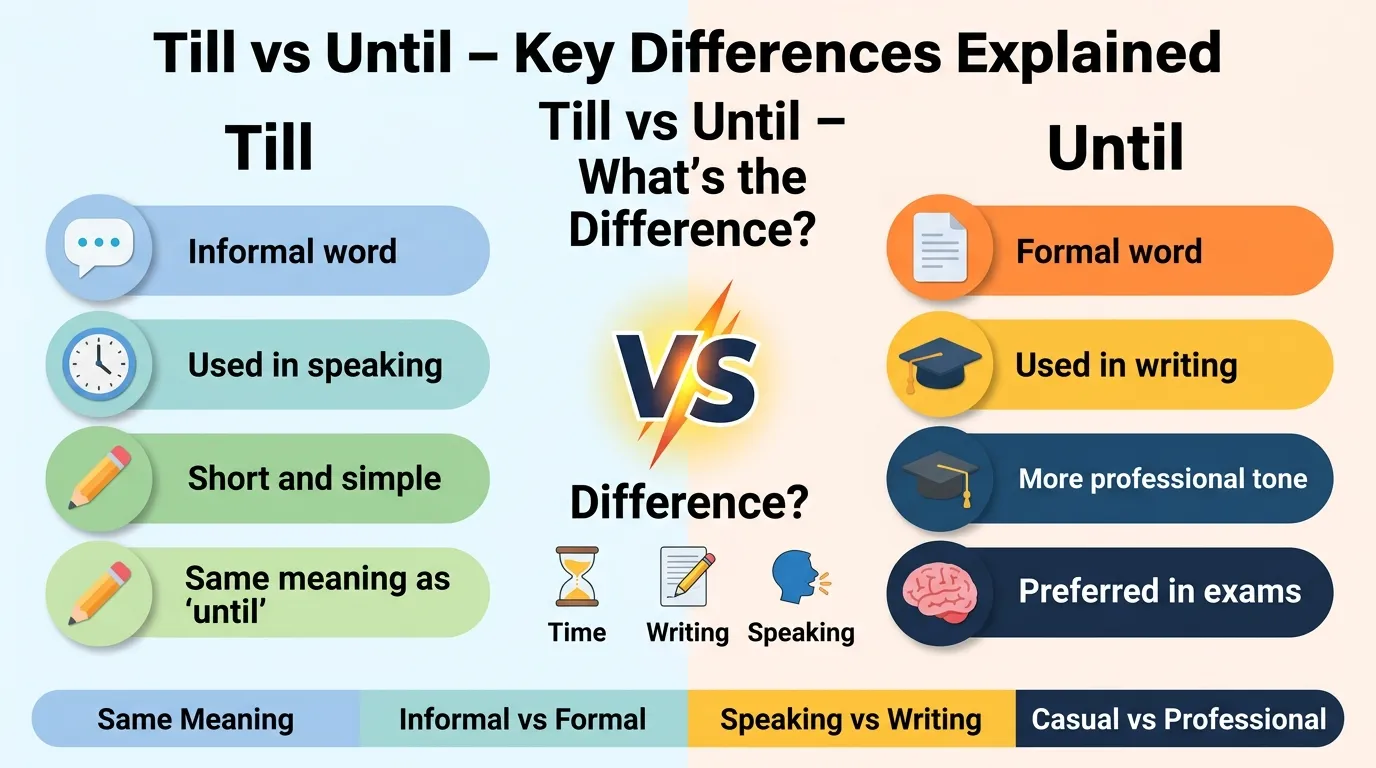
- Till → Casual, short, used in speaking
- Until → Formal, complete, used in writing
When to Use Till vs Until
Use Till when:
- You are speaking casually
- Writing informal messages
- Talking with friends
Use Untilwhen:
- Writing essays or exams
- Communicating professionally
- You want clear and formal tone
Conclusion
The difference between till and until is not about meaning but about style, tone, and context. Both words express the same idea of something continuing up to a certain time, but they are used differently depending on the situation.
Till is shorter, simpler, and more common in everyday conversation, making it ideal for informal use. Until, however, is more formal, widely accepted, and preferred in professional, academic, and written contexts.
To communicate effectively, it’s important to choose the right word based on your audience and purpose. Using until in formal settings shows clarity and professionalism, while using till in casual situations keeps your language natural and relaxed.
Final takeaway:
- Till = Informal, conversational, everyday use
- Until = Formal, standard, professional use
FAQs
1. Are till and until exactly the same?
Yes, they have the same meaning, but they differ in formality and usage.
2. Which is more correct in grammar?
Both are correct, but until is preferred in formal grammar.
3. Is “till” a short form of “until”?
No, till is an original word, not a shortened version.
4. Can I use “till” in exams?
It’s better to use until in exams and academic writing.
5. Which should I use in daily conversation?
You can use till in casual conversation and until in formal situations.

I am content creator and comparison blogger focused on analyzing key differences between terms, concepts, and ideas to deliver accurate, easy-to-understand information. So I decided to create a platform where these differences are explained in the simplest way possible.