The nail enhancement industry has transformed into a highly specialized segment of the beauty market, where technique, product knowledge, and client psychology all play a crucial role. Among the most frequently asked questions by both professionals and clients is the difference between acrylic and gel nails.
At first glance, both options may seem similar—they enhance nail appearance, support nail art, and improve durability. However, beneath the surface lies a significant difference in chemical composition, application process, structural behavior, cost dynamics, and long-term nail health impact.
This article Acrylic vs Gel Nails goes beyond basic comparisons. It is designed for:
- Salon owners and nail technicians seeking professional insights
- Beauty enthusiasts making informed decisions
- Researchers and learners exploring nail technology
We’ll break down everything—from how long each type lasts to advanced material science—so you can confidently choose or recommend the right system.
What Are Acrylic Nails?
Acrylic nails are formed by combining a liquid monomer with a powder polymer, creating a chemical reaction that hardens into a solid protective layer.
Key Features:
- Air-cured (no lamp required)
- Extremely strong and rigid
- Ideal for long nail extensions
- Widely used in high-volume salons
✔️ Industry Insight:
Acrylic systems are often preferred in budget-friendly salons due to their low material cost and high durability, making them profitable for frequent services.
What Are Gel Nails?
Gel nails use a pre-mixed gel formula that hardens under UV or LED light, forming a flexible and glossy coating.
Key Features:
- Requires UV/LED curing
- Lightweight and flexible
- Natural, glossy finish
- Minimal odor
Industry Insight:
Gel nails dominate in premium salon segments, where clients prioritize aesthetics, comfort, and modern nail trends.
How Long Do Acrylic Nails Last?
Acrylic nails typically last:
- 2–3 weeks before a fill is required
- Up to 4 weeks with proper maintenance
Longevity Factors:
- Nail growth speed
- Lifestyle (manual labor vs desk work)
- Aftercare habits
- Technician skill
Acrylic nails are ideal for clients who need maximum durability and long extensions.
How Long Do Gel Nails Last?
Gel nails generally last:
- 2 weeks (gel polish)
- 2–3 weeks (hard gel extensions)
Longevity Insights:
- Less prone to cracking
- More prone to lifting if not sealed properly
- Maintains shine longer than acrylic
Gel nails are perfect for clients prioritizing appearance over strength.
Maintenance & Cost Comparison (Acrylic vs Gel Nails)
Cost Analysis
| Type | Cost Level | Reason |
| Acrylic | Affordable | Low material cost |
| Gel | Premium | Equipment + finish quality |
Maintenance Requirements
- Both require fills every 2–3 weeks
- Acrylic shows more visible regrowth
- Gel requires careful handling to avoid lifting
Business Insight:
- Acrylic = High volume, consistent income
- Gel = Premium pricing, higher profit per client
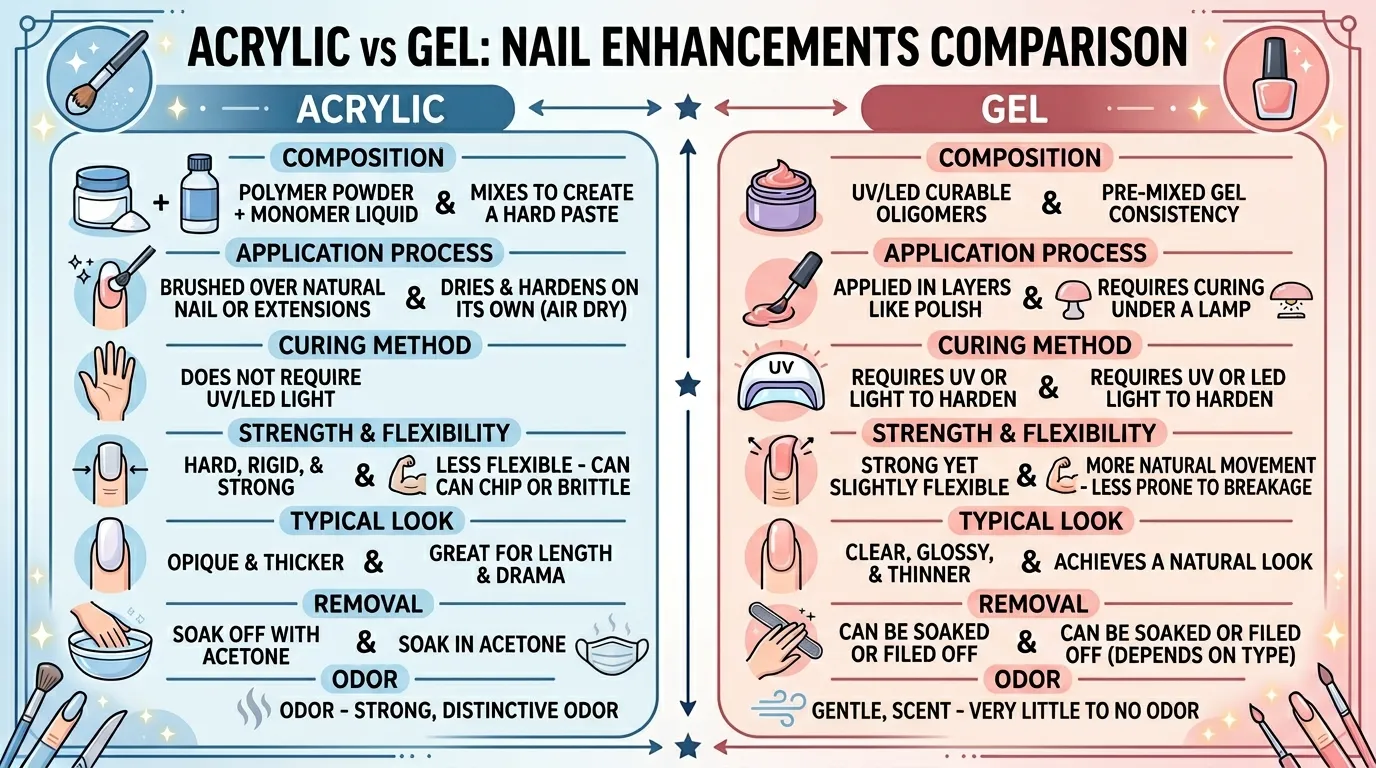
Quick Comparison Table (Acrylic vs Gel Nails)
| Feature | Acrylic Nails | Gel Nails |
| Application | Air-cured chemical reaction | UV/LED cured gel |
| Durability | Very strong | Flexible |
| Appearance | Thick, structured | Natural, glossy |
| Odor | Strong | Minimal |
| Cost | Affordable | Premium |
| Removal | Soak + file | Soak or buff |
Core Difference Between Acrylic and Gel Nails in Details
1. Application Process
Acrylic: Chemical reaction (monomer + polymer), air-cured
Gel: Pre-mixed gel, cured under UV/LED lamp
Professionals must invest in UV/LED equipment for gel systems, whereas acrylic requires manual expertise.
2. Durability & Strength
Acrylic Nails: Extremely strong and long-lasting
Gel Nails: Flexible but slightly less durable
Acrylic is ideal for clients with long extensions or rough nail usage.
3. Appearance & Finish
Acrylic: Can appear thicker and less natural
Gel: Thin, glossy, and more natural-looking
Gel nails dominate in fashion-forward, aesthetic-focused markets.
4. Maintenance & Fill-Ins
Acrylic: Requires regular fills every 2–3 weeks
Gel: Also requires maintenance but less visible regrowth
Acrylic regrowth lines are more noticeable due to rigidity.
5. Removal Process
Acrylic: Soaked in acetone and filed off
Gel: Soaked or gently buffed off
Improper removal of either can damage the nail plate.
6. Odor & Chemical Exposure
Acrylic: Strong chemical smell
Gel: Minimal odor
Ventilation is essential for acrylic application in salons.
7. Cost & Profit Margins
Acrylic: Lower material cost, higher profit margins
Gel: Higher cost but premium pricing potential
Gel services often attract high-paying clients.
8. Flexibility vs Rigidity
Acrylic: Hard and rigid structure
Gel: Soft, flexible structure
Gel reduces breakage risk, while acrylic provides stronger support.
9. Weight & Comfort
Acrylic: Heavier feel on nails
Gel: Lightweight and comfortable
Gel is preferred by clients who prioritize comfort.
10. Nail Health Impact
Acrylic: Can weaken natural nails if misused
Gel: Generally less damaging when applied correctly
Proper technique matters more than product type.
11. Repair & Fixing
Acrylic: Easier to repair small cracks or breaks
Gel: Often requires full reapplication
Acrylic is more practical for quick salon fixes.
12. Skill Requirement
Acrylic: Requires precise liquid-to-powder ratio control
Gel: Requires correct curing timing and layering
Acrylic is technique-heavy; gel is equipment-dependent.
13. Equipment Needs
Acrylic: Basic tools, no machines required
Gel: Requires UV/LED lamp and curing setup
Initial investment is higher for gel services.
14. Nail Art Compatibility
Acrylic: Best for 3D designs and long extensions
Gel: Best for smooth, glossy, detailed designs
Choice depends on design style preference.
15. Market Positioning & Client Type
Acrylic: Budget-friendly, mass-market clients
Gel: Premium service, style-conscious clients
Offering both helps salons target a wider audience and increase revenue.
Is Gel or Acrylic Better for Weak Nails?
For weak or brittle nails, gel is generally the better choice.
Why:
- Flexible structure reduces stress
- Less aggressive on nail plate
- More comfortable for daily wear
Acrylic can still be used carefully for structured overlays, but requires expertise.
First Time Getting Nails Done: What to Ask For?
For beginners, the experience can be overwhelming. Asking the right questions ensures better results.
Key Questions:
- Do I want length or natural nails?
- How long should they last?
- What is my budget?
- Do I prefer comfort or durability?
Recommendations:
- Beginners → Gel nails
- Long extensions → Acrylic nails
Can You Get Nail Art on Gel and Acrylic?
Yes, both support nail art—but their strengths differ.
Acrylic Nail Art:
- Ideal for 3D designs
- Supports heavy embellishments
- Great for bold looks
Gel Nail Art:
- Smooth and glossy finish
- Best for intricate designs
- Trending in modern nail fashion
Pros and Cons
✔️ Acrylic Pros:
- Extremely durable
- Cost-effective
- Ideal for long nails
❌ Acrylic Cons:
- Strong odor
- Less natural look
- Risk of damage if misused
✔️ Gel Pros:
- Natural appearance
- Lightweight
- Odor-free
❌ Gel Cons:
- Higher cost
- Requires equipment
- Slightly less durable
Advanced Insight: Business & Client Psychology
Understanding client behavior is key:
- Acrylic clients prioritize strength and affordability
- Gel clients prioritize appearance and comfort
Offering both allows salons to maximize revenue and client retention.
FAQs
Do acrylic nails last longer than gel?
Yes, acrylic nails generally last longer due to their rigid structure.
Are gel nails more natural-looking?
Yes, gel nails provide a thinner and glossier finish.
Which is better for beginners?
Gel nails are better due to comfort and natural feel.
Can acrylic damage nails?
Yes, if applied or removed incorrectly.
Which is more expensive?
Gel nails are usually more expensive than acrylic nails.
Conclusion
The difference between acrylic vs gel nails is not just about looks—it’s about performance, comfort, cost, and client expectations. Acrylic nails lead in strength and durability, making them ideal for long extensions and heavy use. Gel nails, on the other hand, excel in flexibility, natural appearance, and comfort, making them a favorite in premium beauty segments.
For professionals, the ultimate strategy is not choosing one—but mastering both. This ensures the ability to customize services, meet diverse client needs, and build long-term success in the competitive nail industry.

I am content creator and comparison blogger focused on analyzing key differences between terms, concepts, and ideas to deliver accurate, easy-to-understand information. So I decided to create a platform where these differences are explained in the simplest way possible.