Many people hear the terms inflation and deflation in news reports, economic discussions, and financial articles, but they often struggle to understand what they actually mean. The difference between inflation and deflation is one of the most important concepts in economics because it affects prices, salaries, savings, investments, and the overall economy.
If you have ever wondered why groceries become more expensive over time or why some economies experience falling prices, you are already asking questions related to the difference between inflation and deflation. Understanding this topic helps individuals make better financial decisions and gives businesses insight into market behavior.
In simple words, inflation causes prices to rise, while deflation causes prices to fall. However, the real difference between inflation and deflation goes much deeper than price changes. It influences consumer spending, employment, business growth, government policies, and economic stability.
In this guide, you will learn what inflation and deflation mean, how they work, their key differences, similarities, real-life examples, and why understanding them matters in today’s economy.
Quick Answer: Difference Between Inflation and Deflation
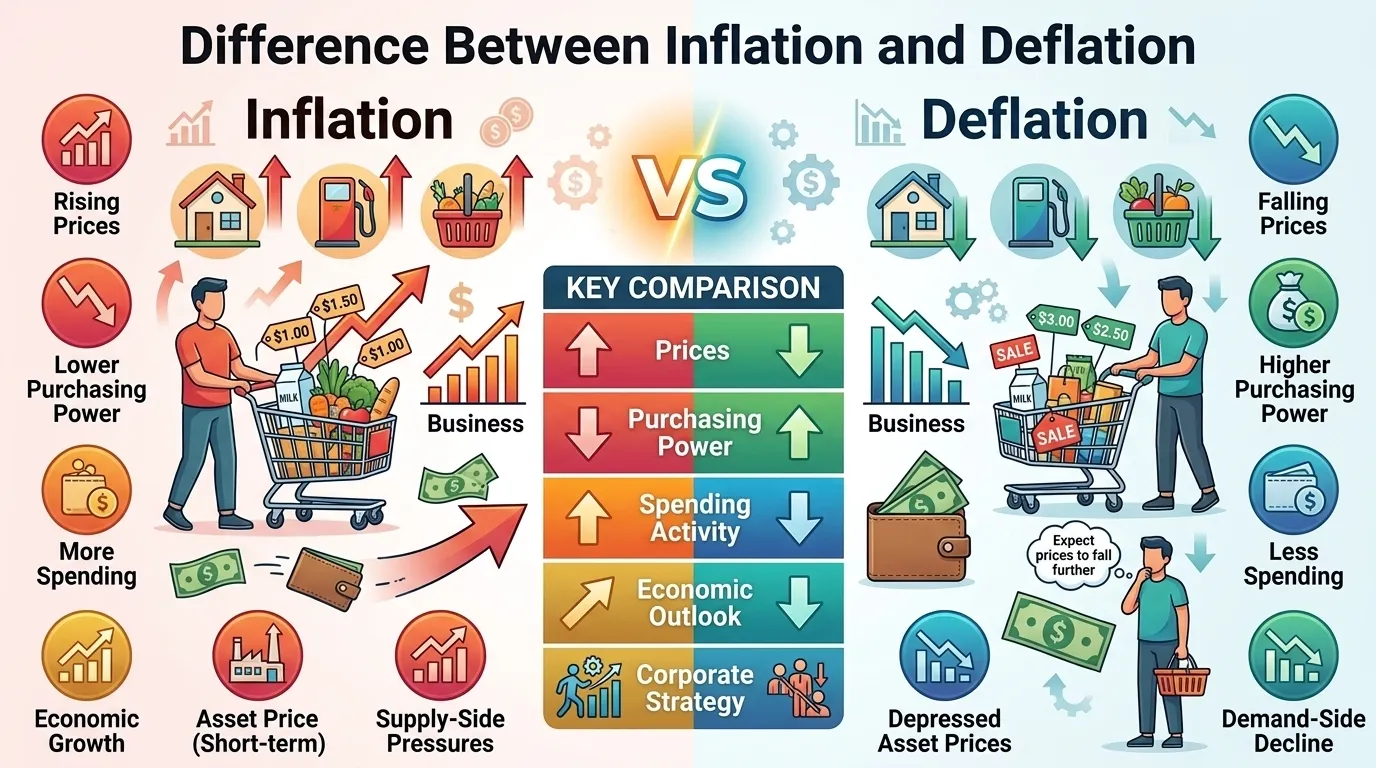
The difference between inflation and deflation is that inflation increases the general price level of goods and services, while deflation decreases it.
Example:
If a loaf of bread costs $2 today and costs $2.20 next year, inflation has occurred. If the same loaf costs $1.80 next year, deflation has occurred.
Inflation reduces purchasing power over time, whereas deflation increases purchasing power but can slow economic growth.
Definition of Inflation and Deflation
- Inflation: A sustained increase in the general prices of goods and services over time, reducing the purchasing power of money.
- Deflation: A sustained decrease in the general prices of goods and services over time, increasing the purchasing power of money.
Simple Example:
With inflation, $100 buys fewer products. With deflation, $100 buys more products.
Pronunciation of Both Terms
Inflation
US: in-FLAY-shun
UK: in-FLAY-shuhn
Deflation
US: dee-FLAY-shun
UK: dee-FLAY-shuhn
Now that the definitions are clear, let’s explore the difference between inflation and deflation in greater detail and understand how they affect everyday life and the global economy.
Inflation vs Deflation: Comparison Table
| Feature | Inflation | Deflation |
|---|---|---|
| Meaning | Prices generally rise | Prices generally fall |
| Purchasing Power | Decreases | Increases |
| Consumer Behavior | Encourages spending | Encourages saving |
| Business Revenue | Often increases | Often decreases |
| Employment | Usually supports job growth | Can increase unemployment |
| Economic Growth | May stimulate growth when moderate | Often slows growth |
| Debt Impact | Makes debt easier to repay | Makes debt more expensive |
| Central Bank Response | Raise interest rates if too high | Lower interest rates to stimulate spending |
| Investment Environment | Encourages asset growth | Can reduce investment activity |
| Economic Risk | Hyperinflation if excessive | Economic recession if prolonged |
Key Differences Explained Between Inflation and Deflation
1. Impact on Prices
Inflation pushes prices upward over time. Deflation causes prices to decline.
Example: Electronics costing $1,000 may rise to $1,100 during inflation but drop to $900 during deflation.
2. Purchasing Power
Inflation reduces what money can buy. Deflation increases purchasing power.
Example: A fixed salary loses value during inflation but gains value during deflation.
3. Consumer Spending
People spend sooner during inflation because prices may rise later. During deflation, consumers often delay purchases expecting lower prices.
4. Business Performance
Businesses generally benefit from moderate inflation because revenues increase. Deflation often reduces profits because companies sell products at lower prices.
5. Employment Levels
Inflation can support job creation. Deflation may lead companies to reduce costs through layoffs.
6. Borrowing and Debt
Inflation benefits borrowers because future repayments are made with less valuable money. Deflation increases the real burden of debt.
7. Government Policy
Governments and central banks typically try to control inflation and avoid long-term deflation because both extremes can damage economic stability.
What Is Inflation and Why Does It Happen?
Inflation occurs when the overall demand for goods and services exceeds supply or when production costs increase.
Common causes include:
- Increased consumer spending
- Rising wages
- Higher energy costs
- Supply chain disruptions
- Expansion of money supply
In practical use, moderate inflation is considered normal and healthy for a growing economy. Most central banks aim for a low and stable inflation rate rather than zero inflation.
What Is Deflation and Why Does It Happen?
Deflation happens when overall demand weakens and businesses lower prices to attract buyers.
Common causes include:
- Reduced consumer spending
- Economic recessions
- Falling wages
- Excess production
- Tight monetary policy
Many beginners assume falling prices are always good. However, prolonged deflation can signal economic weakness and lead to lower business investment and higher unemployment.
How Does the Difference Between Inflation and Deflation Affect Consumers?
Consumers experience inflation and deflation differently.
During Inflation
- Groceries become more expensive
- Housing costs rise
- Transportation expenses increase
- Savings lose purchasing power
During Deflation
- Products become cheaper
- Savings gain value
- Consumers delay spending
- Economic activity may slow
In real scenarios, moderate inflation often creates a balance where consumers continue spending while businesses continue investing.
Difference Between Inflation and Deflation in Business and Investment
Businesses closely monitor inflation and deflation because both affect profitability.
Inflation Effects on Businesses
- Higher sales revenue
- Increased production costs
- Greater pricing power
- Potential wage increases
Deflation Effects on Businesses
- Lower product prices
- Reduced profit margins
- Less investment
- Hiring freezes
Investors also react differently. During inflation, stocks, real estate, and commodities often perform well. During deflation, investors may favor cash and safer assets.
Why Is Moderate Inflation Considered Healthier Than Deflation?
Many users get confused here.
At first glance, lower prices seem beneficial. However, economists generally view moderate inflation as healthier because it encourages spending and investment.
When people expect prices to rise slightly, they are more likely to buy products today. Businesses then expand operations, hire workers, and invest in growth.
During deflation, consumers often postpone purchases. This can create a cycle of declining sales, lower profits, layoffs, and weaker economic growth.
That is why many central banks around the world aim for moderate inflation rather than deflation.
Difference Between Both During Economic Crises
Economic crises often reveal the true impact of inflation and deflation.
Inflationary Crisis
An inflationary crisis occurs when prices rise rapidly.
Examples include:
- Currency depreciation
- Supply shortages
- Excessive money printing
Deflationary Crisis
A deflationary crisis occurs when spending collapses.
Examples include:
- Severe recessions
- Banking crises
- Major demand shocks
Both situations can be harmful, but prolonged deflation is often harder to reverse because consumer confidence becomes weak.
How Governments and Central Banks Manage Inflation and Deflation
Central banks use monetary policy to influence economic conditions.
To Control Inflation
- Increase interest rates
- Reduce money supply
- Tighten lending conditions
To Combat Deflation
- Lower interest rates
- Encourage borrowing
- Increase money supply
- Support economic stimulus programs
Organizations such as the Federal Reserve, European Central Bank, and Bank of England regularly monitor inflation and deflation indicators.
Difference and Similarity Between Inflation and Deflation
| Feature | Inflation | Deflation | Similarity |
|---|---|---|---|
| Meaning | Rising prices | Falling prices | Both affect price levels |
| Purchasing Power | Falls | Rises | Both change money value |
| Consumer Behavior | More spending | More saving | Both influence buying decisions |
| Business Impact | Can increase revenues | Can reduce revenues | Both affect profitability |
| Employment | Often supports jobs | May reduce jobs | Both influence labor markets |
| Government Response | Monetary tightening | Monetary easing | Both require policy intervention |
| Economic Growth | Can stimulate growth | Can slow growth | Both shape economic performance |
| Financial Markets | May boost assets | May increase caution | Both affect investments |
Common Mistakes With Inflation and Deflation
Mistake 1: Assuming Inflation Is Always Bad
Correction: Moderate inflation often supports economic growth.
Mistake 2: Thinking Deflation Is Always Good
Correction: Persistent deflation can damage the economy.
Mistake 3: Confusing Price Drops With Deflation
Correction: A temporary price decrease in one product is not deflation.
Mistake 4: Ignoring Purchasing Power
Correction: Inflation and deflation primarily affect money’s purchasing power.
Mistake 5: Overlooking Business Effects
Correction: Economic health depends on both consumer and business behavior.
Real-Life Examples With Inflation and Deflation
Personal Example
A family notices grocery bills increasing each year due to inflation.
Business Example
A retailer raises product prices because supplier costs have increased.
Investment Example
Investors buy real estate to protect wealth during inflation.
Industry Example
Technology products may experience temporary price declines due to innovation, though this is not always true deflation.
National Economy Example
A country experiencing weak demand may face deflationary pressure and slow growth.
When to Use Each Concept
Use Inflation When
- Discussing rising prices
- Explaining reduced purchasing power
- Analyzing economic expansion
- Studying central bank policies
Use Deflation When
- Discussing falling prices
- Explaining increased purchasing power
- Analyzing recessions
- Evaluating weak consumer demand
Why People Get Confused About Inflation and Deflation
Several factors create confusion:
- Both involve price changes
- News media often oversimplifies economic terms
- Temporary price drops are mistaken for deflation
- Economic discussions use technical language
- Purchasing power concepts are not always explained clearly
Most beginners focus only on prices rather than broader economic effects.
Expert Insight
From an economic perspective, neither inflation nor deflation is inherently good or bad. What matters is the degree and duration.
In practical use, economists generally prefer low, stable inflation because it supports spending, investment, and employment. Persistent deflation, however, often signals underlying economic weakness.
One of the biggest misconceptions is focusing solely on prices. Experienced analysts examine purchasing power, consumer confidence, labor markets, productivity, and monetary policy together before evaluating economic conditions.
Frequently Asked Questions
What is the main difference between inflation and deflation?
Inflation causes prices to rise, while deflation causes prices to fall.
Is inflation better than deflation?
Moderate inflation is generally considered healthier for economic growth than prolonged deflation.
How does inflation affect savings?
Inflation reduces the purchasing power of saved money over time.
Why is deflation dangerous?
Deflation can reduce spending, slow business activity, and increase unemployment.
Can inflation and deflation occur together?
Different sectors may experience different price trends, but the overall economy usually experiences one dominant condition.
What causes inflation?
Inflation is commonly caused by increased demand, higher costs, or expansion of the money supply.
What causes deflation?
Deflation often results from weak demand, economic recession, or reduced money supply.
How do central banks fight inflation?
They often raise interest rates and reduce money supply growth.
How do central banks fight deflation?
They typically lower interest rates and encourage spending and investment.
Why do investors care about inflation and deflation?
Both conditions affect asset values, returns, risk levels, and economic growth expectations.
Conclusion
Understanding the difference between inflation and deflation is essential for making informed financial and economic decisions. While inflation increases the prices of goods and services and reduces purchasing power, deflation lowers prices and increases purchasing power. However, the impact goes far beyond price tags.
Inflation often encourages spending, investment, and business expansion when it remains moderate. Deflation, although it may seem beneficial because products become cheaper, can create serious economic challenges by reducing demand, lowering profits, and increasing unemployment.
In real-world economies, policymakers usually aim for stable and controlled inflation because it supports long-term growth and economic confidence. Deflation is generally viewed as a warning sign of weak demand and economic slowdown.

I am content creator and comparison blogger focused on analyzing key differences between terms, concepts, and ideas to deliver accurate, easy-to-understand information. So I decided to create a platform where these differences are explained in the simplest way possible.