If you are buying a house, apartment, or commercial property, one of the most important terms you will encounter is Freehold vs Leasehold. Many buyers get confused because both involve property ownership, but the rights and responsibilities are very different.
Understanding Freehold vs Leasehold can help you avoid costly mistakes, especially when comparing property value, ownership rights, maintenance obligations, and long-term investment potential. Whether you are purchasing your first home, investing in real estate, or simply researching property ownership types, knowing the difference is essential.
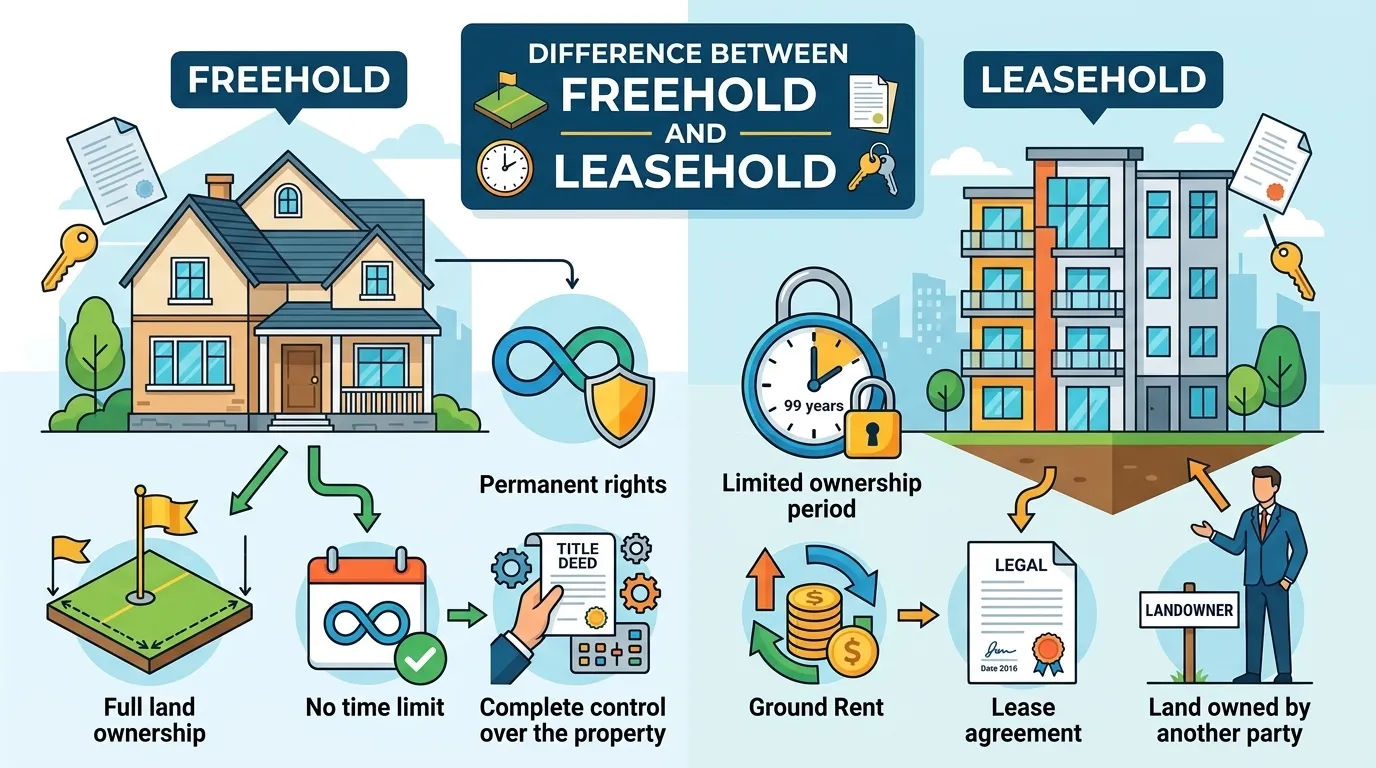
In simple words, a freehold owner owns both the property and the land indefinitely, while a leasehold owner owns the property only for a fixed period and pays certain obligations to the landowner. This guide explains everything you need to know about Freehold vs Leasehold, including definitions, comparisons, advantages, disadvantages, real-life examples, and expert insights.
Quick Answer: Freehold vs Leasehold
The main difference between Freehold vs Leasehold is ownership duration.
- Freehold: You own the property and the land permanently.
- Leasehold: You own the property for a specific lease period, but the land belongs to another party.
Example: If you buy a freehold house, the land is yours forever. If you buy a leasehold apartment with a 99-year lease, ownership returns to the freeholder when the lease expires unless it is extended.
Definition of Freehold vs Leasehold
- Freehold: Complete ownership of a property and the land it stands on with no time limit.
- Leasehold: Ownership of a property for a fixed period under a lease agreement while the land remains owned by the freeholder.
Example: A detached house is commonly sold as freehold, while many apartments and flats are sold as leasehold.
Pronunciation of Both Terms (US & UK)
| Term | US Pronunciation | UK Pronunciation |
|---|---|---|
| Freehold | FREE-hold | FREE-hold |
| Leasehold | LEES-hold | LEES-hold |
Now that the definitions are clear, let’s understand how these property ownership systems work in real-world situations.
Freehold vs Leasehold Comparison Table
| Feature | Freehold | Leasehold |
|---|---|---|
| Ownership Duration | Unlimited ownership | Limited lease period |
| Land Ownership | Own the land | Land owned by freeholder |
| Property Control | Greater control | Restrictions may apply |
| Ground Rent | Usually none | Often payable |
| Service Charges | Generally lower | Common in apartments |
| Property Value | Typically higher | May decline as lease shortens |
| Mortgage Approval | Easier | Can be harder for short leases |
| Long-Term Investment | Stronger investment | Depends on lease length |
| Maintenance Decisions | Owner decides | Often shared management |
| Resale Potential | Usually stronger | Can be affected by remaining lease |
Key Differences Explained Between Freehold vs Leasehold
1. Ownership Rights
Freehold gives complete ownership. Leasehold provides ownership only for a specified term.
Example: A freehold homeowner can keep the property indefinitely, while a leaseholder may have a 99-year or 125-year lease.
2. Land Ownership
A freeholder owns both building and land.
A leaseholder owns the property but not the land beneath it.
3. Financial Obligations
Leaseholders may pay service charges, maintenance fees, and ground rent.
Freeholders usually have fewer ongoing ownership fees.
4. Property Value
Properties with freehold status often maintain stronger market value.
Short lease properties can lose value over time.
5. Property Modifications
Freeholders generally have greater freedom to renovate.
Leaseholders may require permission from the freeholder.
6. Mortgage Availability
Banks and lenders often prefer freehold properties because ownership risks are lower.
7. Long-Term Security
Freehold ownership provides permanent security, while leasehold ownership depends on lease duration.
What Is a Freehold Property?
A freehold property gives the owner permanent rights over both the building and the land.
In practical use, freehold ownership is common for:
- Detached houses
- Semi-detached homes
- Townhouses
- Commercial buildings
Benefits of Freehold Ownership
- Complete control
- No lease expiration concerns
- Strong resale value
- Easier financing
- Greater investment stability
Potential Drawbacks
- Higher purchase price
- Full responsibility for maintenance
- Property taxes remain the owner’s responsibility
What Is a Leasehold Property?
A leasehold property gives ownership rights for a fixed lease term.
Common lease lengths include:
- 99 years
- 125 years
- 250 years
- 999 years
Leasehold ownership is frequently used for:
- Apartments
- Flats
- Condominium-style developments
- Mixed-use buildings
Benefits of Leasehold Ownership
- Lower purchase cost
- Access to premium locations
- Shared maintenance arrangements
- Common facilities management
Potential Drawbacks
- Lease expiration concerns
- Ground rent obligations
- Service charges
- Restrictions on modifications
Why Does the Leasehold System Exist?
Many users ask why leasehold properties exist at all.
The leasehold system allows developers, governments, institutions, and landowners to retain ownership of land while granting long-term occupancy rights.
This model is common in:
- Urban developments
- High-rise residential buildings
- Government-owned land projects
- Large mixed-use communities
The system helps centralize building management and maintenance responsibilities.
How Does Lease Extension Work?
One major concern with leasehold property is lease length.
As a lease becomes shorter:
- Property value may decrease
- Mortgage options may become limited
- Resale can become more difficult
Many leaseholders choose to extend their lease before it becomes too short.
Example
A property with 120 years remaining usually attracts buyers more easily than a property with only 45 years left.
Freehold vs Leasehold: Which Is Better for Investment?
The answer depends on your goals.
Freehold May Be Better If:
- You want long-term ownership
- You prefer full control
- You plan to pass property to future generations
- You seek stronger appreciation potential
Leasehold May Be Better If:
- You want a lower entry cost
- You prefer city-center apartments
- Shared maintenance is important
- The lease term is very long
In real scenarios, many investors prefer freehold properties because ownership certainty often supports long-term value growth.
Difference and Similarity Between Freehold vs Leasehold
| Feature | Freehold | Leasehold | Similarity |
|---|---|---|---|
| Meaning | Permanent ownership | Time-limited ownership | Both provide property rights |
| Property Use | Owner controls usage | Lease agreement governs usage | Both allow occupancy |
| Transferability | Easily transferred | Can be transferred during lease term | Both can be sold |
| Financing | Generally easier | Depends on lease length | Both can qualify for mortgages |
| Maintenance | Owner responsibility | Often shared responsibility | Both require upkeep |
| Investment Potential | Usually stronger long-term | Depends on market and lease | Both can generate returns |
| Legal Ownership | Full ownership | Lease-based ownership | Both require legal documentation |
| Market Value | Usually stable | Influenced by remaining lease | Both have market value |
This table clearly shows the difference and similarity between Freehold vs Leasehold for quick understanding.
Common Mistakes with Freehold vs Leasehold
Mistake 1: Assuming Leasehold Means Renting
Leasehold is ownership, not renting.
Fix: Understand that leaseholders legally own the property for the lease term.
Mistake 2: Ignoring Remaining Lease Years
Many buyers focus only on price.
Fix: Always check the remaining lease length.
Mistake 3: Overlooking Service Charges
Unexpected fees can impact affordability.
Fix: Review all annual charges before purchasing.
Mistake 4: Assuming Freehold Has No Costs
Freeholders still pay taxes, insurance, and maintenance.
Fix: Budget for long-term ownership expenses.
Mistake 5: Not Reading Lease Conditions
Restrictions may affect renovations or subletting.
Fix: Carefully review lease agreements.
Real-Life Examples with Freehold vs Leasehold
Example 1: Family Home
A family buys a freehold house and owns both land and building permanently.
Example 2: City Apartment
A professional purchases a leasehold apartment with a 125-year lease in a city center.
Example 3: Property Investor
An investor chooses a freehold property for long-term rental income and appreciation.
Example 4: Commercial Property
A business acquires leasehold office space in a premium business district.
Example 5: Retirement Planning
A retiree prefers freehold ownership to pass the property to future generations.
When to Use Each
Choose Freehold When:
- Long-term ownership is the goal
- You want full control
- You prefer stronger resale opportunities
- You want maximum property rights
Choose Leasehold When:
- Budget is limited
- Prime locations are important
- Apartment living suits your needs
- Lease length remains substantial
Expert Insight
From a property analysis perspective, neither ownership structure is automatically better.
The key factor is understanding your objectives.
In practical use, most long-term homeowners prefer freehold because of ownership certainty. However, many premium urban properties are leasehold and still offer excellent value when lease terms are long and management is strong.
Experienced real estate professionals often advise buyers to evaluate:
- Remaining lease years
- Annual charges
- Property location
- Future resale demand
- Investment horizon
The ownership structure should support your financial goals rather than determine them.
Frequently Asked Questions (FAQs)
Is freehold better than leasehold?
For many buyers, freehold offers stronger ownership rights and long-term security, but leasehold can still be a good option depending on location and lease length.
Can a leasehold property become freehold?
In some situations, leaseholders may have opportunities to purchase the freehold rights.
Does a leasehold property lose value?
It can, especially when the remaining lease becomes relatively short.
Can I get a mortgage on a leasehold property?
Yes, although lenders often prefer properties with longer remaining leases.
Why are apartments often leasehold?
Leasehold structures help manage shared buildings and common facilities.
Do freehold owners pay ground rent?
Typically, no.
Can leasehold properties be sold?
Yes, leasehold properties can usually be sold during the lease period.
What happens when a lease expires?
Ownership rights generally revert to the freeholder unless the lease is extended or renewed.
Is leasehold ownership common?
Yes, especially in urban residential developments and apartment buildings.
Which is better for long-term investment?
Many investors prefer freehold due to permanent ownership, but leasehold can still be profitable under the right conditions.
Conclusion
Understanding Freehold vs Leasehold is essential before purchasing any property. While both ownership structures provide legal rights to use and benefit from a property, they differ significantly in ownership duration, control, financial obligations, and long-term value.
A freehold property gives permanent ownership of both the building and the land, making it attractive for buyers seeking maximum control, inheritance potential, and long-term security. A leasehold property, on the other hand, offers ownership for a specified period and is commonly found in apartments, city-center developments, and managed communities.
When comparing Freehold vs Leasehold, there is no universal winner. The right choice depends on your budget, location preferences, investment goals, maintenance expectations, and future plans. Most buyers benefit from carefully reviewing lease terms, ownership costs, and resale implications before making a decision.

My name is Ryan Mitchell, and I am a comparison content writer based in the United States. I specialize in creating clear and easy-to-understand articles that explain the differences between similar concepts, products, and ideas. My work focuses on helping readers quickly understand what makes two things different so they can make better decisions.