Have you ever driven home without remembering every turn, or suddenly remembered a solution to a problem while taking a shower? These everyday experiences reveal the fascinating difference between conscious and subconscious processes in the human mind.
Understanding the difference between conscious and subconscious thinking helps explain how we make decisions, form habits, learn skills, and react to situations. Many people search for the difference between conscious and subconscious because the two terms are often used interchangeably, even though they perform very different mental functions.
In this guide, you’ll learn what conscious and subconscious minds are, how they work together, their key differences, similarities, real-life examples, common misconceptions, and why understanding them can improve productivity, learning, decision-making, and personal growth.
Quick Answer: Difference Between Conscious and Subconscious
The conscious mind is the part of your mind that is aware of your thoughts, decisions, and actions in the present moment.
The subconscious mind operates below conscious awareness and stores memories, habits, beliefs, emotions, and automatic behaviors.
Example: When you consciously decide to learn how to drive, you use your conscious mind. After years of practice, driving becomes largely automatic through the subconscious mind.
Definition of Conscious and Subconscious
- Conscious Mind: The aware part of the mind responsible for logical thinking, decision-making, attention, and reasoning.
- Subconscious Mind: The hidden mental system that stores experiences, habits, emotions, learned behaviors, and automatic responses.
Simple Example: Learning to ride a bicycle starts consciously, but once mastered, the skill is largely controlled by the subconscious mind.
Pronunciation of Both Terms
| Term | US Pronunciation | UK Pronunciation |
| Conscious | KON-shus | KON-shus |
| Subconscious | Sub-KON-shus | Sub-KON-shus |
Now that you know what each term means, let’s explore how these two powerful mental systems differ and work together in everyday life.
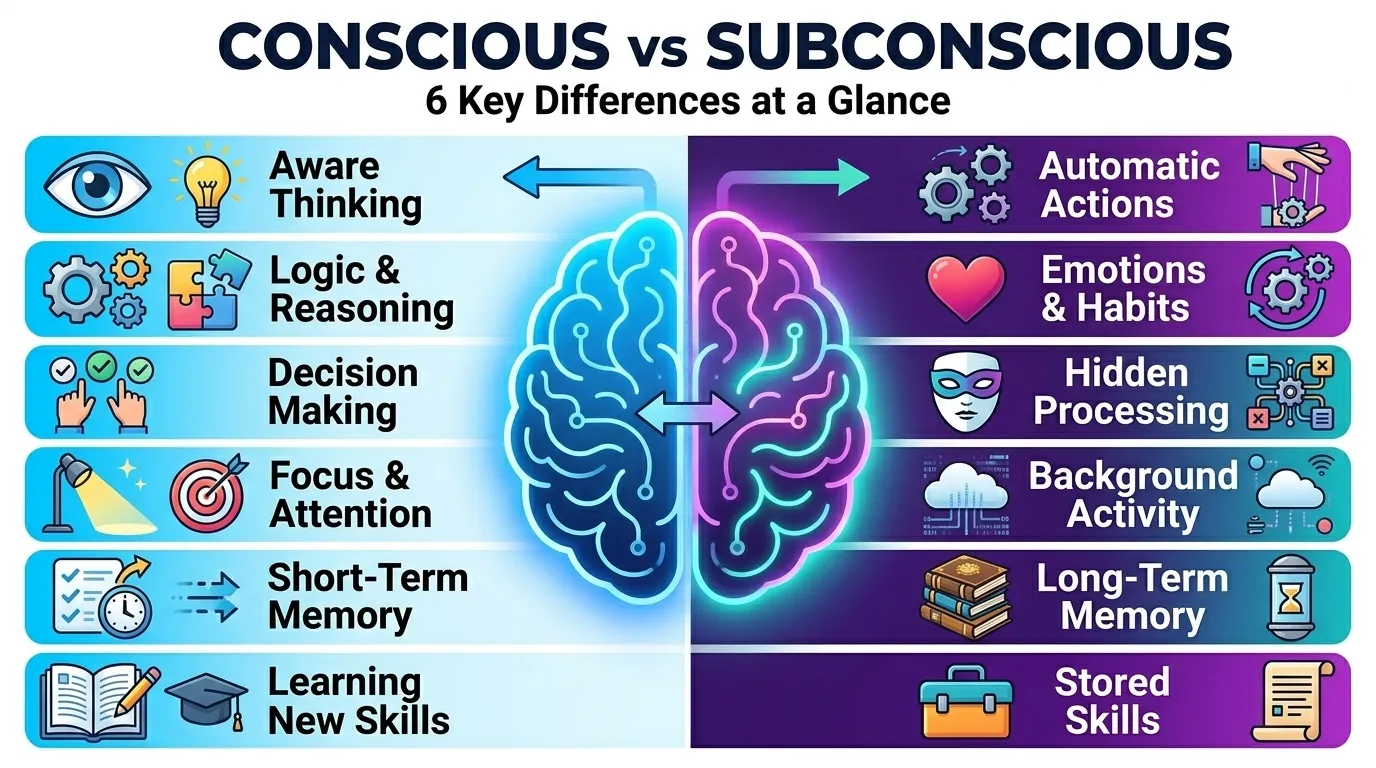
Conscious vs Subconscious Mind: Comparison Table
| Feature | Conscious Mind | Subconscious Mind |
| Awareness | Fully aware | Below awareness |
| Function | Thinking and reasoning | Automatic processing |
| Decision Making | Active decisions | Influences decisions indirectly |
| Speed | Slower and deliberate | Faster and automatic |
| Memory Access | Short-term focus | Long-term storage |
| Learning | Acquires new information | Stores learned patterns |
| Control | Voluntary actions | Involuntary behaviors |
| Attention | Limited capacity | Vast processing capacity |
| Logic | Uses reasoning | Uses associations and emotions |
| Example | Solving a math problem | Typing without looking at keys |
Key Differences Explained Between Conscious and Subconscious
1. Awareness Level
The conscious mind knows what is happening right now.
The subconscious mind works behind the scenes without your direct awareness.
Example: You consciously read this article, while your subconscious controls your breathing.
2. Decision-Making Ability
The conscious mind evaluates options logically.
The subconscious influences choices through habits, emotions, and past experiences.
Example: You consciously choose a healthy meal, but subconscious cravings may influence that choice.
3. Processing Speed
The subconscious processes information much faster than conscious thinking.
Many experts estimate that subconscious processing handles vastly more information than conscious awareness can manage.
4. Memory Storage
The conscious mind handles current information.
The subconscious stores memories, learned skills, and emotional experiences.
Example: Remembering your childhood home often comes from subconscious memory retrieval.
5. Habit Formation
Habits are primarily managed by the subconscious.
The conscious mind initiates new habits, but repetition transfers them into subconscious routines.
6. Emotional Influence
The subconscious is closely connected to emotional responses.
Many emotional reactions occur before conscious analysis begins.
7. Learning Process
The conscious mind learns new concepts.
The subconscious strengthens them through repetition and practice.
How Does the Conscious Mind Work?
The conscious mind functions like the captain of a ship.
It helps you:
- Analyze information
- Solve problems
- Make choices
- Focus attention
- Plan future actions
- Evaluate consequences
When using search engines like Google, consciously comparing products, or deciding what to eat, your conscious mind is actively engaged.
Key Characteristics of Conscious Thinking
- Logical
- Analytical
- Deliberate
- Goal-oriented
- Limited attention span
- Active awareness
How Does the Subconscious Mind Work?
The subconscious mind functions more like the ship’s engine room.
It continuously processes:
- Habits
- Emotions
- Memories
- Learned behaviors
- Automatic responses
- Pattern recognition
In practical use, the subconscious allows you to perform complex activities without actively thinking about every step.
Examples of Subconscious Processing
- Walking
- Driving familiar routes
- Typing on a keyboard
- Recognizing faces
- Understanding language patterns
- Emotional reactions
Why Does the Difference Between Conscious and Subconscious Matter?
Understanding this distinction helps improve:
Learning
New skills start consciously and become automatic through repetition.
Productivity
Many successful routines become subconscious habits over time.
Decision Making
Recognizing subconscious influences can help reduce bias.
Personal Development
Many behavioral changes involve reprogramming subconscious patterns.
Mental Performance
Athletes, musicians, and professionals often train skills until they become subconscious.
Difference Between Conscious and Subconscious in Daily Life
Studying
Conscious: Reading and understanding material.
Subconscious: Retaining information and building long-term memory.
Driving
Conscious: Learning traffic rules.
Subconscious: Operating the vehicle automatically after experience.
Social Media Usage
Platforms such as Instagram,YouTube, and Meta often rely on repeated interactions that gradually create subconscious habits and behavioral patterns.
Sports
Professional athletes consciously learn techniques before subconscious muscle memory takes over.
What Happens When Conscious and Subconscious Work Together?
The most effective performance occurs when both systems cooperate.
Conscious Mind Provides
- Goals
- Intentions
- Direction
- Analysis
Subconscious Mind Provides
- Efficiency
- Automatic execution
- Pattern recognition
- Skill retention
Real-World Example
When learning public speaking, you consciously practice techniques. Eventually, many speaking behaviors become subconscious, allowing smoother delivery.
Difference and Similarity Between Conscious and Subconscious
| Feature | Conscious Mind | Subconscious Mind | Similarity |
| Meaning | Active awareness | Hidden mental processing | Both are parts of mental functioning |
| Attention | Focused on present tasks | Processes background information | Both influence behavior |
| Learning | Acquires new knowledge | Stores learned knowledge | Both contribute to learning |
| Memory | Uses working memory | Stores long-term memories | Both use memory systems |
| Decision Making | Makes deliberate choices | Influences preferences | Both affect decisions |
| Emotions | Interprets emotions | Generates emotional responses | Both interact with emotions |
| Behavior | Controls intentional actions | Controls automatic actions | Both shape behavior |
| Goals | Sets objectives | Supports execution | Both help achieve outcomes |
This table clearly shows the difference and similarity between conscious and subconscious for quick understanding.
Why Does the Subconscious Mind Exist?
Many users get confused about why humans even need a subconscious system.
The answer is efficiency.
Imagine consciously controlling every heartbeat, muscle movement, and memory retrieval. Mental overload would occur instantly.
The subconscious exists because it automates thousands of processes, freeing conscious attention for important decisions.
Can You Influence Your Subconscious Mind?
Yes.
Research in psychology suggests repetition plays a major role in shaping subconscious patterns.
Methods often include:
- Consistent practice
- Habit repetition
- Visualization
- Positive self-talk
- Goal setting
- Reflective journaling
In real scenarios, repeating a behavior frequently increases the likelihood of subconscious adoption.
Common Mistakes With Conscious and Subconscious
| Mistake | Correction |
| Thinking they are completely separate systems | They constantly interact |
| Assuming subconscious means unconscious | The terms are related but not identical |
| Believing subconscious controls everything | Conscious decisions still matter |
| Ignoring habit influence | Habits strongly affect behavior |
| Expecting instant mindset changes | Subconscious changes require repetition |
| Viewing subconscious as mystical | It is a recognized psychological concept |
Real-Life Examples With Conscious and Subconscious
Example 1: Learning a Language
Conscious: Memorizing vocabulary.
Subconscious: Automatically recalling words during conversation.
Example 2: Business Presentation
Conscious: Preparing slides.
Subconscious: Delivering practiced gestures naturally.
Example 3: Fitness Training
Conscious: Learning exercise form.
Subconscious: Developing muscle memory through repetition.
Example 4: Music Performance
Conscious: Learning notes.
Subconscious: Playing smoothly without thinking about every movement.
Example 5: Customer Service
Conscious: Following company procedures.
Subconscious: Using learned communication habits automatically.
When to Use Each
Rely More on Conscious Thinking When:
- Making major financial decisions
- Solving complex problems
- Learning new skills
- Evaluating risks
- Planning long-term goals
Rely More on Subconscious Processing When:
- Performing mastered skills
- Driving familiar routes
- Playing sports
- Typing
- Routine work activities
The best outcomes usually come from combining both systems.
Why People Get Confused About Conscious and Subconscious
Several factors create confusion:
Popular Media Simplification
Movies and self-help content often oversimplify mental processes.
Similar Terminology
The words sound alike and are frequently used together.
Hidden Nature of Subconscious Processing
People cannot directly observe subconscious operations.
Psychology Misconceptions
Many myths exaggerate subconscious capabilities beyond scientific evidence.
Expert Insight
From a psychological and behavioral perspective, one of the most important insights is that conscious goals alone rarely create lasting change.
In practical use, long-term improvement occurs when conscious decisions are repeated often enough to become subconscious habits.
Most beginners focus only on motivation. Professionals focus on systems and repetition because they understand how the subconscious gradually automates behavior.
Whether learning a language, improving fitness, building a business, or mastering a skill, success usually comes from aligning conscious intention with subconscious habit formation.
Frequently Asked Questions (FAQs)
What is the main difference between conscious and subconscious?
The conscious mind handles awareness and active thinking, while the subconscious manages habits, memories, emotions, and automatic behaviors.
Is the subconscious mind more powerful than the conscious mind?
The subconscious processes far more information, but both systems are essential and work together.
Can the subconscious affect decision-making?
Yes. Past experiences, habits, and emotions often influence decisions before conscious analysis occurs.
How can I train my subconscious mind?
Consistent repetition, practice, habit formation, visualization, and goal-focused behavior can influence subconscious patterns.
Does the subconscious store memories?
Yes. Long-term memories and learned skills are largely associated with subconscious processing.
Is muscle memory subconscious?
In most cases, yes. Repeated practice allows actions to become automatic through subconscious learning.
Can conscious thoughts change subconscious beliefs?
Yes, but usually through repetition and reinforcement over time.
Why is understanding the subconscious important?
It helps improve habits, learning, productivity, emotional awareness, and personal development.
Conclusion
Understanding the difference between conscious and subconscious is essential for anyone interested in learning, behavior, productivity, or personal growth. The conscious mind helps you think, analyze, and make deliberate choices, while the subconscious mind stores memories, manages habits, and automates countless mental processes.
In simple words, the conscious mind is the thinker, and the subconscious mind is the doer behind the scenes. Once you understand this relationship, it becomes easier to improve habits, learn faster, make better decisions, and gain greater control over everyday life. The true difference between conscious and subconscious lies not only in awareness but also in how each contributes to the way we think, feel, and act every day.

I am content creator and comparison blogger focused on analyzing key differences between terms, concepts, and ideas to deliver accurate, easy-to-understand information. So I decided to create a platform where these differences are explained in the simplest way possible.