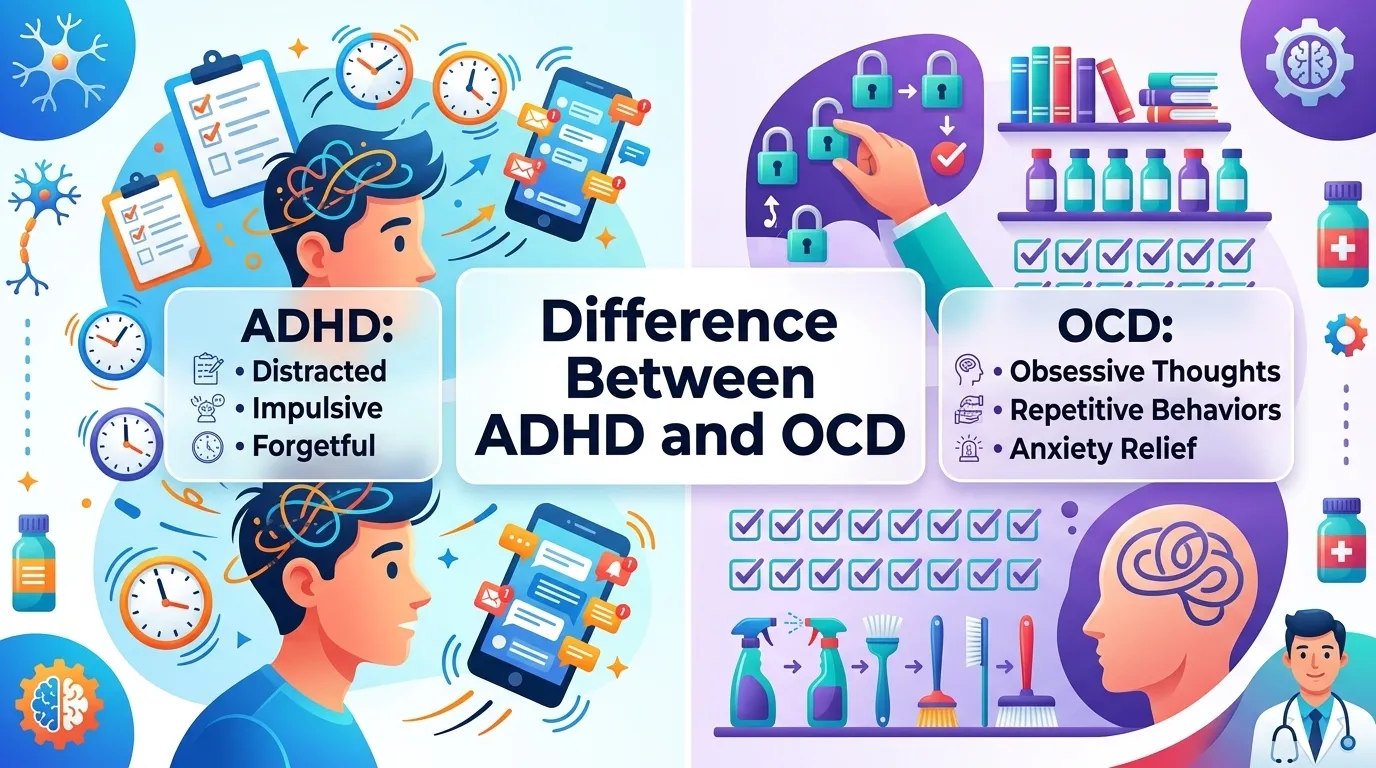
Many people get confused about the difference between ADHD and OCD because both conditions can affect focus, behavior, and daily life. Someone with ADHD may seem distracted and impulsive, while someone with OCD may appear highly focused on certain thoughts or routines. At first glance, they can look similar, but the reasons behind these behaviors are very different.
Understanding the difference between ADHD and OCD is important for parents, teachers, healthcare professionals, and individuals experiencing symptoms. Misunderstanding these conditions can lead to incorrect assumptions, delayed diagnosis, and ineffective treatment.
In this guide, you’ll learn the difference between ADHD and OCD, how each condition works, their symptoms, causes, similarities, treatment options, and practical examples. By the end, you’ll have a clear understanding of which traits belong to ADHD, which belong to OCD, and why the distinction matters.
Quick Answer: Difference Between ADHD and OCD
The main difference between ADHD and OCD is that ADHD causes difficulties with attention, impulse control, and organization, while OCD involves unwanted obsessive thoughts and repetitive compulsive behaviors aimed at reducing anxiety.
Example: A student with ADHD may forget homework because they become distracted. A student with OCD may repeatedly check their backpack because they fear forgetting something, even when they already know it’s there.
Definition of ADHD and OCD
- ADHD (Attention-Deficit/Hyperactivity Disorder): A neurodevelopmental condition that affects attention, self-control, organization, and activity levels.
- OCD (Obsessive-Compulsive Disorder): A mental health disorder characterized by intrusive thoughts (obsessions) and repetitive behaviors or mental rituals (compulsions).
Simple Example:
- ADHD: Frequently losing keys because attention shifts easily.
- OCD: Checking repeatedly whether the door is locked despite already knowing it is.
Pronunciation of Both Terms (US & UK)
ADHD
- US: /ˌeɪ.diː.eɪtʃˈdiː/
- UK: /ˌeɪ.diː.eɪtʃˈdiː/
OCD
- US: /ˌoʊ.siːˈdiː/
- UK: /ˌəʊ.siːˈdiː/
Now that we know what these conditions mean, let’s understand how they differ in everyday life and why so many people confuse them.
ADHD vs OCD: Comparison Table
| Comparison Point | ADHD | OCD |
| Core Issue | Difficulty regulating attention and impulses | Intrusive thoughts and compulsive behaviors |
| Thought Pattern | Mind frequently jumps between topics | Mind gets stuck on specific fears or worries |
| Focus | Easily distracted | Overfocused on obsessions |
| Behavior | Impulsive actions | Repetitive rituals |
| Motivation | Seeks stimulation and novelty | Seeks relief from anxiety |
| Time Management | Often struggles with planning | Often spends excessive time on rituals |
| Emotional Response | Frustration from disorganization | Anxiety from obsessive thoughts |
| Daily Challenges | Forgetfulness and impulsiveness | Repeated checking, cleaning, counting |
| Brain Function | Executive function difficulties | Anxiety-driven thought loops |
| Treatment Focus | Attention regulation and behavior management | Reducing obsessions and compulsions |
Key Differences Explained Between ADHD and OCD
1. Attention vs Obsession
ADHD affects the ability to maintain attention. OCD involves unwanted thoughts that demand attention.
Real-life example: Someone with ADHD may forget a task. Someone with OCD may think about the task repeatedly.
2. Impulsivity vs Compulsivity
People with ADHD often act before thinking. People with OCD perform actions because they feel compelled to reduce anxiety.
3. Forgetting vs Checking
ADHD often causes forgetting. OCD often causes repeated checking due to fear of forgetting.
4. Seeking Stimulation vs Seeking Relief
ADHD brains often seek excitement and novelty. OCD behaviors aim to relieve discomfort.
5. Disorganization vs Overcontrol
ADHD commonly leads to clutter and unfinished tasks. OCD may involve rigid routines and excessive order.
6. Flexible Thoughts vs Stuck Thoughts
ADHD thoughts change rapidly. OCD thoughts can become repetitive and difficult to dismiss.
7. Emotional Trigger Differences
ADHD challenges often stem from executive function issues. OCD symptoms are frequently driven by anxiety.
What Is ADHD and How Does It Affect Daily Life?
ADHD is a neurodevelopmental disorder affecting attention, impulse control, and executive functioning.
Common symptoms include:
- Difficulty focusing
- Frequent distraction
- Poor organization
- Impulsiveness
- Hyperactivity
- Time blindness
- Forgetfulness
In practical use, adults with ADHD may struggle with deadlines, while children may have difficulty staying seated during class.
Modern digital environments such as Google, YouTube, Instagram, and Meta platforms constantly compete for attention. For people with ADHD, these fast-moving information streams can make focus even more challenging.
What Is OCD and Why Does It Happen?
OCD occurs when intrusive thoughts trigger anxiety, leading to repetitive behaviors or mental rituals.
Common obsessions include:
- Fear of contamination
- Fear of harm
- Fear of making mistakes
- Need for certainty
Common compulsions include:
- Repeated checking
- Excessive cleaning
- Counting
- Repeating phrases mentally
The compulsive behavior temporarily reduces anxiety, which reinforces the cycle.
Can Someone Have ADHD and OCD at the Same Time?
Yes.
Research and clinical experience show that ADHD and OCD can occur together.
This creates unique challenges because:
- ADHD encourages impulsive behavior.
- OCD encourages repetitive controlled behavior.
In real scenarios, a person may struggle with organization due to ADHD while simultaneously performing repetitive checking rituals due to OCD.
Proper diagnosis is essential because treatment strategies may differ.
Why Do ADHD and OCD Look Similar?
Many users get confused because both conditions can affect:
- Concentration
- Productivity
- School performance
- Workplace performance
- Emotional regulation
For example, both conditions may cause someone to spend a long time completing a task.
However, the reason is different:
- ADHD → distraction.
- OCD → obsessive thoughts and compulsions.
Understanding the “why” behind the behavior is often the key to identifying the correct condition.
Difference Between ADHD and OCD Symptoms
ADHD Symptoms
- Daydreaming
- Restlessness
- Interrupting others
- Losing items
- Poor planning
- Difficulty completing tasks
OCD Symptoms
- Intrusive unwanted thoughts
- Repetitive checking
- Excessive cleaning
- Mental rituals
- Fear-driven behaviors
- Need for certainty
A symptom may appear similar on the surface but have completely different causes underneath.
What Causes ADHD and OCD?
Causes of ADHD
Factors may include:
- Genetics
- Brain development differences
- Neurotransmitter regulation
- Family history
Causes of OCD
Factors may include:
- Genetic influences
- Brain circuit differences
- Anxiety mechanisms
- Environmental stressors
Scientists continue studying how brain networks involved in attention, decision-making, and emotional processing contribute to both disorders.
Difference and Similarity Between ADHD and OCD
| Feature | ADHD | OCD | Similarity |
| Meaning | Attention regulation disorder | Obsession-compulsion disorder | Both affect daily functioning |
| Focus | Easily distracted | Excessively focused on fears | Focus difficulties can occur |
| Emotions | Frustration and impulsivity | Anxiety and distress | Emotional challenges exist |
| Daily Tasks | Often forgotten | Repeated excessively | Productivity may suffer |
| Brain Processes | Executive function issues | Anxiety-related loops | Both involve brain-based differences |
| Treatment | Behavioral strategies and medication | Therapy and medication | Professional treatment helps |
| Diagnosis | Neurodevelopmental | Mental health disorder | Requires clinical assessment |
| Life Impact | School, work, relationships | School, work, relationships | Both can affect quality of life |
This table clearly shows the difference and similarity between ADHD and OCD for quick understanding.
Common Mistakes With ADHD and OCD
Mistake 1: Assuming ADHD Means Laziness
Correction: ADHD affects executive functioning, not motivation alone.
Mistake 2: Thinking OCD Is Just Being Organized
Correction: OCD involves distressing obsessions and compulsions.
Mistake 3: Confusing Repetitive Behavior With OCD
Correction: Repetition alone does not equal OCD.
Mistake 4: Believing ADHD and OCD Cannot Coexist
Correction: Many individuals experience both conditions.
Mistake 5: Self-Diagnosing Based on Social Media Content
Correction: Professional evaluation remains important.
Real Life Examples With ADHD and OCD
Example 1: Student Scenario
ADHD: Forgets assignments due to distraction.
OCD: Checks assignment repeatedly because of fear of mistakes.
Example 2: Workplace Scenario
ADHD: Misses deadlines because of poor organization.
OCD: Spends excessive time reviewing work repeatedly.
Example 3: Personal Life
ADHD: Misplaces house keys frequently.
OCD: Checks multiple times whether the keys are present.
Example 4: Business Environment
ADHD: Difficulty prioritizing projects.
OCD: Overanalyzing details before making decisions.
Example 5: Healthcare Setting
Clinicians must identify whether behavior is caused by inattention or anxiety-driven compulsions before recommending treatment.
When to Use Each Understanding in Real Situations
You should think about ADHD when:
- Attention is inconsistent.
- Impulsivity is common.
- Organization is difficult.
You should think about OCD when:
- Anxiety drives behavior.
- Thoughts feel intrusive.
- Repetitive rituals are present.
This distinction helps individuals seek appropriate support and treatment.
Why People Get Confused in ADHD and OCD
Several factors contribute to confusion:
- Overlapping symptoms
- Social media simplifications
- Misleading stereotypes
- Popular culture portrayals
- Online self-assessment trends
Platforms such as Google, YouTube, Instagram, and Meta frequently expose users to short-form mental health content. While awareness is helpful, simplified explanations can blur the important distinctions between ADHD and OCD.
Expert Insight
From a professional perspective, the most important distinction is understanding the purpose behind a behavior.
A person with ADHD may avoid completing a task because attention drifts elsewhere. A person with OCD may spend hours on the same task because anxiety demands repeated checking.
In real-world assessments, clinicians focus less on the visible behavior and more on the mental process driving it. This deeper evaluation often reveals whether symptoms stem from executive function challenges, obsessive fears, or a combination of both.
That distinction guides treatment decisions and leads to better outcomes.
Frequently Asked Questions (FAQ)
Is ADHD the same as OCD?
No. ADHD affects attention and impulse control, while OCD involves obsessions and compulsions.
Which is more common, ADHD or OCD?
ADHD is generally more common than OCD.
Can ADHD cause obsessive thoughts?
Some people with ADHD experience intense interests, but these are different from OCD obsessions.
Can OCD cause concentration problems?
Yes. Intrusive thoughts can make concentration difficult.
Can children have both ADHD and OCD?
Yes. Both conditions can occur together.
Is ADHD an anxiety disorder?
No. ADHD is a neurodevelopmental disorder.
Does OCD always involve cleaning?
No. OCD can involve checking, counting, repeating, and many other compulsions.
How is ADHD diagnosed?
Healthcare professionals use clinical evaluations, symptom history, and behavioral assessments.
How is OCD treated?
Common treatments include cognitive behavioral therapy (CBT), exposure and response prevention (ERP), and medication when appropriate.
Can adults develop OCD?
Yes. OCD can begin in childhood, adolescence, or adulthood.
Conclusion
Understanding the difference between ADHD and OCD is essential because these conditions may appear similar while functioning very differently beneath the surface. ADHD primarily affects attention, organization, and impulse control. OCD revolves around intrusive thoughts and compulsive behaviors designed to reduce anxiety.
The key distinction is the reason behind the behavior. Someone with ADHD may struggle because their attention shifts constantly, while someone with OCD may struggle because their mind becomes trapped in repetitive fears and rituals.
Although both conditions can affect school, work, relationships, and daily responsibilities, accurate identification leads to more effective support and treatment. In some cases, both disorders may exist together, making professional assessment even more valuable.

I am content creator and comparison blogger focused on analyzing key differences between terms, concepts, and ideas to deliver accurate, easy-to-understand information. So I decided to create a platform where these differences are explained in the simplest way possible.