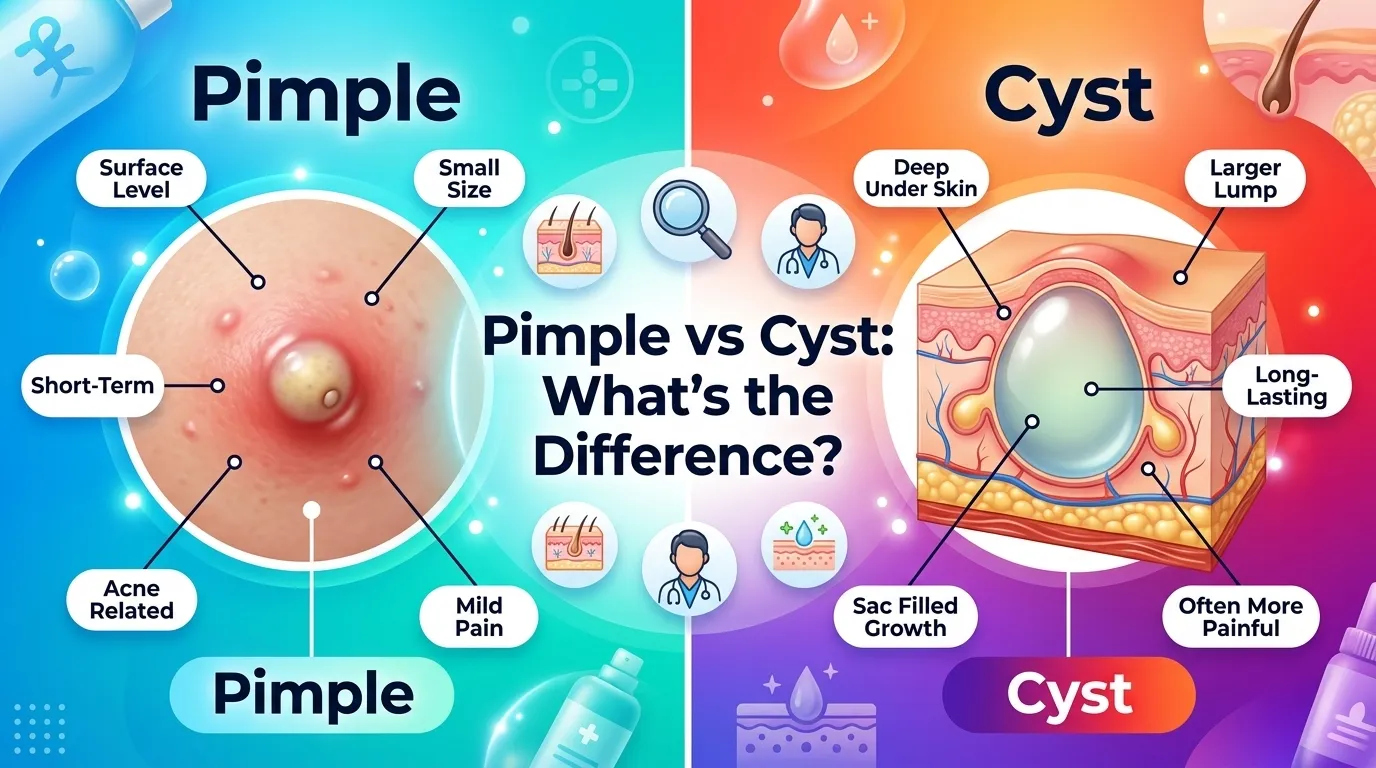
Many people notice a painful bump on their skin and immediately wonder whether it is a pimple or a cyst. The difference between pimple and cyst can be confusing because both appear as raised skin lumps and may look similar at first glance.
Understanding the difference between pimple and cyst is important because they develop for different reasons and often require different treatments. While a pimple is usually a common form of acne that affects the surface of the skin, a cyst tends to form deeper beneath the skin and may last much longer.
If you have ever searched for questions like “What is the difference between a cyst and a pimple?” or “How do I know if I have a cyst or a pimple?” this guide will give you clear answers. You’ll learn the causes, symptoms, treatment options, similarities, and key warning signs that help identify each condition.
Quick Answer: Difference Between Pimple and Cyst
A pimple is a small acne lesion caused by clogged pores, excess oil, bacteria, and inflammation.
A cyst is a deeper sac-like lump beneath the skin that may contain fluid, pus, keratin, or other material.
Example: A whitehead on your forehead is usually a pimple, while a large painful lump under the skin that remains for weeks may be a cyst.
Definition of Pimple and Cyst
- Pimple: A small inflamed bump that develops when a hair follicle or pore becomes blocked with oil, dead skin cells, and bacteria.
- Cyst: A closed sac beneath the skin filled with fluid, pus, or other substances that forms due to blockage, infection, or tissue abnormalities.
Example: A red acne bump on the nose is generally a pimple, while a slow-growing lump on the scalp may be a cyst.
Pronunciation of Both Terms
Pimple
US Pronunciation: /ˈpɪm.pəl/
UK Pronunciation: /ˈpɪm.pəl/
Cyst
US Pronunciation: /sɪst/
UK Pronunciation: /sɪst/
Now that you know what each term means, let’s explore the major differences between pimples and cysts in a way that’s easy to understand and apply in real life.
Pimple vs Cyst: Comparison Table
| Feature | Pimple | Cyst | Similarity |
| Definition | Acne-related skin bump | Sac-like growth under skin | Both appear as skin lumps |
| Cause | Clogged pores and acne bacteria | Blocked glands, infection, or tissue growth | Both may involve inflammation |
| Depth | Near skin surface | Deep beneath skin | Both affect skin tissue |
| Pain Level | Mild to moderate | Often moderate to severe | Both can become painful |
| Size | Usually small | Often larger | Both vary in size |
| Duration | Days to weeks | Weeks, months, or years | Both may persist if untreated |
| Treatment | Acne medications | Drainage or surgical removal sometimes needed | Medical care may help both |
| Recurrence | Common in acne-prone skin | Can return if not fully removed | Both can recur |
This table clearly shows the difference and similarity between difference between pimple and cyst for quick understanding.
Key Differences Explained Between Pimple and Cyst
1. Location Within the Skin
A pimple develops close to the skin’s surface.
A cyst forms deeper under the skin layers.
Real-life example: If you can see a visible white center, it is more likely a pimple than a cyst.
2. Cause of Formation
Pimples usually result from acne, clogged pores, and excess oil production.
Cysts often develop from blocked glands, trapped skin cells, infections, or tissue damage.
3. Pain and Pressure
Most pimples cause mild discomfort.
Cysts often create pressure and tenderness because they grow deeper.
4. Growth Speed
Pimples may appear overnight.
Cysts often grow slowly over days, weeks, or months.
5. Texture
Pimples feel superficial and raised.
Cysts typically feel round, smooth, and movable under the skin.
6. Treatment Requirements
Many pimples respond to over-the-counter acne treatments.
Cysts may require professional evaluation from a dermatologist.
7. Risk of Scarring
Deep cysts generally carry a higher risk of permanent scarring than ordinary pimples.
8. Duration
Most pimples disappear relatively quickly.
Cysts often remain much longer and may not resolve without treatment.
What Is a Pimple and Why Does It Form?
A pimple is one of the most common skin conditions worldwide. It occurs when a pore becomes blocked by:
- Excess sebum (skin oil)
- Dead skin cells
- Acne-causing bacteria
- Inflammation
Teenagers commonly experience pimples because hormonal changes increase oil production. However, adults can develop acne as well.
Common types include:
- Whiteheads
- Blackheads
- Papules
- Pustules
- Nodules
In practical use, most people casually call all acne bumps “pimples,” even though dermatologists classify them into different categories.
What Is a Cyst and Why Does It Develop?
A cyst is a closed sac that forms beneath the skin. Unlike pimples, cysts are not always related to acne.
A cyst may contain:
- Fluid
- Pus
- Keratin
- Dead cells
- Other tissue material
Common causes include:
- Blocked sebaceous glands
- Infections
- Injuries
- Genetic conditions
- Chronic inflammation
Many cysts are harmless, but some require medical attention if they become painful, infected, or continue growing.
How Does a Cyst Feel Different From a Pimple?
One of the easiest ways to recognize the difference between pimple and cyst is by touch.
Typical Pimple Feel
- Small
- Firm
- Close to skin surface
- Sometimes has a visible head
Typical Cyst Feel
- Deeper under skin
- Round and smooth
- Soft or rubbery
- Often movable when touched
Many users get confused because cystic acne exists. Cystic acne combines features of both acne and cyst-like inflammation, creating deep painful lesions beneath the skin.
Why Is a Cyst Usually More Painful Than a Pimple?
The deeper location of a cyst often causes greater pressure on surrounding tissue.
As the cyst grows, it may:
- Stretch nearby skin
- Compress nerves
- Trigger inflammation
This explains why cysts often feel sore even without visible redness.
By contrast, most pimples affect only the upper layers of the skin, limiting discomfort.
Can a Pimple Turn Into a Cyst?
Sometimes severe acne can progress into cystic acne, which creates large, deep, inflamed lesions.
However, a standard pimple does not usually transform into a traditional epidermoid or sebaceous cyst.
This distinction matters because treatment approaches differ significantly.
Difference Between Pimple and Cyst in Acne-Prone Skin
People with acne-prone skin often experience both conditions at different times.
Warning signs suggesting a cyst rather than a pimple include:
- Growth lasting several weeks
- Deep lump beneath skin
- Significant tenderness
- Frequent recurrence in the same location
- No visible whitehead or blackhead
When these signs appear, professional evaluation is often the safest approach.
Difference Between Pimple and Cyst: Similarities and Differences Table
| Feature | Pimple | Cyst | Similarity |
| Appearance | Red, white, or inflamed bump | Larger lump beneath skin | Both appear as raised bumps |
| Cause | Acne and clogged pores | Blocked glands, infection, or tissue buildup | Both may involve blockage |
| Infection Risk | Possible | Possible | Both can become infected |
| Inflammation | Usually present | Often present | Both may become swollen |
| Size | Small to medium | Medium to large | Both vary in size |
| Treatment | Acne products often help | Medical treatment may be needed | Both benefit from proper diagnosis |
| Scarring Potential | Moderate | Higher | Both can leave scars if picked |
| Skin Location | Surface layer | Deep skin layer | Both affect skin health |
This table clearly shows the difference and similarity between difference between pimple and cyst for quick understanding.
How Can You Tell if a Bump Is a Pimple or a Cyst?
A simple way to identify the difference between pimple and cyst is to look at three factors:
Size
Pimples are usually smaller.
Cysts tend to be larger and more noticeable.
Depth
Pimples sit near the skin’s surface.
Cysts develop deeper beneath the skin.
Duration
A pimple may disappear within days.
A cyst can remain for months if left untreated.
Quick Self-Check
You may be dealing with a cyst if:
- The lump feels deep under the skin.
- It has no visible white center.
- It keeps growing.
- It remains for several weeks.
- It feels movable under the skin.
What Causes Pimples and Cysts?
Although both affect the skin, their causes are often different.
Common Causes of Pimples
- Hormonal changes
- Excess oil production
- Acne bacteria
- Poor skincare habits
- Stress
- Certain cosmetics
Common Causes of Cysts
- Blocked sebaceous glands
- Skin injuries
- Chronic inflammation
- Genetic factors
- Infections
- Tissue abnormalities
Understanding the cause helps determine the most effective treatment approach.
Can You Pop a Pimple or a Cyst?
Many people ask this question after seeing a painful bump.
Pimple
Although not recommended, some pimples may drain naturally.
However, squeezing can:
- Increase inflammation
- Spread bacteria
- Cause scarring
Cyst
A cyst should generally never be popped at home.
The material inside a cyst often sits deep beneath the skin. Pressing it may:
- Cause infection
- Increase swelling
- Lead to permanent scarring
- Push contents deeper into tissue
In real scenarios, dermatologists often see complications caused by attempting to pop cysts at home.
What Treatments Work Best for Pimples?
Treatment depends on severity.
Mild Pimples
- Salicylic acid
- Benzoyl peroxide
- Gentle cleansers
- Non-comedogenic moisturizers
Moderate Acne
- Prescription retinoids
- Antibiotics
- Hormonal treatments
Severe Acne
- Oral medications prescribed by dermatologists
- Advanced acne therapies
Most beginners see improvement when they stop over-washing and follow a consistent skincare routine.
What Treatments Work Best for Cysts?
Cyst treatment varies based on type and size.
Options may include:
Observation
Some harmless cysts require no treatment.
Drainage
Doctors may drain infected or painful cysts.
Steroid Injections
Can reduce inflammation and swelling.
Surgical Removal
Often the most effective option for preventing recurrence.
Unlike pimples, many cysts cannot be fully removed with topical creams alone.
Common Mistakes With Difference Between Pimple and Cyst
Mistake 1: Assuming Every Lump Is Acne
Many people automatically assume every bump is a pimple.
Fix: Check for depth, duration, and size.
Mistake 2: Trying to Pop a Cyst
This is one of the most common mistakes.
Fix: Seek professional evaluation for persistent lumps.
Mistake 3: Using Harsh Acne Products on Cysts
Acne treatments often do little for many cyst types.
Fix: Get an accurate diagnosis first.
Mistake 4: Ignoring Long-Lasting Bumps
A lump that remains for months should not be ignored.
Fix: Consult a healthcare professional.
Mistake 5: Picking at Skin Repeatedly
Picking increases the risk of infection and scars.
Fix: Keep hands away from affected areas.
Mistake 6: Believing Pain Always Means Acne
Painful lumps can be cysts, abscesses, or other skin conditions.
Fix: Consider professional assessment if symptoms worsen.
Real-Life Examples With Difference Between Pimple and Cyst
Example 1: Teenager With Forehead Acne
A 16-year-old develops several red bumps across the forehead.
These are most likely pimples caused by acne.
Example 2: Adult With a Scalp Lump
A 35-year-old notices a round lump beneath the scalp that slowly grows over six months.
This is more consistent with a cyst.
Example 3: Deep Painful Jawline Bump
A person develops a painful lump under the jawline that lasts several weeks.
This may represent cystic acne or a cyst requiring medical evaluation.
Example 4: Workplace Professional
An office worker notices a small whitehead before an important meeting.
This is typically a pimple and often resolves quickly.
Example 5: Healthcare Scenario
A patient reports a recurring lump in the same location every few months.
Recurring growth often suggests a cyst rather than a simple pimple.
When to Use Each: Practical Identification Guide
More Likely a Pimple When:
- It appears suddenly.
- It has a visible head.
- You have acne-prone skin.
- It heals within days or weeks.
More Likely a Cyst When:
- It grows slowly.
- It feels deep beneath the skin.
- It persists for months.
- It repeatedly returns.
- It becomes increasingly painful.
This practical approach helps users make better decisions about seeking treatment.
Why People Get Confused About the Difference Between Pimple and Cyst
Several factors create confusion.
Similar Appearance
Both conditions appear as bumps on the skin.
Social Media Misinformation
Platforms such as Instagram, YouTube, and Meta contain countless skincare videos, but not all advice is medically accurate.
Cystic Acne Confusion
Cystic acne combines acne and deep inflammation, making identification more difficult.
Self-Diagnosis
People often rely on internet photos rather than professional evaluation.
Expert Insight
From a dermatology perspective, one of the most important distinctions is persistence.
In practical use, a typical pimple follows a predictable cycle. It appears, becomes inflamed, and gradually heals.
A cyst behaves differently. It often remains beneath the skin for extended periods and may recur even after temporary improvement.
Most beginners focus only on appearance. Professionals focus on:
- Depth
- Duration
- Recurrence
- Pain level
- Underlying cause
This approach leads to more accurate identification and better treatment outcomes.
Frequently Asked Questions (FAQ)
What is the main difference between a pimple and a cyst?
A pimple is a surface-level acne lesion, while a cyst is a deeper sac-like lump beneath the skin.
Is a cyst more serious than a pimple?
Not always, but cysts are generally larger, deeper, and more likely to require medical treatment.
Can a cyst go away on its own?
Some cysts may shrink naturally, but many persist for months or years.
Are cysts caused by acne?
Some are related to acne, but many develop from blocked glands, injuries, or other causes.
How long does a pimple last?
Most pimples improve within several days to a few weeks.
Why does my cyst keep coming back?
Recurrence often occurs when the cyst wall remains beneath the skin after drainage.
Can stress cause pimples?
Stress can contribute to hormonal changes that may worsen acne.
Do cysts hurt more than pimples?
In many cases, yes. Their deeper location often creates more pressure and discomfort.
Should I see a doctor for a cyst?
If a cyst grows, becomes painful, infected, or persists, medical evaluation is recommended.
Can a pimple leave a scar?
Yes. Picking, squeezing, and severe inflammation increase scarring risk.
Conclusion
Understanding the difference between pimple and cyst is essential for proper skin care and treatment decisions. Although both appear as bumps on the skin, they are not the same condition.
A pimple is typically a form of acne caused by clogged pores, excess oil, bacteria, and inflammation near the skin’s surface. A cyst, on the other hand, develops deeper beneath the skin and may contain fluid, pus, keratin, or other material.
The easiest way to identify the difference between pimple and cyst is by considering size, depth, pain level, and duration. Pimples usually appear quickly and heal relatively fast, while cysts tend to grow slowly and remain longer. Many users become confused because cystic acne shares characteristics of both conditions.

I am content creator and comparison blogger focused on analyzing key differences between terms, concepts, and ideas to deliver accurate, easy-to-understand information. So I decided to create a platform where these differences are explained in the simplest way possible.