Many users get confused when comparing the difference between finance and economics because both fields deal with money, markets, and decision-making. At first glance, they seem almost identical. However, the difference between finance and economics becomes clear when you understand their goals, methods, and real-world applications.
In simple words, economics studies how resources are produced, distributed, and consumed across society, while finance focuses on managing money, investments, assets, and financial risks. Understanding the difference between finance and economics helps students choose the right career path, businesses make better decisions, and investors understand market behavior.
In this guide, you’ll learn what finance and economics mean, how they work, their similarities, major differences, career opportunities, and which field may be right for you.
Quick Answer: Difference Between Finance and Economics
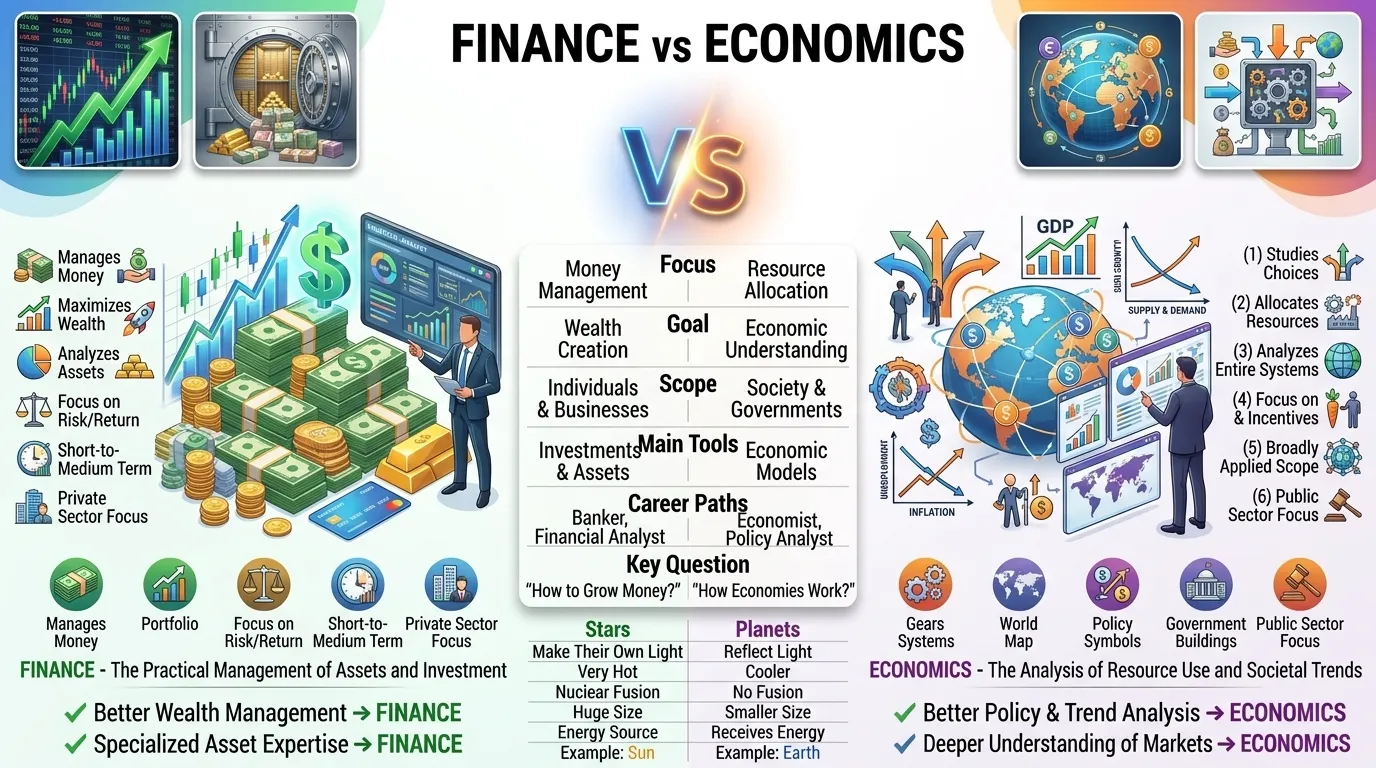
The main difference between finance and economics is that economics studies how individuals, businesses, and governments allocate scarce resources, while finance focuses on managing money, investments, and financial assets to maximize returns and minimize risks.
Example:
An economist may study why inflation rises in a country, while a finance professional may decide how investors should adjust their portfolios during inflation.
Definition of Finance and Economics
- Finance: The study and management of money, investments, assets, liabilities, budgeting, and financial planning.
- Economics: The study of how people, businesses, and governments use limited resources to satisfy unlimited wants and needs.
Simple Example:
Economics explains why housing prices increase, while finance helps determine whether buying a house is a good investment.
Pronunciation of Both Terms
| Term | US Pronunciation | UK Pronunciation |
|---|---|---|
| Finance | fih-NANS / FYE-nance | fih-NAHNS |
| Economics | ee-kuh-NOM-iks | ee-kuh-NOM-iks |
Now that the definitions are clear, let’s understand the difference between finance and economics in greater detail.
Finance vs Economics Comparison Table
| Comparison Point | Finance | Economics |
|---|---|---|
| Primary Focus | Managing money and investments | Studying resource allocation |
| Main Goal | Wealth creation and financial growth | Understanding economic behavior |
| Scope | Individuals, companies, investors | Society, markets, governments |
| Decision Level | Mostly micro-level financial decisions | Micro and macro-level decisions |
| Key Questions | How should money be invested? | Why do markets behave this way? |
| Main Tools | Financial models, valuation, risk analysis | Economic theories, data analysis |
| Career Paths | Financial analyst, banker, investment manager | Economist, policy analyst, researcher |
| Risk Analysis | Financial risk and return | Economic uncertainty and market trends |
| Time Horizon | Often short to medium term | Often long-term economic impact |
| Real Example | Managing a stock portfolio | Studying unemployment trends |
Key Differences Explained Between Finance and Economics
1. Purpose
Finance aims to maximize wealth and manage financial resources effectively.
Economics aims to understand how scarce resources are allocated within society.
Example: A financial advisor helps clients grow savings, while an economist studies national spending patterns.
2. Scope of Study
Finance mainly focuses on investments, capital markets, and financial management.
Economics covers production, consumption, trade, employment, inflation, and public policy.
3. Decision-Making Level
Finance often deals with individual investors and companies.
Economics evaluates decisions affecting entire industries, countries, and global markets.
4. Use of Data
Finance uses financial statements, stock prices, and investment performance metrics.
Economics uses economic indicators such as GDP, inflation, unemployment, and productivity.
5. Career Orientation
Finance careers tend to be business-focused.
Economics careers often involve research, policy, consulting, and academia.
6. Time Perspective
Finance frequently focuses on current and future returns.
Economics often examines long-term economic trends and cycles.
7. Core Questions
Finance asks:
- Which stock should I buy?
- How can a company raise capital?
Economics asks:
- Why is inflation rising?
- What causes unemployment?
8. Risk Perspective
Finance measures investment risk and return.
Economics studies broader economic uncertainty affecting entire populations.
Why Does Economics Exist?
Economics exists because resources are limited while human wants are unlimited.
Every country faces questions such as:
- What should be produced?
- How much should be produced?
- Who should receive these goods and services?
Economics provides frameworks to answer these questions efficiently.
Real-World Example
When governments decide healthcare spending or taxation policies, they rely heavily on economic principles.
Why Does Finance Exist?
Finance exists because individuals and organizations need to manage money effectively.
Without finance, businesses would struggle to raise capital, investors would lack investment strategies, and households would find it difficult to plan for future expenses.
Real-World Example
When a company issues shares or bonds to raise funds, financial principles guide the process.
How Finance and Economics Work Together
Although different, finance and economics are closely connected.
Economics often creates the broader environment in which financial decisions occur.
For example:
- Inflation affects investment returns.
- Interest rates influence borrowing costs.
- Economic growth impacts stock market performance.
In practical scenarios, finance professionals constantly monitor economic indicators before making investment decisions.
Difference Between Finance and Economics in Education
Students often wonder which degree is better.
Finance Degree Focus
Subjects commonly include:
- Investment Analysis
- Corporate Finance
- Financial Markets
- Risk Management
- Portfolio Management
Economics Degree Focus
Subjects commonly include:
- Microeconomics
- Macroeconomics
- International Trade
- Economic Policy
- Econometrics
Which Is More Mathematical?
Both require mathematics.
However:
- Finance often emphasizes financial calculations and valuation models.
- Economics may involve advanced statistics, modeling, and econometric analysis.
Difference Between Finance and Economics Careers
| Finance Careers | Economics Careers |
|---|---|
| Financial Analyst | Economist |
| Investment Banker | Policy Analyst |
| Portfolio Manager | Economic Researcher |
| Wealth Manager | Government Advisor |
| Risk Analyst | International Development Specialist |
| Corporate Finance Manager | Academic Researcher |
Salary Perspective
In many markets, finance careers can offer higher earning potential due to performance-based compensation. Economics careers may provide stronger opportunities in research, government, and policy development.
Difference Between Finance and Economics in Business Decisions
Businesses use both disciplines daily.
Finance Helps Answer
- Should we invest in a new project?
- How should we finance expansion?
- What is our expected return?
Economics Helps Answer
- Will consumer demand increase?
- How will inflation affect pricing?
- What market conditions should we expect?
Successful organizations combine both perspectives before making strategic decisions.
Difference Between Finance and Economics in Modern Technology
Technology companies rely heavily on both disciplines.
For example, companies such as Google, Meta, and YouTube use economic analysis to understand consumer behavior and market trends.
At the same time, they use finance to:
- Allocate budgets
- Manage investments
- Evaluate acquisitions
- Forecast revenue growth
This shows why finance and economics frequently overlap in modern business environments.
Difference and Similarity Between Finance and Economics
| Feature | Finance | Economics | Similarity |
|---|---|---|---|
| Meaning | Managing money and investments | Studying resource allocation | Both involve decision-making |
| Main Objective | Wealth maximization | Efficient resource use | Both seek optimal outcomes |
| Focus Area | Financial assets | Economic systems | Both analyze markets |
| Users | Investors and businesses | Governments and researchers | Both support business decisions |
| Data Used | Financial metrics | Economic indicators | Both rely on quantitative analysis |
| Risk Evaluation | Investment risk | Economic uncertainty | Both assess future outcomes |
| Application | Corporate and personal finance | Public and private sectors | Both influence policy and strategy |
| Decision Support | Investment decisions | Economic decisions | Both guide planning |
This table clearly shows the difference and similarity between finance and economics for quick understanding.
Common Mistakes With Difference Between Finance and Economics
Mistake 1: Thinking They Are the Same Subject
Correction: Economics studies systems; finance manages money within those systems.
Mistake 2: Assuming Finance Is Only About Stocks
Correction: Finance includes budgeting, banking, insurance, corporate finance, and risk management.
Mistake 3: Believing Economics Is Only About Government
Correction: Economics applies to businesses, consumers, industries, and international markets.
Mistake 4: Ignoring Their Relationship
Correction: Economic conditions heavily influence financial outcomes.
Mistake 5: Choosing a Degree Without Understanding Career Goals
Correction: Match your education to your interests and professional objectives.
Real-Life Examples With Difference Between Finance and Economics
Scenario 1: Personal Investment
A person deciding where to invest savings uses finance principles.
Scenario 2: National Inflation
A government studying rising prices uses economics principles.
Scenario 3: Business Expansion
A company evaluating project profitability uses finance while also considering economic demand forecasts.
Scenario 4: Central Bank Decisions
Interest rate policies rely heavily on economic analysis.
Scenario 5: Stock Market Investing
Investors use finance techniques but monitor economic indicators before buying assets.
When to Use Each
Choose Finance When:
- You enjoy investing.
- You like business and money management.
- You want a career in banking or corporate finance.
- You enjoy analyzing company performance.
Choose Economics When:
- You enjoy understanding markets and society.
- You are interested in policy and research.
- You like analyzing large-scale trends.
- You want to influence public decision-making.
Why People Get Confused in Finance and Economics
Several reasons create confusion:
- Both involve money.
- Both analyze markets.
- Universities often place them in the same business schools.
- News media frequently use economic and financial terms interchangeably.
- Many careers require knowledge of both disciplines.
In simple words, economics explains the environment, while finance helps people operate within that environment.
Expert Insight
From an educational and career-planning perspective, most beginners focus too heavily on job titles instead of understanding the actual work involved.
In real scenarios, finance is generally more action-oriented because professionals make investment, budgeting, and capital allocation decisions. Economics is often more analytical and research-driven because it seeks to explain how markets and economies function.
The strongest professionals frequently combine both skill sets. Investment managers who understand economics often make better market predictions, while economists with financial knowledge can better evaluate business impacts of economic policies.
The future workplace increasingly rewards professionals who can bridge both disciplines rather than specialize in only one area.
Frequently Asked Questions
Is finance harder than economics?
Neither is universally harder. Finance focuses on financial analysis, while economics often requires deeper theoretical and statistical understanding.
Which pays more, finance or economics?
Finance careers often offer higher earning potential, especially in investment banking and asset management.
Can I study finance and economics together?
Yes. Many universities offer combined finance and economics programs.
Is economics useful for investing?
Absolutely. Economic indicators help investors understand market conditions and potential risks.
Does finance use economics?
Yes. Finance relies heavily on economic concepts such as inflation, interest rates, and economic growth.
Which degree is better for business?
Both are valuable. Finance may be more practical for business operations, while economics provides broader market understanding.
Is economics more theoretical than finance?
Generally yes. Economics often focuses on theories and models, whereas finance emphasizes application and decision-making.
Can economists work in finance?
Yes. Many economists work in investment firms, banks, and financial institutions.
Why are finance and economics connected?
Both study decisions involving resources, markets, and value creation.
Which field has more career options?
Both offer diverse opportunities, but finance generally provides a wider range of private-sector roles.
Conclusion
Understanding the difference between finance and economics is essential for students, investors, business owners, and professionals. While both disciplines deal with money and markets, their perspectives are very different. Economics focuses on how resources are allocated and how economies function, whereas finance concentrates on managing money, investments, assets, and financial risks.
The simplest way to remember the distinction is this: economics explains why markets behave the way they do, while finance focuses on what decisions should be made within those markets. Economics studies inflation, employment, economic growth, and policy effects. Finance studies investing, budgeting, capital management, and wealth creation.

I am content creator and comparison blogger focused on analyzing key differences between terms, concepts, and ideas to deliver accurate, easy-to-understand information. So I decided to create a platform where these differences are explained in the simplest way possible.