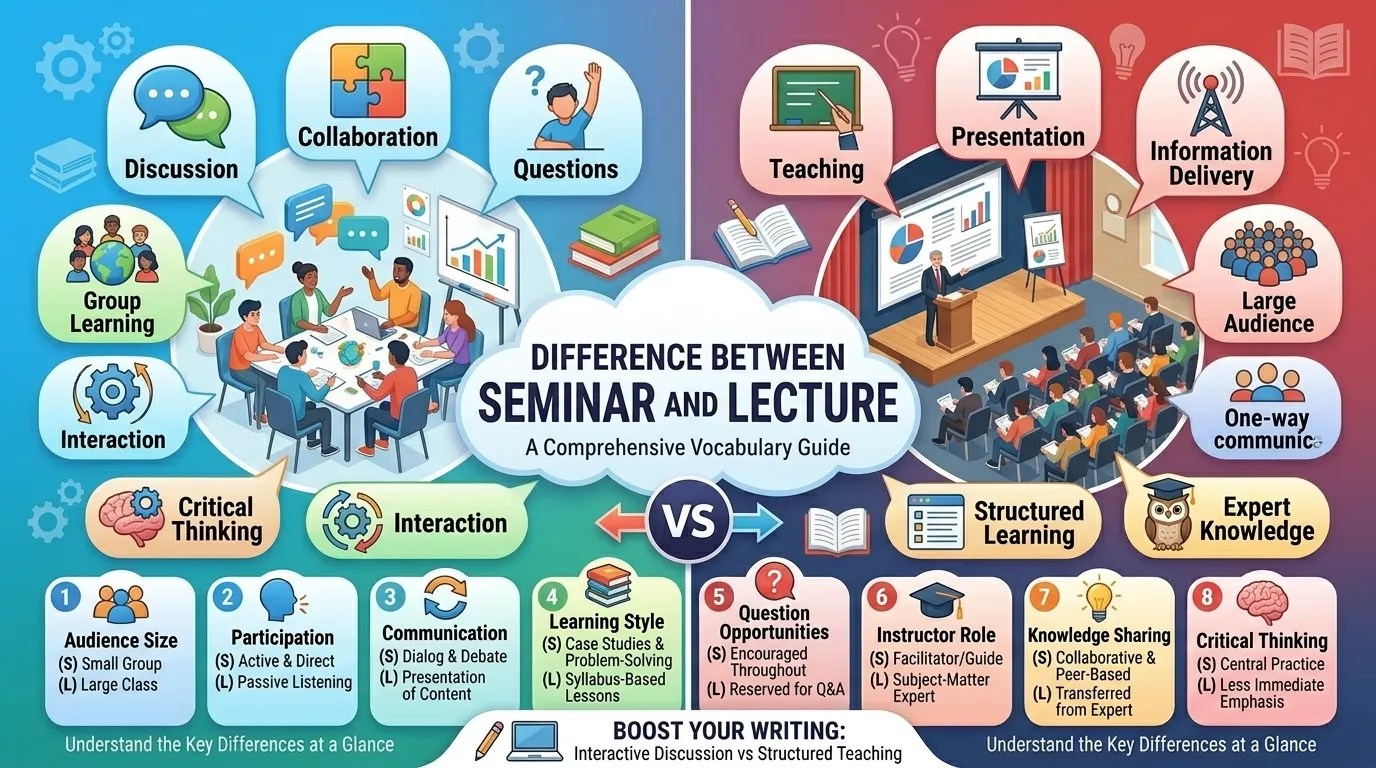
Many students, teachers, and professionals often get confused about the difference between seminar and lecture because both are educational methods used to share knowledge. However, a seminar and a lecture serve different purposes and create different learning experiences.
Understanding the difference between seminar and lecture helps learners choose the right learning environment and participate more effectively. While lectures focus on delivering information from an expert to an audience, seminars encourage discussion, interaction, and deeper exploration of a topic.
If you have ever wondered what is a seminar, what is a lecture, how they differ, and when each should be used, this complete guide will answer all your questions with practical examples, comparison tables, expert insights, and real-world applications.
Quick Answer: Difference Between Seminar and Lecture
The main difference between seminar and lecture is the level of interaction.
- A lecture is a structured presentation where an instructor or expert delivers information to an audience.
- A seminar is an interactive learning session where participants discuss, analyze, and exchange ideas about a specific topic.
Example
A university professor explaining economics to 200 students is conducting a lecture.
A small group of students discussing economic theories and presenting their viewpoints is participating in a seminar.
Definition of Seminar and Lecture
Seminar:
A seminar is an interactive educational session where participants actively discuss, analyze, and exchange ideas on a specific topic under the guidance of a facilitator.
Lecture:
A lecture is a formal teaching method where an instructor presents information, concepts, or knowledge to an audience with limited participant interaction.
Simple Example
- Seminar: Students discussing climate change solutions in groups.
- Lecture: A professor explaining climate change causes to an entire class.
Pronunciation of Both Terms (US & UK)
| Term | US Pronunciation | UK Pronunciation |
| Seminar | SEM-uh-nar | SEM-ih-nah |
| Lecture | LEK-cher | LEK-chuh |
Now that the basic definitions are clear, let’s explore the differences in greater detail.
Seminar vs Lecture: Comparison Table
| Feature | Seminar | Lecture |
| Learning Style | Interactive | Instructor-led |
| Participation | High | Low |
| Audience Size | Small to medium | Large |
| Communication | Two-way | One-way |
| Purpose | Discussion and analysis | Information delivery |
| Student Involvement | Active | Passive |
| Question Opportunities | Frequent | Limited |
| Presentation Style | Collaborative | Formal |
| Critical Thinking | Strongly encouraged | Less emphasized |
| Knowledge Sharing | Mutual | Instructor-focused |
Key Differences Explained Between Seminar and Lecture
1. Level of Participation
In a seminar, participants are expected to contribute ideas and engage in discussions.
In a lecture, learners mostly listen and take notes.
Real-world example: Graduate students often participate in seminars, while introductory university courses usually rely on lectures.
2. Learning Environment
Seminars create a collaborative environment.
Lectures create a structured teaching environment.
3. Communication Style
Seminars encourage two-way communication.
Lectures typically involve one-way communication from speaker to audience.
4. Group Size
Seminars work best with smaller groups.
Lectures can accommodate hundreds of participants.
5. Focus of Learning
Seminars focus on understanding and applying concepts.
Lectures focus on introducing and explaining concepts.
6. Role of the Instructor
In seminars, instructors act as facilitators.
In lectures, instructors act as primary knowledge providers.
7. Assessment Opportunities
Seminars often include presentations, discussions, and peer feedback.
Lectures usually involve quizzes, exams, or assignments after the session.
What Is the Purpose of a Seminar?
A seminar exists because learning becomes more effective when participants engage actively.
The primary goals include:
- Encouraging critical thinking
- Promoting discussion
- Developing communication skills
- Exploring complex topics deeply
- Building collaboration
In practical scenarios, business organizations use seminars to train employees and encourage problem-solving discussions.
What Is the Purpose of a Lecture?
Lectures exist because they allow experts to efficiently deliver information to large audiences.
Common objectives include:
- Teaching foundational knowledge
- Introducing new concepts
- Providing structured explanations
- Reaching many learners simultaneously
For example, universities use lectures to teach core subjects such as mathematics, psychology, history, and engineering.
Difference Between Seminar and Lecture in Education
Educational institutions frequently use both methods.
Seminar in Education
- Graduate-level learning
- Research discussions
- Case study analysis
- Student presentations
Lecture in Education
- Undergraduate courses
- Introduction to subjects
- Large classroom teaching
- Theory explanations
Most universities combine both approaches to improve learning outcomes.
How Does a Seminar Work?
A seminar usually follows these steps:
- Topic selection
- Participant preparation
- Presentation or discussion
- Question-and-answer session
- Collaborative conclusions
Participants are often expected to prepare beforehand.
Because of this preparation, seminars generate deeper discussions than lectures.
How Does a Lecture Work?
A lecture generally follows a structured format:
- Introduction of topic
- Explanation by instructor
- Visual aids or slides
- Examples and demonstrations
- Limited questions
Many modern lectures use digital tools such as presentations, videos, and interactive polling software.
Platforms like Google Classroom and video learning systems have made lectures more engaging than traditional formats.
Seminar vs Lecture in Corporate Training
The difference between seminar and lecture is also visible in workplace learning.
Corporate Seminars
Used for:
- Leadership development
- Team-building
- Problem-solving workshops
- Professional development
Corporate Lectures
Used for:
- Company announcements
- Policy training
- Compliance education
- Industry updates
Organizations often blend lectures and seminars to maximize employee learning.
Difference Between Seminar and Lecture in Online Learning
Modern digital education has transformed both formats.
Online Lectures
Platforms such as YouTube and Google Meet allow experts to deliver lectures globally.
Online Seminars
Virtual seminars often include:
- Live discussions
- Breakout rooms
- Participant presentations
- Interactive collaboration
This flexibility has increased the popularity of online seminars in higher education and professional development.
Benefits of Seminars
Stronger Engagement
Participants stay involved throughout the session.
Better Critical Thinking
Discussion encourages deeper analysis.
Improved Communication Skills
Participants practice speaking and presenting.
Enhanced Collaboration
Group interaction develops teamwork abilities.
Practical Learning
Real-world scenarios can be explored collectively.
Benefits of Lectures
Efficient Information Delivery
Large amounts of information can be shared quickly.
Suitable for Large Audiences
Hundreds of learners can attend simultaneously.
Structured Learning
Information follows a clear sequence.
Expert Knowledge Transfer
Learners gain direct access to subject matter expertise.
Cost-Effective Education
Institutions can educate many students at once.
Difference and Similarity Between Seminar and Lecture
| Feature | Seminar | Lecture | Similarity |
| Purpose | Discussion and exploration | Knowledge delivery | Both support learning |
| Instructor Role | Facilitator | Teacher or speaker | Both guide participants |
| Audience | Small groups | Large groups | Both involve learners |
| Communication | Two-way | One-way | Information exchange occurs |
| Learning Goal | Deep understanding | Concept introduction | Education remains central |
| Questions | Frequent | Limited | Clarification is possible |
| Preparation | Often required | Usually optional | Topic-focused learning |
| Setting | Interactive | Formal | Academic and professional use |
This table clearly shows the difference and similarity between seminar and lecture for quick understanding.
Common Mistakes with Seminar and Lecture
Mistake 1: Assuming They Are the Same
Many people use both terms interchangeably.
Correction: A seminar is interactive, while a lecture is primarily instructional.
Mistake 2: Expecting Discussion During Every Lecture
Not all lectures encourage active discussion.
Correction: Most lectures prioritize information delivery.
Mistake 3: Treating Seminars Like Presentations
Seminars involve participation from multiple attendees.
Correction: Encourage dialogue rather than one-sided speaking.
Mistake 4: Ignoring Preparation for Seminars
Participants often need prior reading or research.
Correction: Prepare before attending.
Mistake 5: Choosing the Wrong Format
Some topics require discussion rather than presentation.
Correction: Match the format to learning objectives.
Real-Life Examples with Seminar and Lecture
Personal Learning Example
A student watches a lecture about digital marketing and later joins a seminar discussing marketing strategies.
University Example
A professor teaches psychology through lectures, while advanced students attend seminars analyzing research papers.
Business Example
A company executive delivers a lecture on company goals followed by a seminar where teams discuss implementation plans.
Technology Industry Example
Tech firms often conduct seminars to explore innovations while using lectures to explain new policies.
Professional Development Example
Healthcare professionals attend lectures for updated medical guidelines and seminars for case discussions.
When to Use Each
Use a Seminar When:
- Discussion is important
- Critical thinking is needed
- Collaboration is desired
- Participants have prior knowledge
- Problem-solving is the goal
Use a Lecture When:
- Teaching large groups
- Introducing new concepts
- Sharing information quickly
- Standardized training is required
- Expert knowledge must be delivered efficiently
Why People Get Confused in Seminar and Lecture
Several factors contribute to confusion:
Similar Educational Settings
Both occur in schools, colleges, and training programs.
Overlapping Objectives
Both aim to educate learners.
Modern Hybrid Formats
Today’s educational programs often combine lecture and seminar elements.
Industry Terminology
Different organizations may label similar events differently.
Online Learning Evolution
Virtual learning platforms sometimes blur traditional distinctions.
Expert Insight
From an educational design perspective, neither format is inherently better.
In real scenarios, the most effective learning programs combine both approaches.
Lectures provide the foundation. Seminars build understanding through discussion and application.
Most beginners benefit from lectures first because they establish core knowledge. As learners become more advanced, seminars help them analyze, challenge, and apply what they have learned.
Educational institutions, corporate trainers, and professional organizations increasingly use blended learning models because they combine the strengths of both formats.
Frequently Asked Questions (FAQs)
What is the main difference between seminar and lecture?
A seminar focuses on discussion and participation, while a lecture focuses on information delivery by an instructor.
Is a seminar better than a lecture?
Neither is universally better. The best choice depends on the learning objective.
Can a lecture include discussion?
Yes. Modern lectures often include short discussions and question sessions.
Are seminars only for universities?
No. Businesses, professional organizations, and training centers also use seminars.
Why are seminars usually smaller?
Smaller groups allow more meaningful interaction and discussion.
Do seminars require preparation?
Usually yes. Participants often review materials before attending.
Are online webinars seminars or lectures?
They can be either depending on the level of audience interaction.
Which method improves critical thinking more?
Seminars generally encourage more critical thinking because participants actively engage with ideas.
Can one event include both a seminar and a lecture?
Yes. Many conferences start with lectures and then move into seminar-style discussions.
Which is more common in higher education?
Universities commonly use both lectures and seminars together.
Conclusion
Understanding the difference between seminar and lecture is important for students, educators, professionals, and organizations. Although both methods are designed to share knowledge, they achieve this goal in different ways.
A lecture is ideal when an expert needs to deliver information efficiently to a large audience. A seminar, on the other hand, is designed for active participation, discussion, and deeper exploration of ideas. In simple words, lectures help learners gain knowledge, while seminars help them apply and analyze that knowledge.
Most modern educational systems use a combination of both because they complement each other. Lectures provide structure and foundational learning, whereas seminars encourage engagement, collaboration, and critical thinking.

I am content creator and comparison blogger focused on analyzing key differences between terms, concepts, and ideas to deliver accurate, easy-to-understand information. So I decided to create a platform where these differences are explained in the simplest way possible.